
Community Development Planning in India
(Relevant for Sociology Paper I: Social Change in Modern Society and Paper II: Rural and Agrarian Transformation in India)
Introduction
Community development planning is a strategic and participatory process that aims to improve the quality of life in communities by addressing social, economic, cultural, and environmental challenges. Rooted in Gandhian philosophy, bolstered by post-independence rural reconstruction, and aligned with constitutional decentralization under the 73rd and 74th Amendments, community development planning has become a key tool for grassroots governance and inclusive development in India.
Historical Background of Community Development in India
Community Development Programme (CDP), 1952
- Launched as India’s first major effort at rural development.
- Envisioned an integrated approach to agriculture, health, education, housing, and employment.
- Aimed at community participation, but became bureaucratically driven over time.
Panchayati Raj System
- Balwantrai Mehta Committee (1957) emphasized the need for decentralized governance.
- Institutionalization of 3-tier Panchayati Raj structure (village, block, and district).
- Constitutionally empowered by the 73rd Amendment Act (1992), enabling local-level planning through Gram Sabhas and District Planning Committees.
What is Community Development Planning?
Community development planning is a bottom-up, participatory process wherein local communities assess their own needs, identify priorities, and collaborate with local institutions and government bodies to achieve developmental goals. Unlike top-down models, it emphasizes local knowledge, needs-based resource allocation, and empowerment of marginalized sections.
Core Elements of Community Development Planning
- Participatory Planning: Involving all stakeholders—especially the marginalized—in decision-making.
- Needs Assessment: Understanding community-specific problems through surveys and local dialogues.
- Capacity Building: Empowering communities via training, SHGs, cooperatives, and NGOs.
- Sustainable Resource Use: Planning based on environmental sustainability and local ecology.
- Social Inclusion: Addressing caste, gender, class, and regional disparities in development.
- Monitoring and Accountability: Transparency in fund utilization and policy outcomes.
Sociological Analysis

- C. Dube, a pioneering Indian sociologist, emphasized the need to align the mentality of planners with the needs of the rural people. He suggested that development must be based on village-specific conditions and implemented through humble persuasion, not top-down compulsion. He also highlighted the importance of proper training and orientation of community development personnel like Gramsevaks. While he acknowledged the positive outcomes of the Community Development Programme—such as strengthened village solidarity, infrastructure creation, and increased visibility of government—he also criticized its faulty implementation, particularly the bureaucratic tendency to please superiors rather than serve villagers.
- R. Desai, from a Marxist perspective, pointed out that caste and class hierarchies were largely ignored in development planning. As a result, dominant castes continued to capture the benefits, while lower castes remained marginalized. Instead of transforming rural power structures, community development programs often reinforced existing inequalities, failing to bring about genuine social change.
- Oscar Lewis, an American anthropologist, observed that Indian bureaucrats lacked a “service mentality”. He noted that officials were more focused on enforcing policy and reporting success rather than engaging empathetically with local communities. This disconnects between bureaucracy and people weakened the participatory intent of development planning.
- Taylor added to this critique by stating that the administration of community development programs was overly dependent on government machinery, with minimal initiative from the people. He argued that local participation was often symbolic, while real decisions were made by officials focused more on documentation and performance metrics than actual transformation.
- Bulsara stressed the importance of training local-level workers like Gramsevaks, who serve as crucial links between villagers and government institutions. Without proper training and sensitization, these workers become bureaucratic functionaries rather than true agents of community empowerment.
Community Development and the Role of Panchayats
- Gram Sabha serves as the foundational platform for planning.
- Village Development Plans (VDPs) are created and submitted to higher levels.
- Women’s participation mandated via 33% reservation in Panchayats.
- Panchayat-level schemes include:
- MGNREGA planning and job card allocation
- Local water management under Jal Jeevan Mission
- Village Health, Sanitation, and Nutrition Committees (VHSNCs)
Examples of Community-Based Development Initiatives
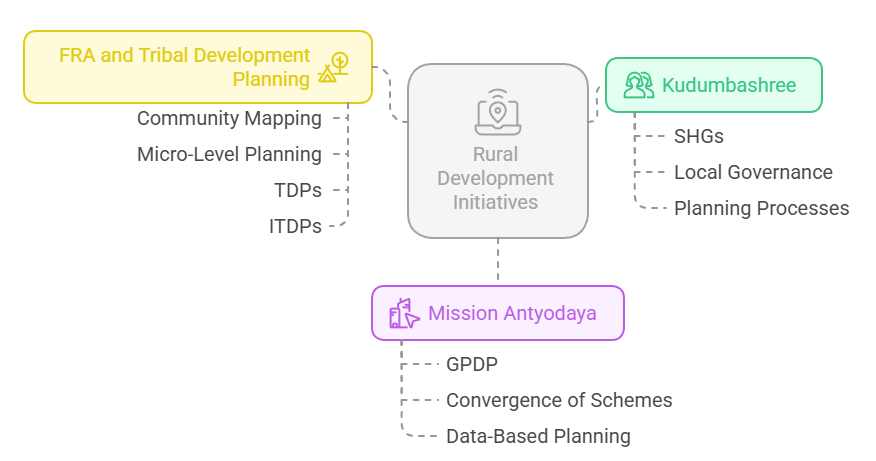
- Kudumbashree in Kerala
- A women-led poverty eradication and micro-credit initiative.
- Combines SHGs, local governance, and planning processes.
- Focus on livelihood, housing, sanitation, and education.
- Mission Antyodaya
- Ministry of Rural Development’s initiative to create Gram Panchayat Development Plans (GPDP).
- Emphasis on convergence of schemes, data-based planning, and bottom-up execution.
- FRA (Forest Rights Act) and Tribal Development Planning
- Recognition of forest dwellers’ rights involves community mapping and micro-level planning.
- Tribal Development Plans (TDPs) are created under Integrated Tribal Development Projects (ITDPs).
Challenges in Community Development Planning
| Elite Capture | Local elites dominate planning processes, excluding marginalized voices. |
| Low Awareness | Communities lack awareness about rights, schemes, and institutional processes. |
| Bureaucratic Delays | Administrative inefficiencies lead to poor implementation. |
| Gender Exclusion | Women’s participation often remains symbolic. |
| Caste Discrimination | Dalits face exclusion and tokenism in participatory forums. |
| Fragmented Data | Lack of real-time and disaggregated data impedes planning accuracy. |
Recent Developments in Community Development Planning

- Localized SDG Planning
India’s commitment to Sustainable Development Goals (SDGs) has led to:
- Local SDG indicators.
- Mapping of poverty, gender inequality, and ecological sustainability at the Gram Panchayat level.
- Digital Tools and e-Panchayat
- Use of platforms like PlanPlus, ActionSoft, and Area Profiler for:
- Online plan submission
- Real-time monitoring
- Scheme integration at the local level
- NITI Aayog’s Aspirational District Programme
- Targets backward districts through data-driven planning.
- Emphasis on community participation, especially in health, nutrition, and education.
Role of Civil Society and NGOs
Community-based organizations and NGOs act as intermediaries, enabling:
- Capacity-building of marginalized groups
- Grassroots surveys and participatory rural appraisal (PRA)
- Mobilization for local resource management and micro-planning
Examples:
- PRADAN and SEWA in livelihood planning
- Mazdoor Kisan Shakti Sangathan (MKSS) for social audits and RTI
Conclusion
Community development planning represents a transformative approach to governance—where people are not passive recipients of state aid but active agents of change. When embedded in participatory democracy, informed by local realities, and oriented towards social inclusion, such planning becomes a catalyst for social justice and empowerment. However, for community development to be truly transformative, it must confront social hierarchies, gender biases, and institutional inertia. The challenge is not only about making good plans—but about creating a just and inclusive society where every voice counts.
Previous Year Questions
Paper II:
- “Discuss the role of NGOs in planning and implementation of rural development programmes.” (2016)
- “Explain how participatory development can be a tool of social transformation in rural India.” (2017)
- “Examine the role of self-help groups in community empowerment.” (2019)
- “Discuss the role of Panchayati Raj institutions in rural development.” (2020)
- “How does community-based planning influence sustainable development goals?” (2022)

To Read more topics, visit: www.triumphias.com/blogs
Read more Blogs:
Deepening India-Latin America Relations: A Strategic Foreign Policy Shift