Introduction
Communal tensions in India have emerged as a persistent social issue, deeply embedded in the historical, political, and cultural fabric of the nation. These tensions refer to conflict between religious communities—most often between Hindus and Muslims, but also involving other religious minorities such as Christians and Sikhs. For aspirants of the UPSC Civil Services Exam, particularly those with Sociology optional, understanding communalism through a sociological lens is critical. This blog will provide a comprehensive analysis using sociological concepts and current examples.
Communalism: A Deep-rooted Challenge
Communalism is not merely religious intolerance; it is the politicization of religion for narrow gains. Communal tensions often surface around elections, religious festivals, or after provocative acts (like alleged blasphemy or inter-faith marriages).
Notable Incidents
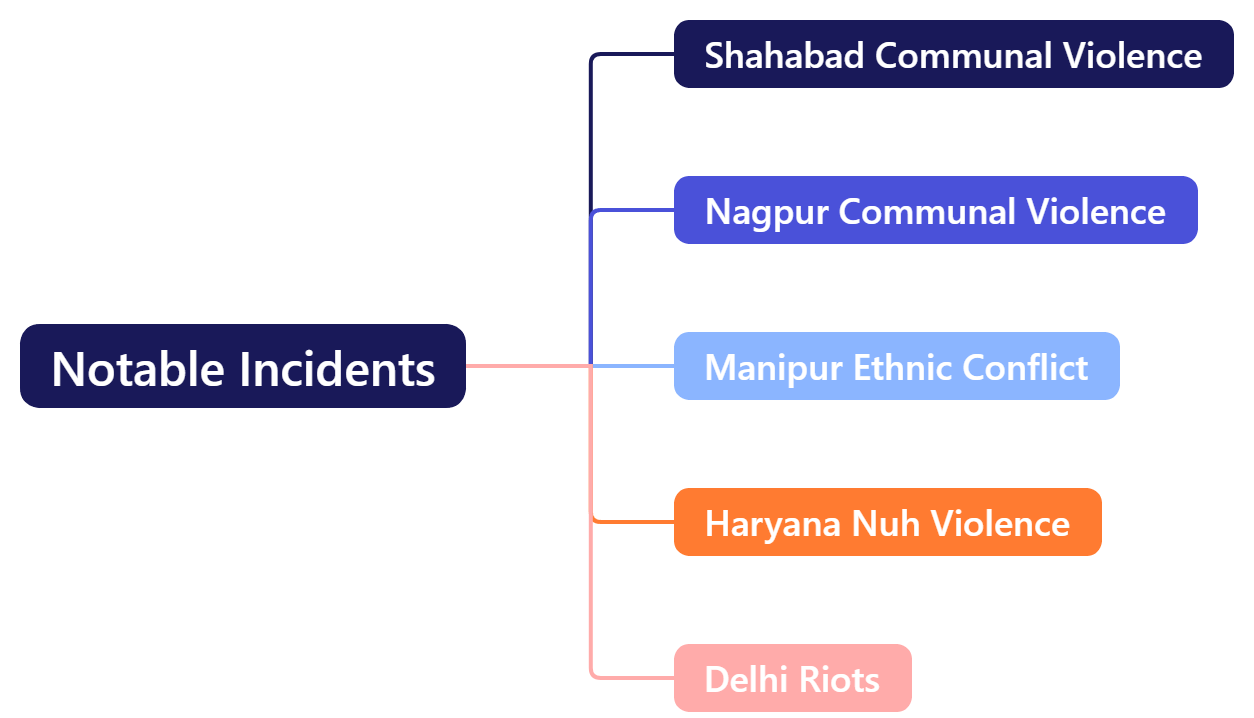
- Shahabad Communal Violence – Uttar Pradesh (April 2025): A religious procession on Ram Navami turned violent in Shahabad, with stone-pelting, arson, and severe injuries. The procession’s route near a mosque was contested, sparking clashes.
- Nagpur Communal Violence – Maharashtra (April 2025): Just days after Shahabad, Nagpur witnessed sectarian violence triggered by inflammatory speeches during a political rally and alleged desecration of a religious symbol. The violence included mob attacks, vandalism of places of worship, and destruction of property in mixed localities.
- Manipur ethnic conflict (2023–24): Though primarily ethnic, it had strong religio-cultural underpinnings, with tensions between Meitei Hindus and Kuki Christians.
- Haryana Nuh Violence (2023): Sparked by a religious procession, it spiraled into mob violence, highlighting the fragile inter-community trust.
- Delhi Riots (2020): A stark example of urban communal violence, where socio-economic vulnerability and ghettoization played a significant role.
Sociological Understanding of Communal Tensions
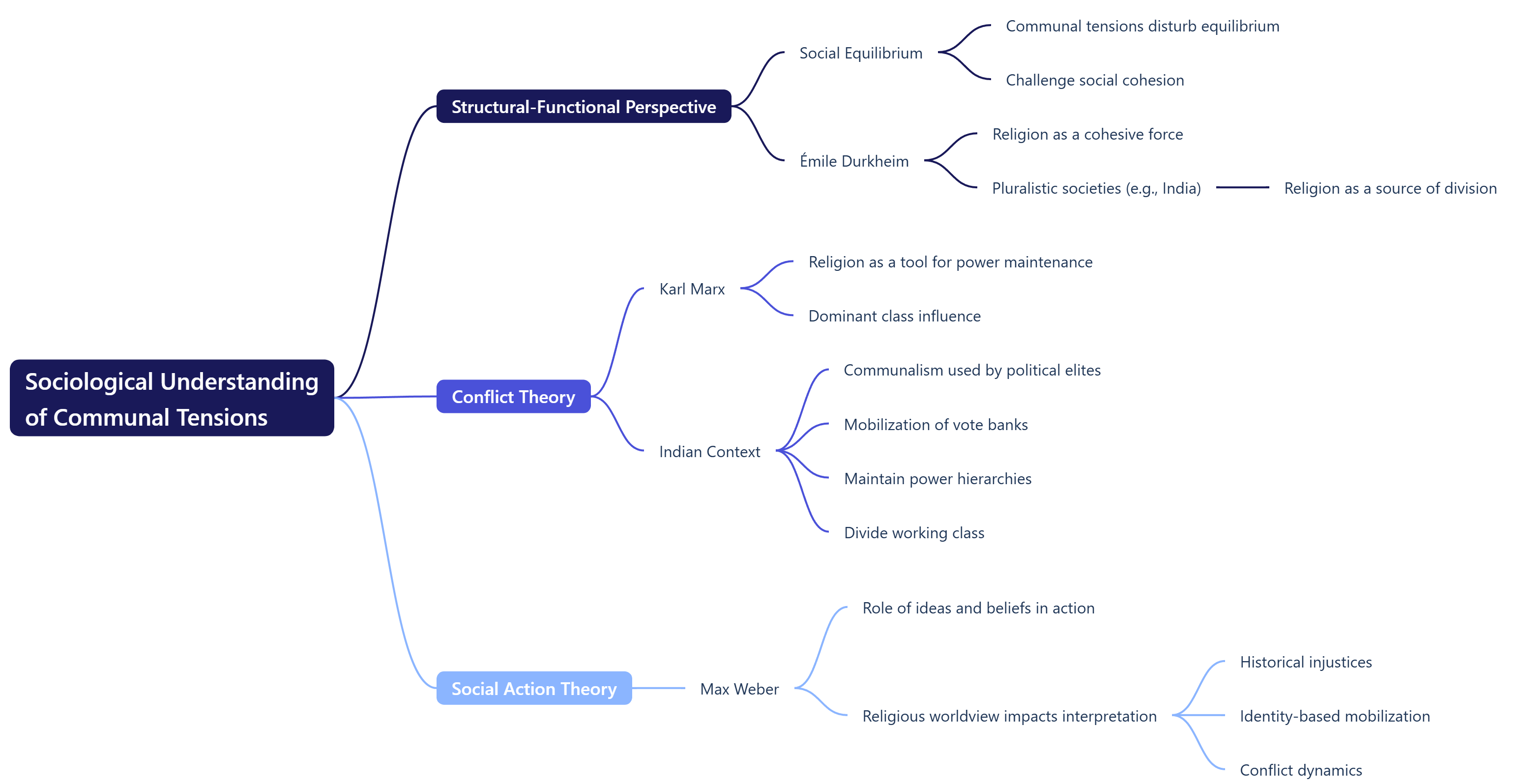
- Structural-Functional Perspective: Communal tensions disturb the social equilibrium and challenge the social cohesion essential for nation-building. Émile Durkheim argued that religion acts as a cohesive force, but in pluralistic societies like India, it may also become a source of collective division.
- Conflict Theory: Karl Marx viewed religion as a tool used by the dominant class to maintain power. In the Indian context, communalism is often used by political elites to mobilize vote banks, maintain power hierarchies, and divide the working class.
- Social Action Theory: Max Weber emphasized the role of ideas and beliefs in shaping action. The religious worldview of communities shapes their interpretation of historical injustices, contributing to identity-based mobilization and conflict.
Current Affairs Integration
The recent spate of communal tensions shows a rise in hate crimes, mob lynching, and targeted misinformation on social media platforms. These events are not isolated but are embedded in structural inequalities, historical prejudices, and identity politics.
Role of Social Media
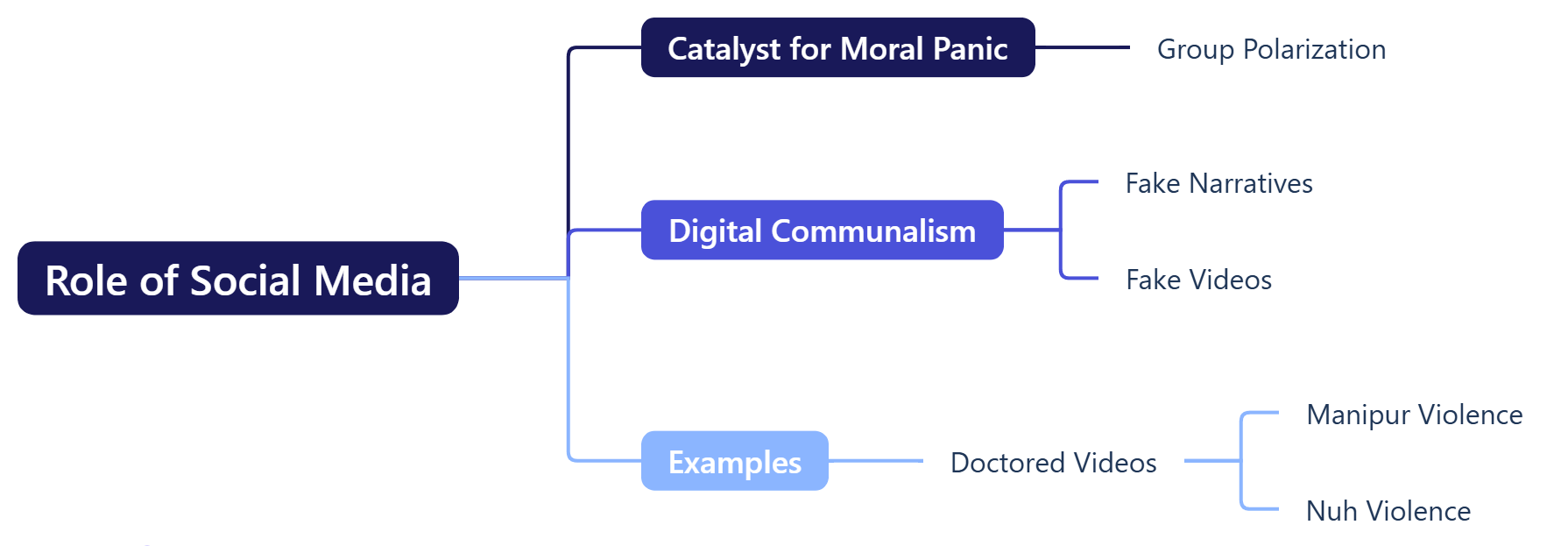
- Acts as a catalyst for moral panic and group polarization.
- Promotes digital communalism through fake narratives and videos.
- Example: Circulation of doctored videos during the Manipur and Nuh violence.
Way Forward
- Strengthening secular values in education and media.
- Promoting interfaith dialogue and community bonding.
- Addressing structural marginalization of minorities.
- Curbing hate speech and enforcing digital accountability.
- Empowering civil society and promoting grassroots peacebuilding.
Conclusion
Communal tensions in India represent more than sporadic outbreaks of violence—they are symptomatic of deep-rooted socio-political fissures shaped by history, identity, and structural inequality. Through a sociological lens, we see how these tensions are not merely religious in nature but are often engineered or worsened by political agendas, economic insecurities, and social disorganization. The recent incidents in Shahabad and Nagpur illustrate how fragile communal harmony can be when inflammatory rhetoric and mistrust are left unchecked. For aspiring civil servants, the challenge lies in transforming these flashpoints into opportunities for inclusive dialogue, community rebuilding, and preventive governance. Only by addressing the structural roots and symbolic triggers of communalism can India truly realize the constitutional promise of unity in diversity.
PYQs
Paper – I
- How does Marx’s theory of religion as ‘opium of the people’ help explain modern communal politics? (2015)
- Explain the concept of symbolic boundaries and how it relates to intergroup conflict. (2016)
- Examine the role of religion in the integration and disintegration of society. (2018)
- Is religion a source of social cohesion or social conflict in contemporary societies? Discuss. (2019)
- Evaluate the relevance of Durkheim’s theory of religion in pluralistic societies like India. (2019)
- Explain the concept of collective consciousness and its relevance in understanding contemporary social unrest. (2020)
- Discuss Weber’s view on religion and its role in shaping social action. (2020)
- Critically examine the role of ideology in social movements and collective violence. (2021)
- Explain the concept of ‘social disorganization’ with reference to recent mass violence in society. (2022)
Paper – II
- Discuss the role of religion in the Indian society and polity. How has it contributed to both integration and disintegration? (2014)
- How does religious fundamentalism challenge the secular fabric of Indian society? (2015)
- What are the challenges faced by secularism in India today? Illustrate with recent examples. (2016)
- Examine the impact of communalism on Indian society. Suggest sociological measures to combat it. (2017)
- Examine the relationship between ethnicity, religion, and regionalism in Indian society. (2018)
- Examine the role of caste and religion in contemporary electoral politics. (2019)
- Communalism is a threat to democracy. Discuss in the context of recent social unrest in India. (2020)
- Analyze the role of social media in mobilizing communal and caste-based identities in recent years. (2022)
- What are the sociological implications of communal riots on inter-community relations? Use recent examples. (2023)
|



One comment