Introduction:
In the evolving landscape of India’s economic development, land and labour—historically rooted in community life and social relations—are increasingly being treated as marketable assets. This transformation, referred to as the commodification of land and labour, marks a shift from use value to exchange value, driven by capitalist market dynamics. From rural dispossession due to SEZs to precarious gig economy jobs, this phenomenon lies at the heart of India’s developmental contradictions.
Understanding this transformation is crucial not only for sociologists but also for UPSC aspirants, especially in the context of globalization, inequality, labour rights, and rural transformation.
What is Commodification?
Commodification is the process of converting social relationships, services, or natural resources into commodities—items for market exchange.
- Land is commodified when its value is derived not from community sustenance or cultural symbolism but from its price in the real estate or industrial market.
- Labour becomes a commodity when human effort is detached from the person and treated as a purchasable unit of production.
Sociologist Karl Polanyi termed land and labour as “fictitious commodities” because they were not produced for sale, yet capitalism forces them into the logic of the market.
Commodification of Land:

Key Drivers
- Neoliberal Reforms (Post-1991): Opening up the economy led to privatization and encouraged land as a capital-generating resource.
- Real Estate and Infrastructure Projects: Urban sprawl, highways, airports, and SEZs triggered mass land acquisition—often forcibly.
- Digitalization of Land Records (DILRMP): While aimed at transparency, it also enables smoother commodification for corporate purchase.
Societal Consequences
- Displacement and Migration: Farmers, tribals, and rural poor lose ancestral land, leading to forced urban migration.
- Loss of Commons: Grazing land, forests, and water bodies—crucial for subsistence communities—are sold off or privatized.
- Landlessness and Inequality: Caste and class disparities are reinforced as marginalized groups lose land without fair compensation.
Recent Cases
- Mumbai Metro car shed in Aarey forest: Environmental concerns vs. urban development.
- Niyamgiri Hills (Vedanta Mining): Tribal resistance upheld by Supreme Court.
Sociological Analysis
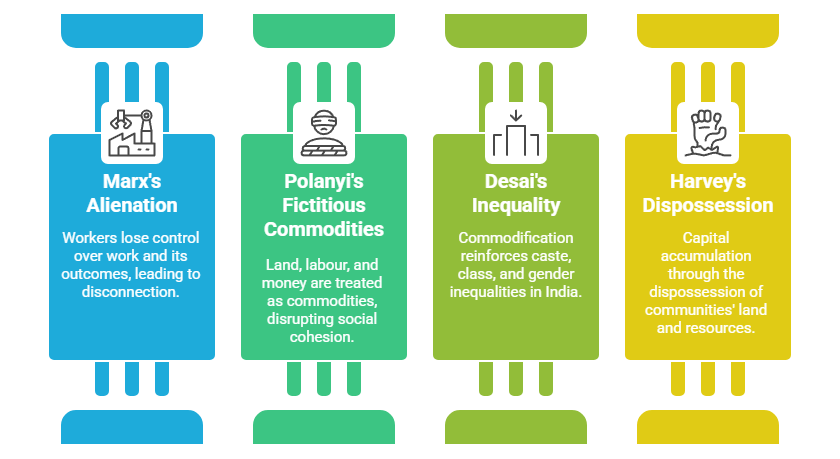
- Karl Marx viewed both land and labour as central elements in the capitalist mode of production. He argued that under capitalism, labour is commodified, meaning workers sell their labour power for wages, losing control over both the work process and its outcomes. This leads to alienation, where workers become disconnected from the product, the process, their fellow workers, and ultimately themselves. He also emphasized that land becomes a commodity controlled by the bourgeoisie, contributing to the class divide between those who own the means of production and those who do not.
- Karl Polanyi introduced the idea of “fictitious commodities”, referring to land, labour, and money, which were never meant to be bought or sold. He argued that market society disembedded the economy from social life, leading to a breakdown in social relations and cohesion. For Polanyi, the commodification of land and labour results in social disintegration, prompting society to initiate a counter-movement in the form of protests, legislation, and social protections to restore balance between market forces and human needs.
- A.R. Desai, an Indian Marxist sociologist, critiqued capitalist development in India for its exploitative character, especially towards marginalized communities. He highlighted that land reforms remained incomplete, and both land and labour were commodified in a way that reinforced caste, class, and gender inequalities. Desai argued that this commodification did not liberate labour but instead intensified its subjugation, especially for Dalits, tribals, and women, who are systematically excluded from land ownership and fair labour practices.
- David Harvey, a neo-Marxist geographer, extended Marx’s theory by coining the term “accumulation by dispossession”. He explained how capitalism thrives not only by exploiting labour but also by dispossessing communities of their land and resources, often through state-led initiatives like privatization and land acquisition. In this framework, commodification is not just an economic act but a political strategy that facilitates capital accumulation by transferring public or communal resources into private hands.
Current Affairs
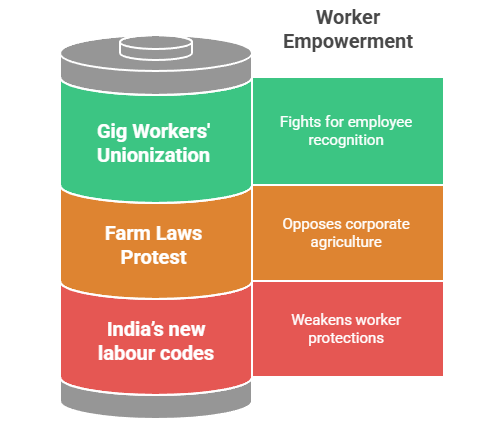
- India’s new labour codes (2020): Aim to consolidate and simplify laws, but critics argue they weaken worker protections.
- Farm Laws Protest (2020-21): Farmers opposed perceived corporatization of agriculture and potential commodification of land.
- Gig Workers’ Unionization (2021–present): Growing resistance and legal battles over recognition as employees.
Policy Recommendations
- Community Land Titles: Recognize traditional ownership, especially for Adivasi communities.
- Universal Social Security: Cover gig and informal workers.
- Labour Market Reforms: Balance employer flexibility with worker dignity and rights.
- Re-skilling Programs: Help rural and semi-skilled labour transition into the digital economy.
- Strengthen MGNREGA: Reduce rural dependency on commodified labour markets.
Conclusion:
The commodification of land and labour may drive GDP figures, but it also erodes social bonds, livelihoods, and human dignity. From a sociological lens, it’s a process that demands critical evaluation. India must balance market efficiency with social justice—by ensuring that neither land nor labour is reduced to a mere input in the growth machine.
Alternatives like collective farming, cooperatives, and universal basic income offer hope. Sociology provides the frameworks to understand the crisis—and the imagination to move beyond it.
Previous Year Questions
Paper I
- How relevant is the Marxian concept of alienation in the Indian context? (UPSC Sociology, 2020)
Paper II
- Discuss the problems of displaced communities in India. (2021)
- Describe the impact of land reforms on rural class structure in India. (2019)
- Critically examine the role of informal sector in the Indian economy. (2017)
|

One comment