Introduction
The term “colonial legacy” refers to the enduring effects of colonial rule on the social, political, economic, and cultural fabric of formerly colonized societies. For countries like India, which was under British colonial rule for nearly two centuries, the colonial legacy continues to shape contemporary realities. In this blog, we delve into the sociological significance of colonial legacy, and analyze the long-lasting impact of colonialism on Indian society with references to major sociological thinkers.
What is Colonial Legacy?
Colonial legacy refers to the institutional structures, social hierarchies, economic systems, and cultural patterns that continue to persist even after the formal end of colonial rule. It often includes:
- Legal and administrative systems
- Language and education
- Bureaucratic structures
- Economic dependency
- Social divisions like caste and religion
Colonial Legacy in India:
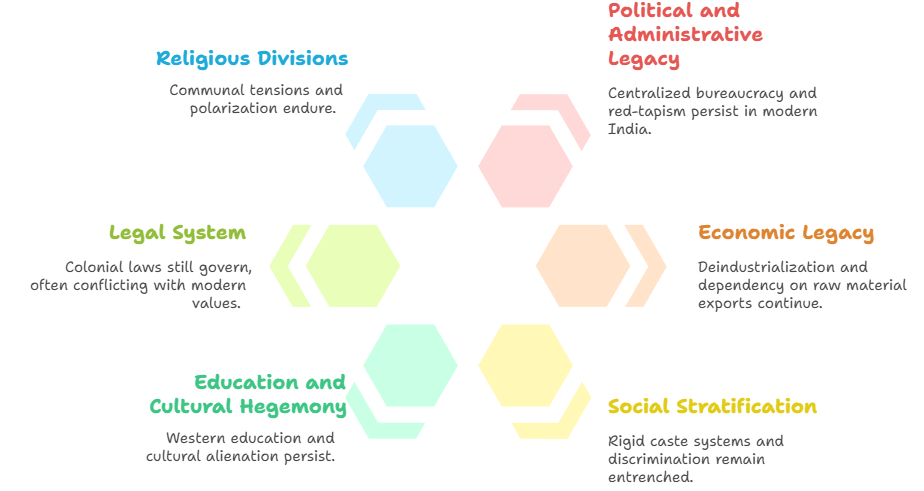
- Political and Administrative Legacy
The British introduced a centralized bureaucracy in India with institutions like the Indian Civil Services, police, and judiciary designed primarily to serve imperial interests. These systems were hierarchical and rigid, focusing more on control than welfare. Even today, India’s administrative structure bears the imprint of colonial authority, visible in red-tapism and centralization of power.
- Economic Legacy
Colonial economic policies led to deindustrialization, stagnation of indigenous crafts, and the prioritization of cash crops over food grains. The economic structure created during British rule made India a supplier of raw materials and a consumer of British goods, establishing patterns of dependency that continue in the form of trade imbalances and rural underdevelopment.
- Social Stratification and Caste System
British administrators formalized and rigidified caste categories through Census operations and legal interventions. The codification of caste identities replaced the earlier fluidity of the system, institutionalizing discrimination. Laws like the Criminal Tribes Act further marginalized already vulnerable communities, embedding caste-based exclusion in governance.
- Education and Cultural Hegemony
The Macaulay-inspired education system promoted English education and Western knowledge systems, creating a class of English-educated elites. This led to the alienation of masses from indigenous learning and fostered a sense of cultural inferiority. It also marked the beginning of linguistic elitism and urban-rural divides in access to quality education.
- Legal System and Judiciary
Colonial India saw the imposition of codified laws that replaced community-based justice mechanisms. Many of these laws, such as the Indian Penal Code and the Sedition Law, continue to govern India’s legal landscape, often clashing with democratic and human rights values of postcolonial India.
- Religious and Communal Divisions
British rulers institutionalized religious identities through separate electorates and communal representation, promoting a “divide and rule” strategy. These measures fueled religious polarization, ultimately contributing to Partition. Communal tensions in post-Independence India are a direct legacy of these colonial interventions.
Sociological Analysis
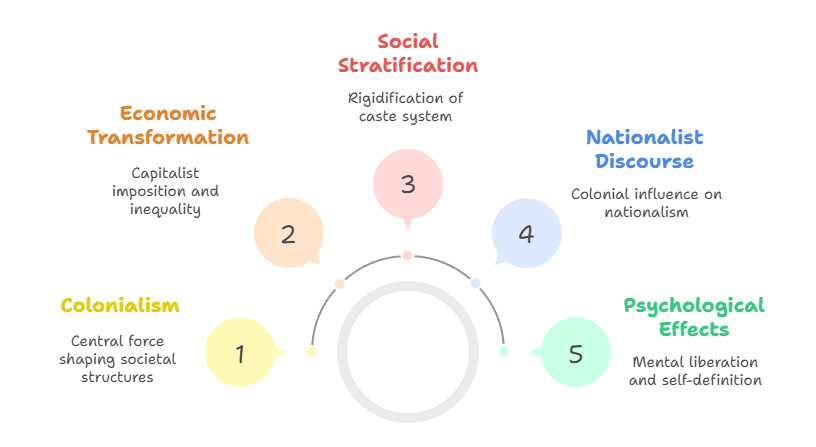
- A.R. Desai viewed colonialism as the imposition of capitalist relations in a pre-capitalist society. He argued that British rule led to the development of a semi-feudal, semi-capitalist economy that worsened class inequality and hindered genuine industrial development.
- M.N. Srinivas emphasized how colonial interventions rigidified the caste system. He observed that processes like Sanskritization emerged as lower castes tried to climb the social ladder under colonial conditions, highlighting how caste mobility became embedded within the colonial framework.
- Partha Chatterjee
Partha Chatterjee critiqued the nationalist movement for operating within a colonial framework of modernity. He argued that Indian nationalism was a “derivative discourse,” adopting colonial constructs instead of genuinely decolonizing thought and institutions.
- Frantz Fanon’s work on decolonization focused on the psychological effects of colonialism, particularly among the colonized elite. His call for mental liberation and self-definition resonates in the Indian context where colonial attitudes continue to shape education, governance, and cultural aspirations.
- Edward Said’s theory of Orientalism explains how colonial powers constructed the East as exotic, backward, and inferior. This ideological framework justified colonial domination and continues to shape global perceptions of India and other formerly colonized societies.
Impact of Colonial Legacy on Post-Independence India
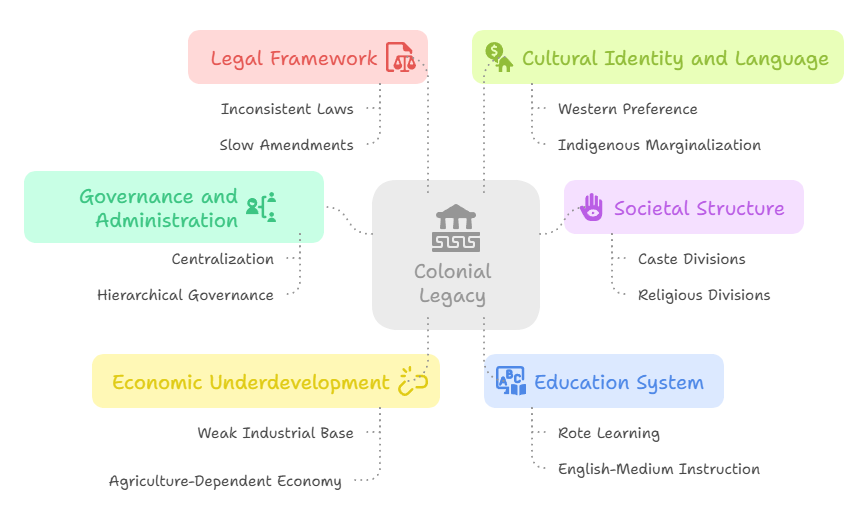
- Governance and Administration: Post-independence, India retained colonial institutions like the bureaucracy, which were efficient in control but poorly adapted for democratic governance. Centralization and hierarchical governance structures continue to hinder participatory development.
- Societal Structure: Colonialism reinforced caste and religious divisions by institutionalizing them. These divisions have outlived colonialism and remain sources of inequality and social conflict in modern India.
- Economic Underdevelopment: The exploitative nature of colonial economic policies created a weak industrial base and an agriculture-dependent economy. This structural imbalance remains a hurdle in achieving inclusive growth and self-sufficiency.
- Education System: The British-introduced system still persists with a focus on rote learning and English-medium instruction, perpetuating class disparities. Indigenous knowledge systems and regional languages remain marginalized.
- Legal Framework: Obsolete colonial laws, many of which are inconsistent with human rights and constitutional morality, still exist. Attempts to repeal or amend such laws are ongoing but slow and contested.
- Cultural Identity and Language: The colonial mindset led to a preference for Western lifestyles and values among the elite. This resulted in the undervaluing of indigenous culture and language, fostering identity conflicts and cultural alienation.
Colonial Mindset: The Invisible Legacy
Even in independent India, the colonial mindset manifests as:
- Blind imitation of Western models
- Obsession with English as a medium of progress
- Suppression of indigenous knowledge systems
- Over-reliance on bureaucracy and centralized governance
Recent Example: Debates on reforming colonial-era laws like the Indian Penal Code and sedition laws highlight the urgency of decolonizing our legal and mental frameworks.
Recent Developments and Efforts at Decolonization
- New Education Policy (NEP) 2020 aims to promote regional languages and holistic education.
- Calls for replacing colonial laws like IPC and CrPC.
- Revival of indigenous knowledge systems in education and health.
- Renaming cities (e.g., Bombay to Mumbai) as symbolic acts of decolonization.
Challenges in Overcoming Colonial Legacy
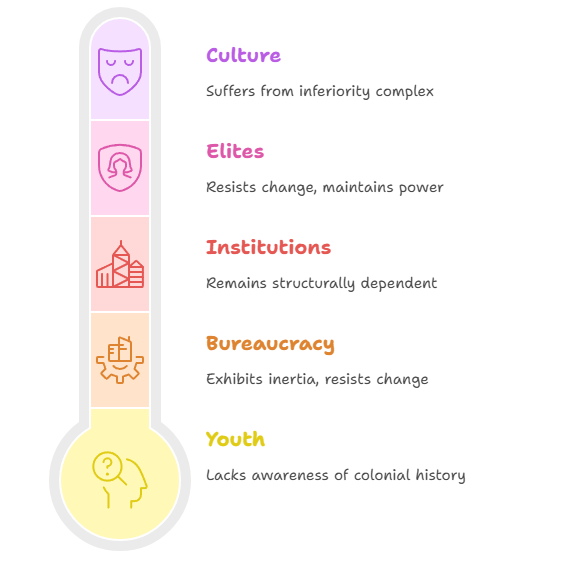
- Resistance from entrenched elites
- Structural dependence on old institutions
- Bureaucratic inertia
- Deep-seated cultural inferiority complex
- Lack of awareness among youth about colonial history
Way Forward:
- Educational Reforms: Include indigenous history, languages, and thinkers.
- Legal Reforms: Replace outdated laws with people-centric frameworks.
- Administrative Reforms: Decentralization and public accountability.
- Cultural Assertion: Promote indigenous art, literature, and languages.
- Mindset Change: Encourage critical thinking over rote learning and revive pride in Indian identity.
Conclusion
The colonial legacy in India is not just a historical phenomenon—it is a living reality. It continues to influence our institutions, our thoughts, and our identities. A sociological analysis reveals how deep and multifaceted this legacy is, affecting everything from bureaucracy to education, from caste to communalism. The path to true independence lies not just in political freedom, but in intellectual and cultural decolonization.
Previous Year Questions
Paper II
- Discuss the impact of colonial rule on Indian society with special reference to caste and education. – (2020)
- Examine how colonial policies shaped the agrarian structure in India. – (2017)
- Evaluate the continuity and change in Indian social structure under colonial rule. – (2015)
|


One comment