
Class Struggle in Contemporary Society
(Relevant for Sociology Paper I: Sociological Thinkers- Karl Marx; Social stratification and mobility and Sociology Paper II: Social Classes in India)
Introduction:
Class struggle refers to the on-going conflict between different classes in society due to their opposing interests in economic resources and power. It is one of the most critical themes in sociology, particularly in Karl Marx’s conflict theory, which views history as a continuous battle between the oppressors (bourgeoisie) and the oppressed (proletariat). In modern India, class struggle manifests in multiple forms: from agrarian distress and urban poor exploitation, to gig workers’ protests, making it a crucial topic in Sociology.
Sociological Analysis
- Karl Marx viewed class struggle as the central force in historical development. He argued that society is divided into two main classes—the bourgeoisie (owners of production) and the proletariat (workers)—whose interests are inherently opposed. The exploitation of labor by capitalists creates inequality, leading to alienation and eventual revolution.
- Max Weber offered a more nuanced view. He believed that class is only one dimension of inequality, alongside status (social honor) and party (political power). According to Weber, individuals’ life chances are determined not just by economic position but also by their access to social prestige and influence.
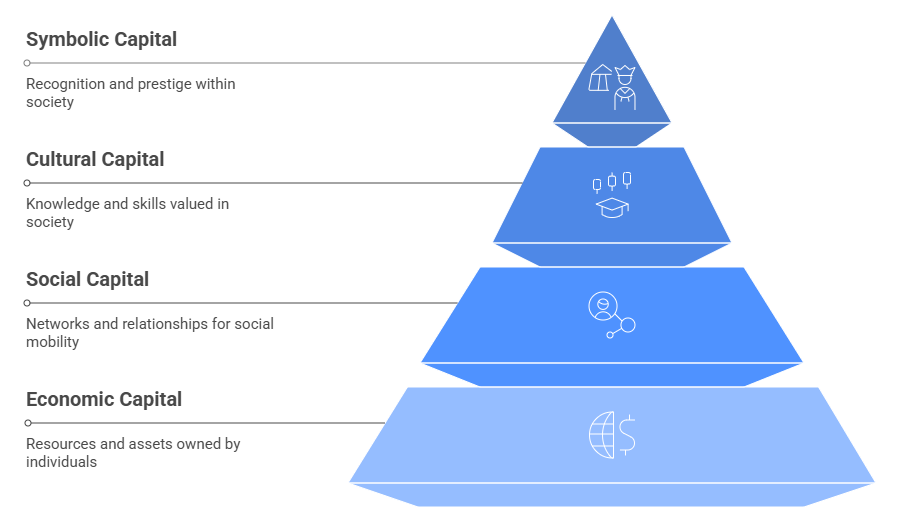
- Pierre Bourdieu expanded the debate by introducing the concept of cultural, social, and symbolic capital. He argued that class is reproduced across generations through education, family upbringing, and social networks, making inequality deeply entrenched in everyday practices and institutions.
Class Struggle in India:
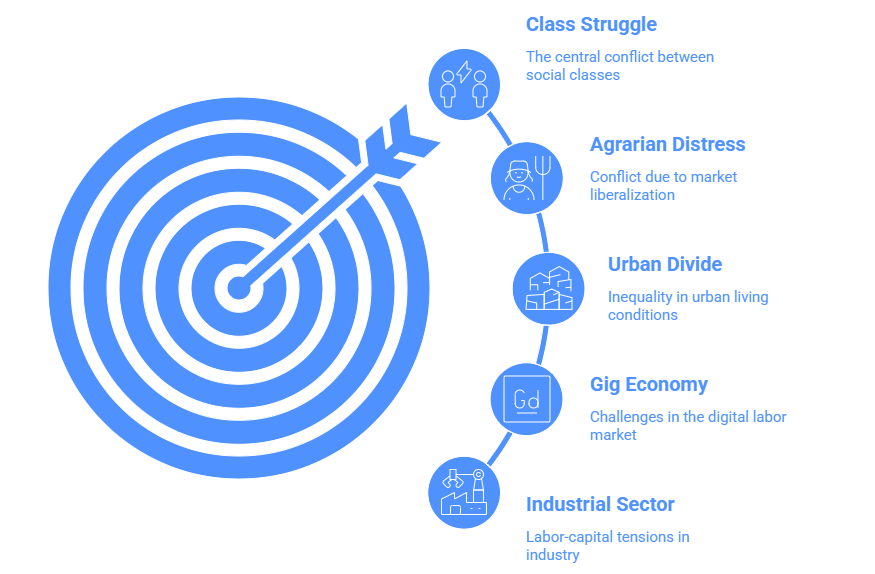
- Agrarian distress continues to be a major site of class conflict. The farmers’ protest (2020–21) against the farm laws highlighted the resistance of small farmers and rural laborers against market liberalization and corporate control over agriculture.
- In urban India, slums and informal settlements reflect the deep divide between the rich and poor. The urban working class faces poor housing, low wages, and lack of access to basic services, while the middle and upper classes enjoy gated communities and private amenities.
- The gig economy has given rise to a new working class. Delivery workers, ride-hailing drivers, and freelancers face job insecurity, long hours, and no social protection. Their protests for rights and recognition show modern forms of class struggle in a digital capitalist system.
- In the industrial sector, workers continue to face issues like wage stagnation and union suppression. Events like the Maruti Suzuki Manesar plant strike reveal the ongoing tensions between labor and capital in India’s industrial economy.
Class Struggle and Other Social Institutions
- In education, class inequalities are reproduced through access to elite schools, private tuition, and English-medium institutions. Children from poor families often remain trapped in under-resourced public schools, limiting their chances of upward mobility.
- Healthcare systems are also class-stratified. During the COVID-19 pandemic, wealthier classes could afford private hospitals, while the poor were dependent on overcrowded public facilities. This highlights how health outcomes are linked to economic class.
- The state and policy frameworks often reflect class interests. While welfare programs like MGNREGA and PDS aim to support the poor, neoliberal policies such as corporate tax cuts and privatization tend to favor the elite, reinforcing existing class divisions.
- These institutions—education, healthcare, and the state—do not operate independently but often reinforce and reproduce class hierarchies, making class struggle a central axis of social dynamics in India.
Globalization and Class Conflict
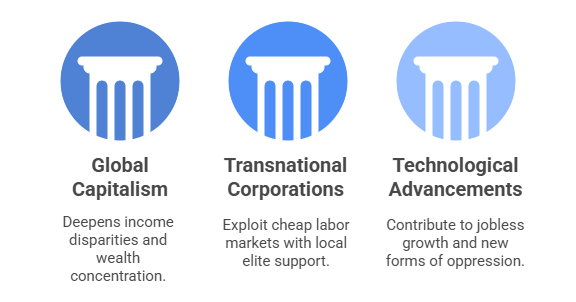
- Global capitalism has deepened income disparities. According to Oxfam, the richest 1% in India own more than 40% of the wealth.
- Transnational corporations, backed by local elites, exploit cheap labor markets.
- Outsourcing, jobless growth, and AI automation add to new forms of class oppression.
Sociological Indicators of Class Inequality in India
| Indicator | Upper Class | Working Class/Lower Class |
| Education Quality | Elite English Schools | Government Schools, Drop-outs |
| Employment | Salaried, White Collar | Daily Wage, Contractual |
| Housing | Gated Societies | Slums, Informal Settlements |
| Healthcare Access | Private Multispecialty | Underfunded Public Facilities |
| Social Mobility | High Intergenerational | Stagnant, Low upward mobility |
Sociological Implications of Class Struggle
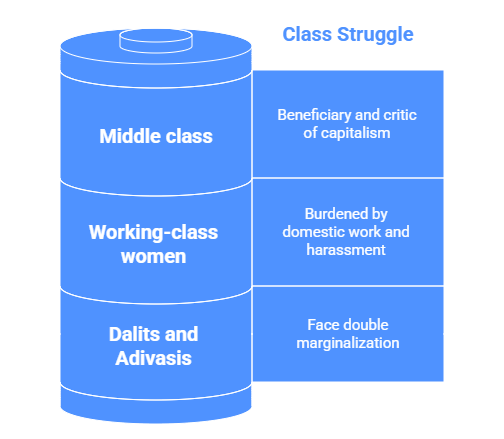
- Class and Caste Intersection: Dalits and Adivasis often form the lowest economic classes, facing double marginalization.
- Gendered Class Struggles: Working-class women face domestic work burdens, wage discrimination, and sexual harassment.
- Rise of Middle-Class Aspirations: As per Gurucharan Das, India’s middle class is both a beneficiary and critic of capitalism.
Policy Interventions to Address Class Conflict
- Universal Basic Income (UBI) proposals to ensure minimum economic security.
- Strengthening labor rights, especially in the informal and gig economy.
- Progressive taxation on wealth and inheritance to reduce income inequality.
- Inclusive education and healthcare reforms to reduce class reproduction.
- Land reforms and tenancy security to address agrarian class issues.
Conclusion
Class struggle is not an outdated concept—it remains a crucial lens to understand modern India’s socio-economic transformations. Whether it is the digital worker’s protest, the agrarian movements, or the urban housing crisis, class continues to define access, mobility, and power.
Sociology must engage with class not only as a historical conflict but as a living reality—shaped by neoliberal policies, global capitalism, and the everyday lives of people. We must explore the intersectionality of class with caste, gender, and region to grasp the multi-layered nature of inequality in India.
PYQs
Paper I
- “Marxian idea of class struggle has not remained relevant in the present capitalist society.” Critically examine. (2022)
- Write a note on class-in-itself and class-for-itself. (2021)
- Distinguish between social class and status group with suitable examples. (2016)
Paper II
- Describe the impact of globalization on labor and class structure in India. (2020)
- Examine the changes in the nature of class relations in the agrarian sector after the Green Revolution. (2018)
- Discuss the growth of the working class in India and their role in class mobilization. (2017)

To Read more topics, visit: www.triumphias.com/blogs
One comment