
Relevant for Sociology Optional Paper 1, Paper 2, and GS Paper I (Indian Society)
IntroductionCivil society has long been regarded as a crucial pillar of democratic governance. It refers to the sphere of voluntary associations, organizations, and collective initiatives that exist between the state and the market. Civil society includes non-governmental organizations (NGOs), social movements, advocacy groups, professional associations, and community organizations that seek to represent citizens’ interests and hold power structures accountable. In democratic societies, civil society plays a vital role in strengthening participatory governance, promoting rights, and ensuring that the voices of marginalized communities are heard.
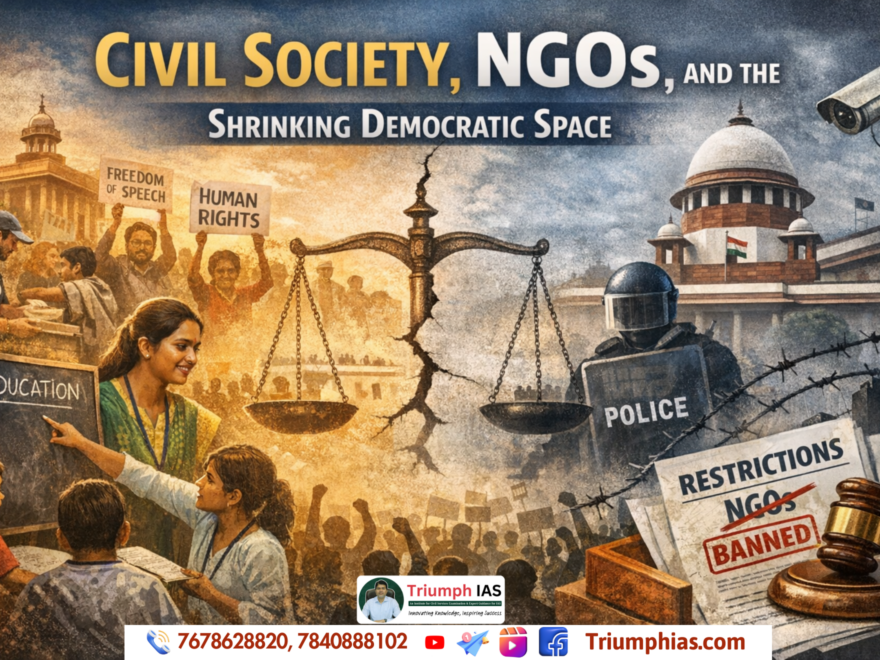
From a sociological perspective, civil society acts as an intermediary space that facilitates dialogue between the state and society. Political sociologists argue that a vibrant civil society promotes democratic values such as participation, accountability, and transparency. Thinkers like Alexis de Tocqueville emphasized that voluntary associations are essential for sustaining democracy because they cultivate civic consciousness and collective responsibility among citizens. Similarly, contemporary sociologists view civil society as a platform through which citizens mobilize for social change and policy reforms. NGOs have emerged as one of the most prominent actors within civil society. They operate in diverse sectors such as education, health, environmental protection, gender justice, and rural development. In developing countries, NGOs often complement state efforts by providing services and advocating for policy change. Sociologically, NGOs function as agents of social development and empowerment. They contribute to capacity building, promote grassroots participation, and act as watchdogs against abuses of power. However, in recent years, scholars and activists have increasingly raised concerns about the phenomenon of a “shrinking democratic space.” This concept refers to the gradual restriction of civil society freedoms, including limitations on freedom of association, expression, and assembly. Governments in several parts of the world have introduced regulatory frameworks that impose tighter control over NGOs, especially those receiving foreign funding. While states justify such regulations in terms of national security, transparency, or accountability, critics argue that these measures often restrict legitimate civil society activities. From a sociological standpoint, the shrinking democratic space can be understood as part of broader transformations in the relationship between the state and civil society. Modern states sometimes perceive independent civil society organizations as potential sources of political dissent or challenges to state authority. Consequently, regulatory mechanisms such as stringent funding rules, surveillance, or administrative barriers may be used to limit their influence. This trend has important implications for democratic governance. Civil society organizations play a crucial role in representing marginalized groups, advocating human rights, and monitoring government policies. When their operational space is restricted, the capacity of society to question authority and demand accountability may weaken. Sociologists argue that such restrictions can reduce the pluralism that is essential for a healthy democracy. Another important sociological debate concerns the institutionalization and professionalization of NGOs. While NGOs are often viewed as vehicles of grassroots participation, some critics suggest that excessive dependence on funding agencies and bureaucratic structures may distance them from the communities they claim to represent. This has led to discussions about the “NGOization” of social movements, where activism becomes project-based and less politically transformative. In the context of globalization, civil society networks have also expanded beyond national boundaries. Transnational advocacy networks connect NGOs, activists, and international organizations to address global issues such as climate change, human rights, and social justice. However, this transnational character sometimes leads to tensions with national governments, particularly when international funding or advocacy is perceived as external interference. Ultimately, the relationship between civil society, NGOs, and the state remains dynamic and complex. While regulations may be necessary to ensure transparency and accountability, excessive restrictions can undermine democratic participation and weaken the role of civil society in promoting social justice. A balanced approach that protects democratic freedoms while ensuring responsible governance is essential for sustaining a vibrant civil society. |

UPSC Civil Services (Mains) Question
Q. “Civil society organizations and NGOs play a crucial role in strengthening democracy, yet their operational space is increasingly shrinking in many countries.” Discuss from a sociological perspective. (250 words)
To Read more topics, visit: www.triumphias.com/blogs
Read more Blogs: