Introduction
The idea of “family” in India has long been tied to the heteronormative, patriarchal, and often caste-endogamous structure, where marriage and blood relations define legitimacy. This model — typically nuclear or joint — dominates the public imagination and legal frameworks. However, for many marginalised individuals, including LGBTQ+ persons, non-normative women, persons with disabilities, survivors of domestic abuse, and the elderly, this very family structure can become a site of exclusion, violence, and control rather than support.
In recent years, the concept of a “chosen family” — networks of care and support formed outside of blood and marital ties — has emerged as a radical yet humane reimagining of kinship. It challenges conventional definitions while advocating for legal recognition to safeguard the rights of those living in alternative care arrangements.
The Dominance of the Heterosexual Family
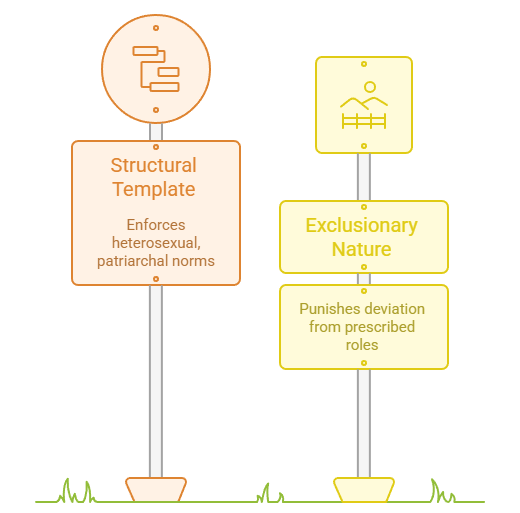
- Structural Template of Social Organisation: The heterosexual, patriarchal family is historically positioned as the primary site of social reproduction — not just biologically, but in terms of cultural norms, gender roles, and property inheritance. It acts as a mechanism of social control, enforcing norms about sexuality, marriage, and gender behaviour.
- Exclusionary Nature: While idealised as a space of love and care, in practice, the family often excludes and punishes those who deviate from prescribed roles. Members who are queer, Trans, disabled, elderly without dependents, or survivors of abuse may find themselves disowned, ostracised, or subjected to violence.
Family as a Site of Violence
In India, reports of natal and marital family violence are disturbingly common. From honour killings to abuse of women, children, and queer individuals, the family often becomes a space of structural violence. For LGBTQ+ individuals, natal families are frequently the first sites of discrimination, with documented cases of confinement, physical assault, and “corrective” sexual violence.
During the COVID-19 pandemic, these vulnerabilities were magnified — many queer youth were forced into unsafe homes during lockdowns, and some had to flee to shelter homes, where safety was also uncertain.
Chosen Family:
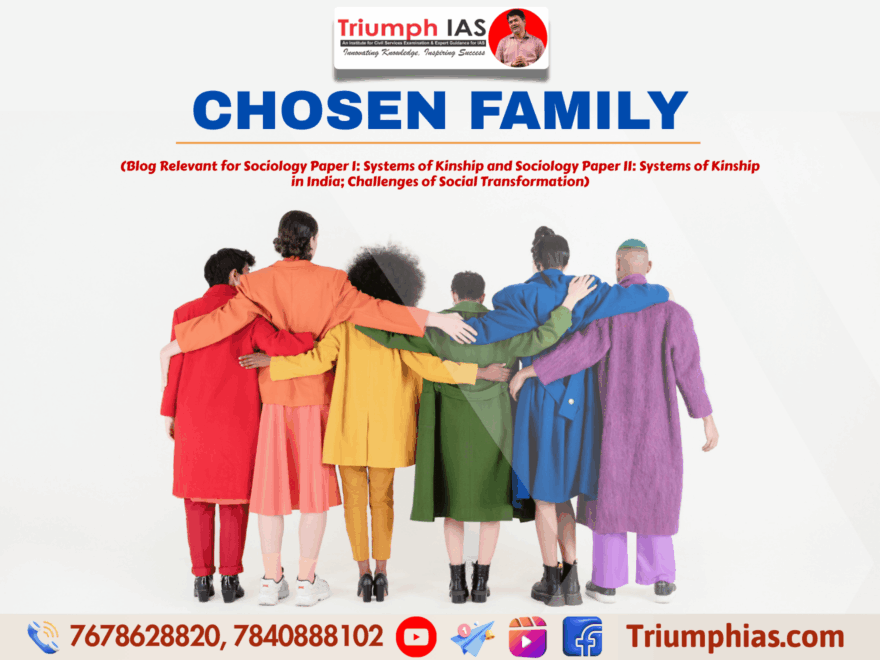
- A chosen family consists of individuals who voluntarily come together to provide emotional, social, and sometimes financial support to one another, regardless of blood or marital ties. This form of kinship is rooted in mutual care, commitment, and shared survival strategies.
- For queer individuals, chosen families often replace hostile natal families, offering safe havens where gender identity and sexual orientation are affirmed rather than suppressed.
Legal Gap and Urgent Need for Recognition
Current Limitations
Indian laws primarily recognise family in terms of marriage, adoption, and blood relations. This excludes chosen families from critical rights such as:
- Medical decision-making in emergencies
- Hospital visitation rights
- Guardianship for minors in their care
- Access to health insurance and employment benefits
- Parental leave
During the pandemic, these legal gaps had life-and-death consequences for queer people and others in non-normative arrangements.
Sociological Analysis
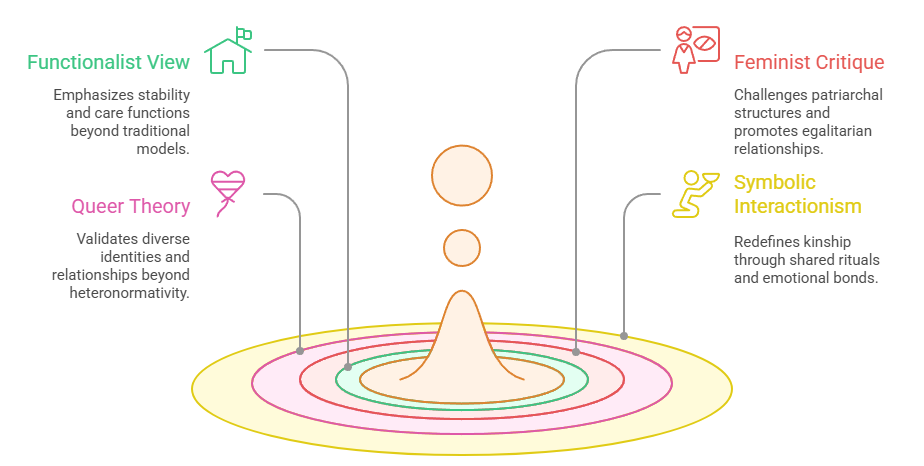
- Functionalist Perspective
From a functionalist lens, the family is a stabilising social institution, but functionalists traditionally emphasise the heterosexual nuclear model. The chosen family challenges this view by proving that care and socialisation functions can be effectively fulfilled outside of the traditional template.
- Feminist Perspective
Feminists critique the patriarchal family as a site of gendered oppression. They view chosen families as spaces that can disrupt patriarchal authority, redistribute care work, and foster egalitarian relationships, especially for women and queer persons.
- Queer Theory
Queer theory interrogates the heteronormativity embedded in legal and cultural definitions of family. It supports chosen families as a way to validate diverse identities and relationships beyond binary gender roles and state-sanctioned marriage.
- Symbolic Interactionism
This perspective highlights how the meaning of “family” is socially constructed. Chosen families redefine kinship through shared rituals, emotional bonds, and mutual recognition, challenging mainstream symbolic associations tied to blood and legality.
Intersectionality and the Chosen Family
The demand for chosen family recognition is not exclusively an LGBTQ+ issue. It also addresses:
- Women escaping domestic violence
- Persons with disabilities needing non-biological carers
- Elderly without biological kin
- Survivors of caste and community-based ostracism
Intersectional analysis shows that multiple oppressions — gender, caste, sexuality, ability — converge to make chosen families essential for survival and dignity.
Indian Context:
India is not unfamiliar with alternative kinship forms:
- Maitri Karar in Gujarat allowed individuals, including same-sex couples, to formalise live-in partnerships.
- Hijra Gharanas function as kinship structures where guru-chela relationships replace parental roles.
- Communal living arrangements among tribal groups often include non-biological caregiving roles.
These examples demonstrate that non-normative kinship models are culturally embedded, even if not legally recognised.
Policy Pathways for Legal Recognition
- Domestic Partnership Laws: Introduce a framework where two or more people in a relationship of mutual support, care, and commitment can register as a legal family unit.
- Inclusive Definition of Family in Existing Laws: Modify laws relating to healthcare, housing, insurance, and inheritance to include chosen families.
- Anti-Discrimination Safeguards: Extend protection from discrimination in housing, employment, and healthcare to chosen family arrangements.
- Recognition in Welfare Schemes: Allow chosen family members to be nominated for benefits in government welfare programs like Ayushman Bharat or PMAY.
Sociological Implications of Legal Recognition
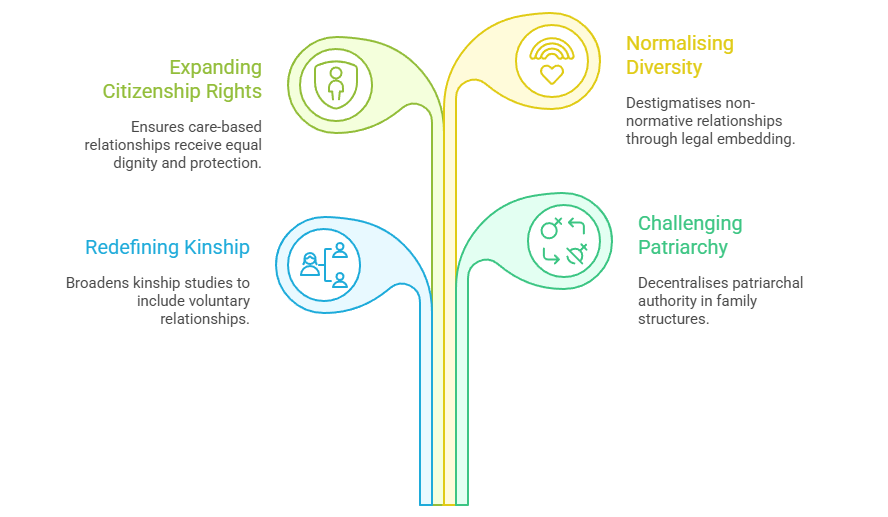
- Redefining Kinship – Moving beyond blood and marriage would broaden kinship studies to include voluntary and affinity-based relationships.
- Challenging Patriarchy – Alternative family models can decentralise patriarchal authority and create more democratic domestic arrangements.
- Expanding Citizenship Rights – Legal recognition would ensure that care-based relationships are afforded the same dignity and protection as conventional families.
- Normalising Diversity – By embedding chosen families in law, the state can help destigmatise non-normative relationships.
Conclusion
Reimagining the family through the lens of the chosen family is not an attempt to dismantle the traditional household but to expand the legal and cultural definition to be inclusive of all care-based relationships. For many in India — queer persons, survivors of violence, the disabled, and the elderly — chosen families are not an abstract idea but a lived necessity. Recognising them in law is a step towards ensuring that love, care, and protection are rights accessible to all, regardless of how one’s family is formed.
PYQs
Paper 1
- Discuss the changes in the institution of family in modern societies. (2014)
- Examine the impact of globalisation on marriage and family systems in contemporary society. (2015)
- How do feminist and queer perspectives challenge the functionalist understanding of family? (2016)
- Discuss the relevance of kinship studies in understanding alternative family structures in modern times. (2017)
- Examine the concept of “chosen family” in the context of changing definitions of kinship. (2018)
- Analyse the role of family as both a site of care and a site of violence. (2019)
- Discuss the impact of legal changes on the institution of marriage and family in India. (2020)
- Examine the sociological significance of recognising non-normative family arrangements in the 21st century. (2021)
- How do intersectionality and identity politics influence contemporary debates on family and marriage? (2022)
- Critically examine the concept of “marriage equality” from a sociological perspective. (2023)
Paper 2
- Analyse the persistence of patriarchy in Indian family structures despite socio-economic change. (2014)
- Discuss the status of LGBTQ+ persons in Indian society in the context of family and kinship. (2015)
- Examine how caste and religion influence marriage and family patterns in India. (2016)
- Analyse the implications of Supreme Court verdicts on Section 377 for Indian family systems. (2018)
- Discuss the challenges faced by same-sex couples in India with respect to legal recognition of their families. (2019)
- Examine the role of customary practices like hijra gharanas in redefining kinship in India. (2020)
- Discuss the social and legal barriers to recognising non-normative kinship arrangements in India. (2021)
- Analyse the debates on marriage equality in India in the context of LGBTQ+ rights. (2022)
- Critically analyse the concept of “chosen family” in Indian society with suitable examples. (2023)
- Discuss the impact of non-heteronormative relationships on the traditional Indian joint family system. (2024)
|

One comment