
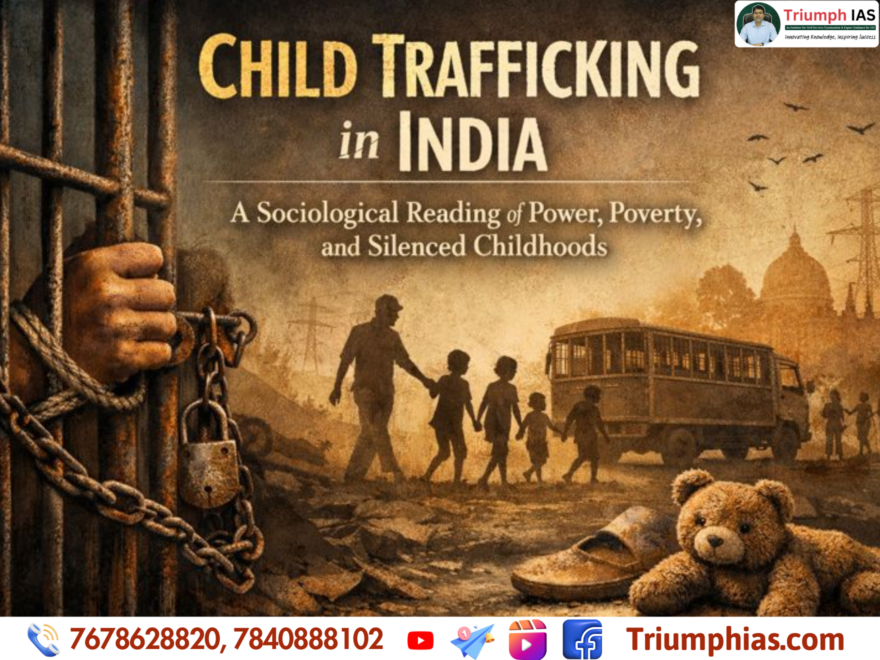
Child Trafficking in India: A Sociological Reading of Power, Poverty, and Silenced Childhoods
(Relevant for Sociology Paper 1: Stratification and Mobility and Paper 2: Industrialization and Urbanization in India and Challenges of Social Transformation)
|
The Supreme Court of India’s recent recognition of child trafficking and commercial sexual exploitation as a “deeply disturbing reality” marks a crucial juridical shift. By directing courts to treat trafficked children as injured witnesses and to assess their testimonies with sensitivity, the Court has implicitly acknowledged a sociological truth long emphasized by scholars: crime cannot be understood in isolation from the social structures that produce vulnerability. Child trafficking is not merely a legal violation; it is a manifestation of structural inequality, power asymmetries, and systemic neglect. Structural Inequality and the Production of Vulnerability
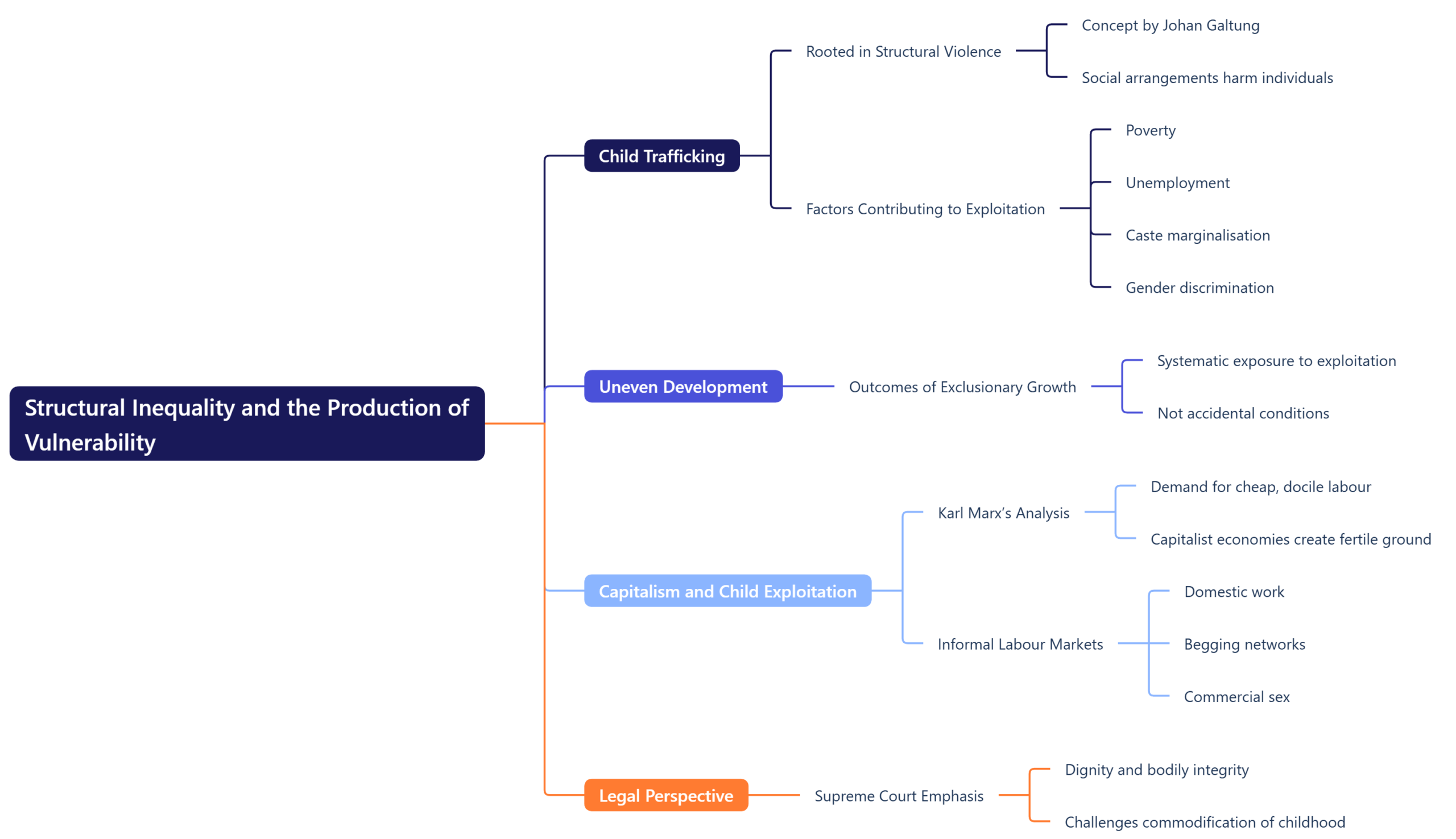
From a sociological standpoint, child trafficking is rooted in what Johan Galtung conceptualised as structural violence—social arrangements that harm individuals by preventing them from meeting their basic needs. Poverty, unemployment, caste marginalisation, gender discrimination, migration, and family breakdown systematically expose children to exploitation. These are not accidental conditions but outcomes of uneven development and exclusionary growth. Karl Marx’s analysis of capitalism is particularly relevant here. The demand for cheap, docile, and disposable labour under capitalist economies creates a fertile ground for child exploitation. Trafficked children are absorbed into informal labour markets—domestic work, brick kilns, begging networks, entertainment industries, and commercial sex—where regulation is weak and profit maximisation overrides human dignity. The Supreme Court’s emphasis on dignity and bodily integrity directly challenges this commodification of childhood. Trafficking Networks and Weberian PowerMax Weber’s concept of power as the ability to impose one’s will despite resistance helps explain the functioning of trafficking networks. Traffickers operate through organised, layered chains spanning source, transit, and destination areas. Children, positioned at the lowest end of the power hierarchy, are deprived of agency through deception, coercion, threats, and violence. Weber’s idea of bureaucratic rationality also sheds light on institutional failures. While India has multiple laws addressing trafficking, fragmented enforcement, delayed data collection, and procedural rigidity often undermine justice. When courts demand “perfect” testimonies from traumatised children, they replicate what Weber warned against: excessive formalism that ignores human realities. Trauma, Memory, and the Sociology of TestimonyThe Supreme Court’s directive that minor inconsistencies should not discredit a child’s testimony reflects insights from sociology and victimology. According to trauma studies, victims of prolonged abuse often narrate experiences in fragmented, non-linear ways. Expecting chronological precision ignores the psychological impact of exploitation. Pierre Bourdieu’s concept of symbolic violence is useful here. When courts or investigators dismiss testimonies due to inconsistencies, they impose dominant norms of rationality and communication on marginalised children. This subtle form of violence delegitimises the child’s lived experience and reinforces existing power hierarchies between the state and the victim. Stigma, Silence, and the Social Construction of Victimhood
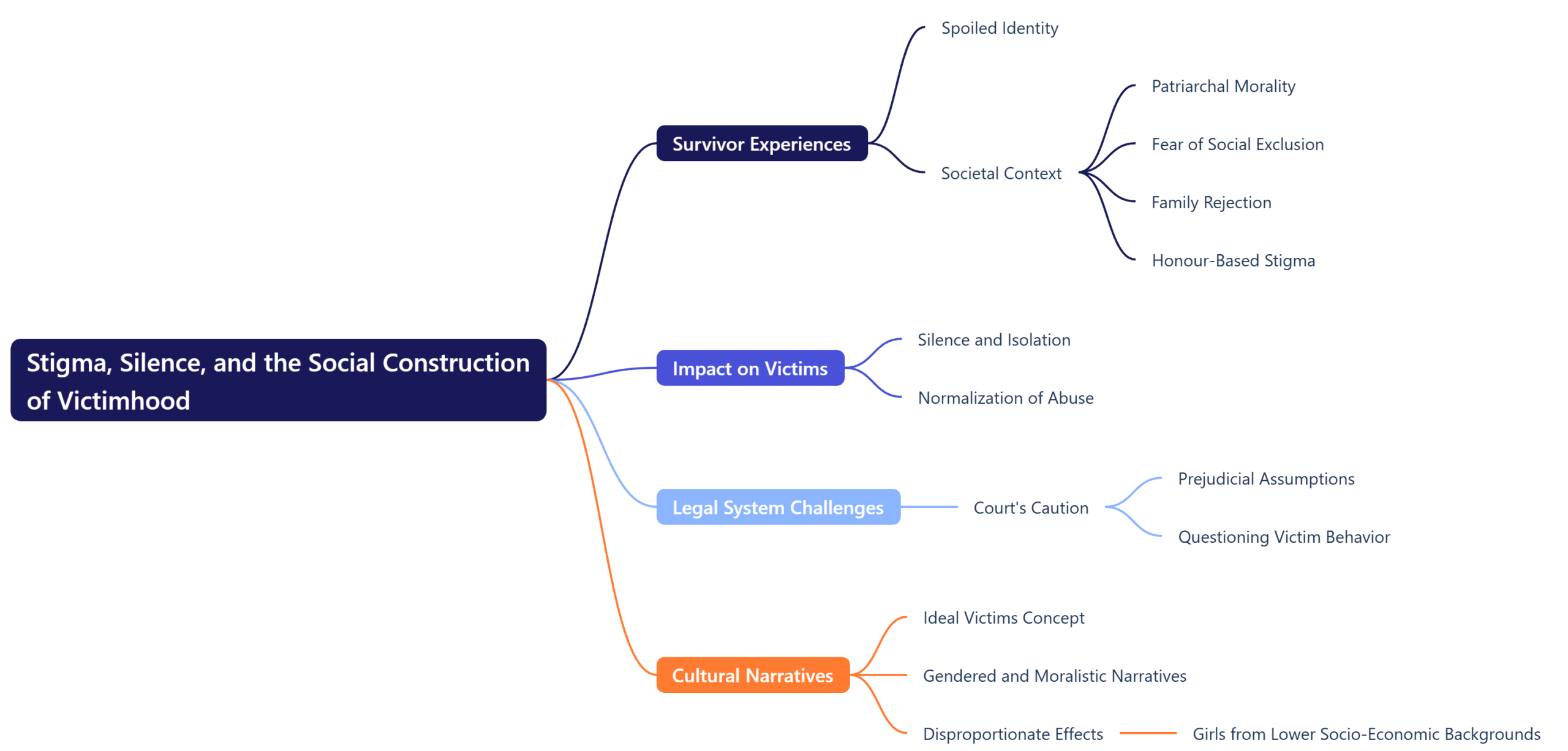
Erving Goffman’s theory of stigma helps explain why child trafficking remains underreported. Survivors of sexual exploitation often carry a “spoiled identity” in societies governed by patriarchal morality. Fear of social exclusion, family rejection, and honour-based stigma silences victims and normalises abuse. The Court’s caution against prejudicial assumptions—such as questioning why a child did not resist or report immediately—directly challenges dominant cultural narratives about “ideal victims.” Feminist sociologists have long argued that such narratives are gendered and moralistic, disproportionately affecting girls from lower socio-economic backgrounds. Gender, Patriarchy, and IntersectionalityFeminist sociology emphasises that child trafficking, particularly for sexual exploitation, cannot be separated from patriarchal structures. Girls are disproportionately trafficked due to gender norms that devalue female autonomy and normalise control over women’s bodies. Kimberlé Crenshaw’s concept of intersectionality further reveals how caste, class, gender, and regional inequality intersect to intensify vulnerability. For instance, Dalit, Adivasi, migrant, and homeless children face compounded risks due to historical exclusion and limited access to welfare institutions. The Supreme Court’s emphasis on recognising socio-economic and cultural vulnerabilities reflects an intersectional understanding of exploitation. Technology, Modernity, and New Forms of ExploitationAnthony Giddens’ idea of late modernity helps explain how technology has transformed trafficking. Social media platforms enable what sociologists call “virtual recruitment,” where traffickers masquerade as talent scouts or employers. This reflects Ulrich Beck’s notion of the risk society, where modern systems create new, unpredictable dangers beyond traditional regulatory mechanisms. The misuse of digital spaces demonstrates that trafficking adapts to changing social conditions, demanding equally adaptive institutional responses. Law as Social Control and Social ReformÉmile Durkheim viewed law as a reflection of collective conscience. The Supreme Court’s guidelines indicate a shift from repressive justice to restorative and protective justice, recognising trafficked children as victims rather than unreliable witnesses. This aligns with Durkheim’s idea that law evolves with social morality. However, sociologists caution against legal centrism—the belief that law alone can resolve deeply social problems. Despite robust legislation, trafficking persists due to weak welfare delivery, inadequate rehabilitation, and lack of community vigilance. Prevention Through Social InstitutionsThe National Commission for Protection of Child Rights’ prevention-first approach resonates with sociological insights. Strengthening families through welfare convergence, empowering Panchayats, engaging schools and Anganwadi workers, and monitoring transit spaces recognise that social institutions, not just police and courts, shape children’s safety. Travis Hirschi’s social control theory suggests that strong bonds to family, school, and community reduce deviance and victimisation. When these bonds weaken due to poverty or migration, children become easy targets for traffickers. Conclusion: Towards Sociologically Informed JusticeThe Supreme Court’s recognition of trafficked children as injured witnesses represents more than a procedural reform—it is an acknowledgment of structural injustice. Child trafficking thrives where inequality, stigma, and silence intersect. A sociological lens reveals that justice must extend beyond convictions to prevention, rehabilitation, and dignity restoration. True eradication of child trafficking requires transforming the social conditions that make exploitation possible. Until poverty, patriarchy, exclusion, and institutional apathy are addressed, traffickers will continue to exploit the cracks in society. Justice, therefore, must not only punish offenders but also repair the social fabric that failed its children. |
To Read more topics, visit: www.triumphias.com/blogs
Read more Blogs:
Child Marriage in India: A Sociological Lens on Poverty, Patriarchy, and the Limits of Law
How to Choose the Best Teacher for Sociology Optional for UPSC Exams – Triumph IAS Insights