Introduction: Child Pornography
Child pornography, also known as child sexual abuse material (CSAM), is a grave form of sexual exploitation of minors. In the digital era, the proliferation of smartphones, encrypted apps, and the dark web has led to a sharp increase in its circulation. This issue is not just criminal and psychological, but deeply sociological, reflecting the failures of social institutions, cultural norms, and digital governance.
Legal Framework in India
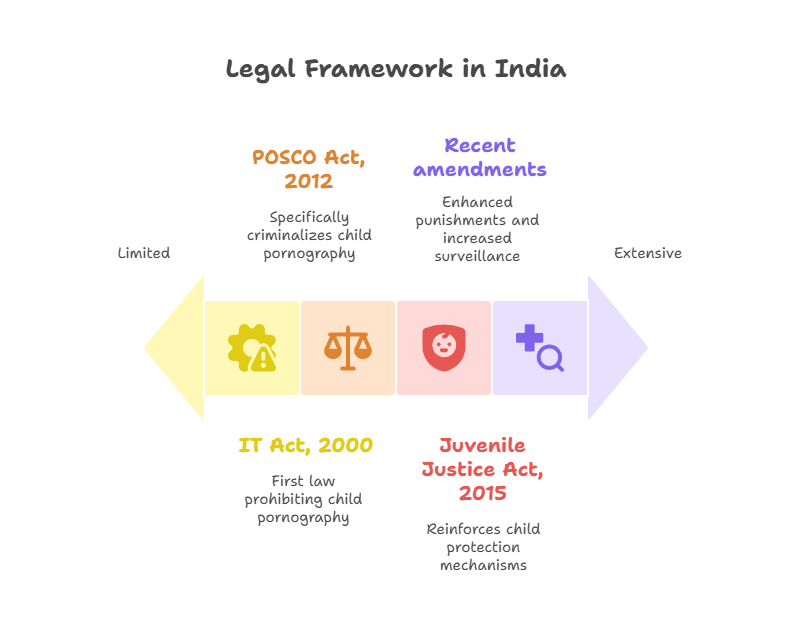
- POSCO Act, 2012: Specifically criminalizes child pornography.
- IT Act, 2000 (Section 67B): Prohibits material depicting children in sexually explicit acts.
- Juvenile Justice Act, 2015: Reinforces child protection mechanisms.
- Recent amendments: Enhanced punishments and increased surveillance.
Despite these laws, enforcement faces challenges due to encrypted communication, jurisdictional limitations in cybercrime, and lack of digital literacy.
Applicable Sociological Theories
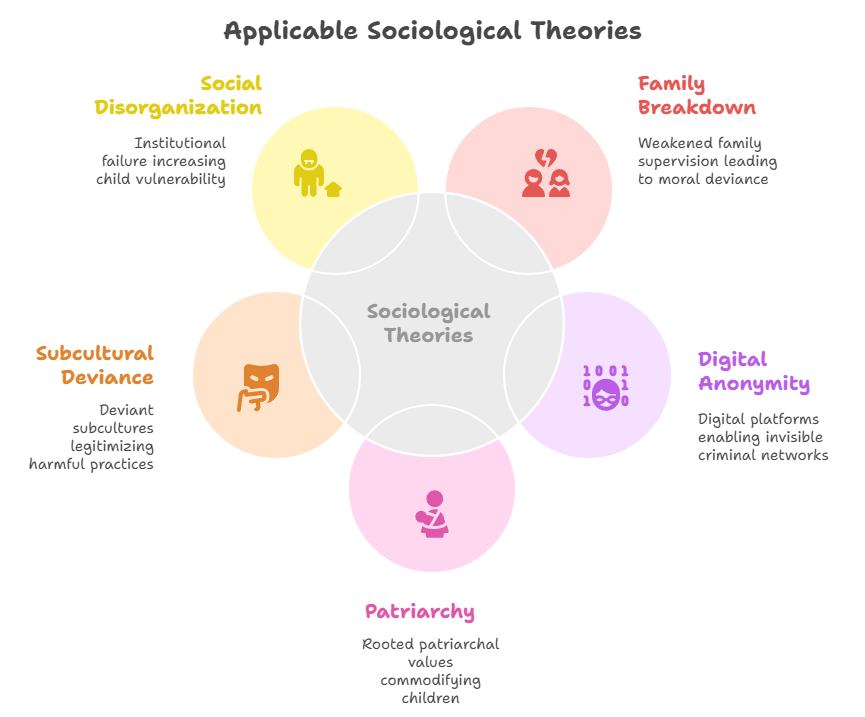
- Breakdown of Family and Moral Values: Functionalist theorists like Talcott Parsons argue that weakened family supervision can contribute to moral deviance. Dysfunctional family settings, abuse at home, and neglect create vulnerable targets.
- Digital Anonymity and Cyber Deviance: Manuel Castells’ theory of the Network Society highlights how digital platforms enable invisible criminal networks. Encrypted apps and dark web forums facilitate trafficking, sharing, and abuse.
- Patriarchy and Objectification: Feminist sociologists emphasize that child pornography reflects deeply rooted patriarchal values, commodifying the female (and sometimes male) child body for male gratification. Sylvia Walby’s theory of patriarchal structures is useful to explain this exploitation.
- Subcultural Deviance: Albert Cohen and Cloward & Ohlin show how deviant subcultures form, legitimizing such practices through peer validation. Online groups normalize deviant behavior through shared ideology.
- Social Disorganization: In urban slums or conflict zones, where Shaw and McKay’s theory applies, poor enforcement and institutional failure lead to increased vulnerability of children.
Impact on Children and Society
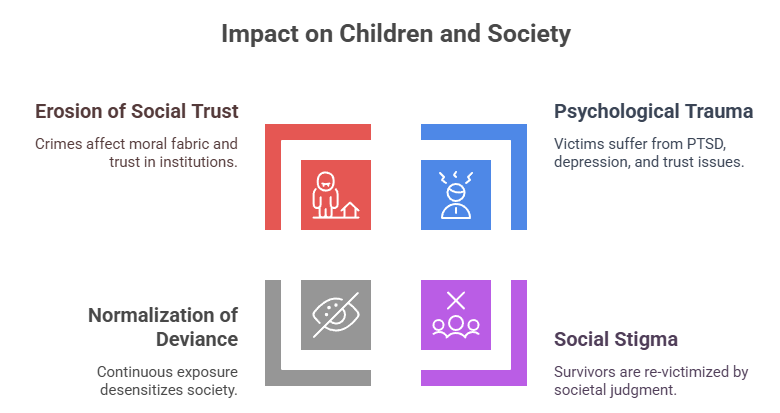
- Psychological Trauma: Victims face PTSD, depression, and trust issues.
- Social Stigma: Survivors are often re-victimized by society’s judgment.
- Normalization of Deviance: Continuous exposure desensitizes society, creating a culture of silence and denial.
- Erosion of Social Trust: Such crimes deeply affect the moral fabric of society, eroding trust in digital platforms and institutions.
Government and Civil Society Response
- National Cyber Crime Reporting Portal: Allows anonymous reporting of CSAM.
- Interpol Coordination: India collaborates globally to trace dark web offenders.
- NGOs like Bachpan Bachao Andolan: Work on child
Conclusion
Child pornography is one of the most alarming consequences of unregulated digital growth, reflecting deep-rooted structural inequalities, moral breakdown, and institutional failure. While laws like the POCSO Act and IT Act provide a legal shield, they must be complemented by strong sociological understanding, digital literacy, community engagement, and moral accountability. This issue cannot be viewed merely as an individual deviance—it is a social pathology, born out of a combination of technological misuse, patriarchal power structures, and socio-economic vulnerabilities. To protect the dignity and future of children, India must adopt a multi-pronged approach—involving state regulation, global cooperation, sociological intervention, and a conscious effort to rebuild a value-based digital culture. Only then can society reclaim the internet as a space of learning and connection rather than exploitation and harm.
PYQs
Paper 1
- Examine how subcultures can legitimize deviant behavior. Discuss with examples from online communities. (2021)
- Discuss the differential association theory of Sutherland and evaluate its applicability to cybercrime and digital deviance. (2020)
- What is the role of social control in maintaining order in technologically advanced societies? (2020)
- How does labelling theory explain deviant behavior in modern societies? Substantiate with examples. (2019)
- Critically examine the concept of moral panic and its role in understanding media’s response to child sexual abuse. (2018)
- How is deviance socially constructed? Evaluate with reference to Becker’s interactionist perspective. (2017)
- Examine Durkheim’s concept of anomie and discuss its relevance in understanding deviant behavior in the digital age. (2016)
Paper 2
- What are the implications of rising internet penetration on child safety in India? Suggest sociological interventions. (2023)
- Analyze the role of state and family in ensuring child protection in India in the context of recent digital abuse cases. (2022)
- Discuss the challenges faced by law enforcement agencies in dealing with crimes against children in cyberspace. (2021)
- Discuss how globalization and digital technologies have transformed the nature of crimes against women and children in India. (2020)
- Explain the intersectionality of class, caste, and gender in child exploitation in India. (2019)
- Examine the role of NGOs and civil society in addressing child trafficking and exploitation in India. (2018)
- Discuss the impact of weakening traditional institutions like family and community on juvenile delinquency and deviance. (2017)
- Critically examine the role of the Juvenile Justice Act in protecting vulnerable children from sexual exploitation. (2016)
|



This post does a great job highlighting how digital tools have amplified the reach and anonymity of child pornography, making it a uniquely modern social problem. It might also be worth exploring how tech companies and platform algorithms contribute to both the spread and detection of CSAM—an area where sociology, law, and technology intersect powerfully.