
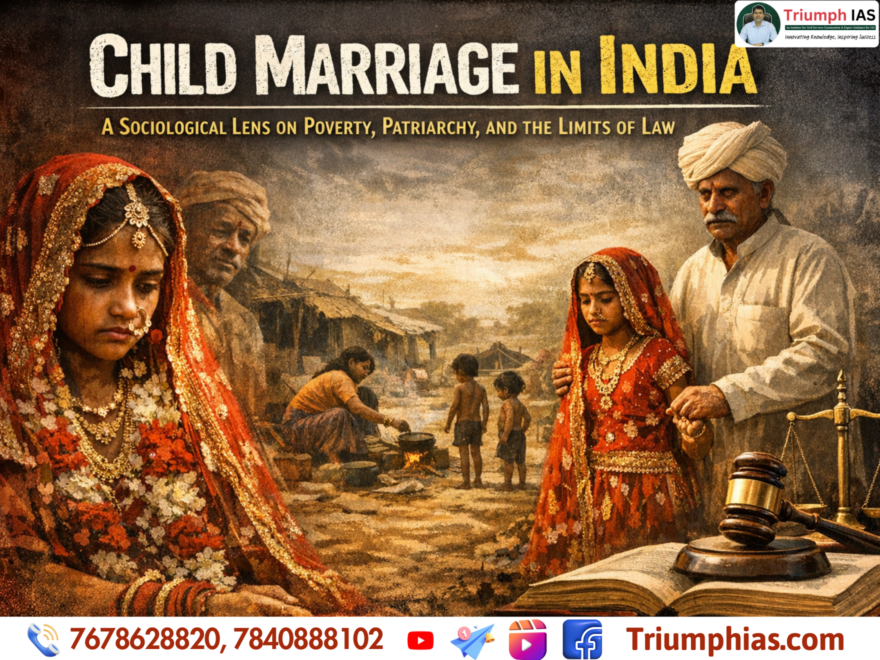
Child Marriage in India: A Sociological Lens on Poverty, Patriarchy, and the Limits of Law
(Relevant for Sociology Paper 2: System of Kinship in India and Politics and Society)
|
Despite a strong legal framework and visible decline in prevalence, India remains off-track to eliminate child marriage by the 2030 Sustainable Development Goal deadline. The persistence of child marriage reveals a deeper sociological reality: laws alone cannot dismantle social practices that are embedded in structures of poverty, patriarchy, and cultural legitimacy. From a sociological standpoint, child marriage is not an aberration but a social institution sustained by inequality and normative power. Understanding Child Marriage as a Social InstitutionÉmile Durkheim argued that social facts—ways of acting, thinking, and feeling—exist outside the individual and exert coercive power. Child marriage in India functions as such a social fact. In many communities, it is normalised, morally justified, and socially rewarded, even when legally prohibited. The decline in child marriage from nearly 47% (NFHS-3) to 23.3% (NFHS-5) reflects changing social conditions—education, urbanisation, welfare expansion—but the uneven progress across states highlights that legal uniformity does not translate into social uniformity. States like West Bengal, Bihar, and Tripura continue to report rates above 40%, indicating that deeply rooted social structures resist legal reform. Poverty, Insecurity, and Rational ChoicesFrom a political economy perspective, poverty is a major driver of child marriage. However, sociology cautions against viewing this simply as ignorance or backwardness. James Coleman’s rational choice theory helps explain why families may choose early marriage under conditions of scarcity. For economically insecure households, marrying a daughter early reduces perceived financial burden and shifts responsibility to the marital household. Yet this “rationality” is shaped by structural constraints. Amartya Sen’s capability approach highlights that poor households lack real freedom to choose alternatives such as prolonged education or delayed marriage. Child marriage thus emerges not from free choice, but from constrained agency within unequal social systems. Patriarchy and Gendered Power RelationsFeminist sociology places patriarchy at the centre of the child marriage debate. Sylvia Walby defines patriarchy as a system of social structures in which men dominate, oppress, and exploit women. Child marriage is one of patriarchy’s most visible manifestations, controlling female sexuality, labour, and reproduction. Girls are disproportionately affected because their bodies are seen as bearers of family honour. Early marriage ensures sexual control, limits autonomy, and secures lineage purity. Pierre Bourdieu’s concept of symbolic violence explains how these practices are internalised by women themselves, who may come to view early marriage as destiny rather than deprivation. Education, Social Capital, and Norm ChangeSociologists widely agree that education is the strongest antidote to child marriage. However, education functions not merely as schooling, but as a form of cultural capital (Bourdieu). Educated girls acquire aspirations, awareness of rights, and negotiating power within families. NFHS data consistently shows lower child marriage rates among girls with secondary education. Yet access to education remains unequal due to school dropouts, safety concerns, distance, and household labour demands. Where education systems fail, marriage becomes the default transition into adulthood. Community-level interventions—such as Panchayats declaring themselves child-marriage-free—are sociologically significant because they target normative change rather than individual behaviour. According to Everett Rogers’ diffusion of innovations theory, social practices decline only when new norms gain collective legitimacy. Law, Legitimacy, and the Limits of CoercionThe Prohibition of Child Marriage Act (PCMA), 2006 provides a strong legal framework, criminalising child marriage and empowering Child Marriage Prohibition Officers. However, Max Weber’s distinction between legal authority and legitimate authority explains why enforcement remains weak. In communities where child marriage is morally accepted, law lacks legitimacy. Families may hide marriages, falsify age records, or conduct ceremonies informally. The law’s coercive power often clashes with community norms, leading to underreporting and selective enforcement. Michel Foucault’s idea of governmentality further explains this dynamic. The state seeks to regulate marriage through surveillance and punishment, but without transforming the underlying social rationalities that govern family behaviour. As a result, compliance remains superficial. Intersectionality and Regional VariationKimberlé Crenshaw’s concept of intersectionality is crucial for understanding why child marriage persists unevenly. Girls from Scheduled Castes, Scheduled Tribes, minority communities, and migrant families face overlapping disadvantages—poverty, discrimination, low educational access, and weak institutional support. Regional variation reflects differences in land relations, female labour participation, literacy, and gender norms. In agrarian, land-scarce regions, early marriage is often tied to survival strategies. In contrast, states with higher female education and employment show faster decline, demonstrating how structural empowerment reduces harmful practices. Child Marriage and the Reproduction of InequalityFrom a Marxian perspective, child marriage contributes to the reproduction of labour and inequality. Early marriage truncates education, leads to early childbearing, poor health outcomes, and intergenerational poverty. Girls married young are more likely to remain in informal labour, unpaid domestic work, or economic dependence. Thus, child marriage is not merely a cultural problem but an economic one that sustains class and gender hierarchies. Breaking this cycle requires addressing material conditions alongside normative change. Role of Welfare Schemes and State InterventionsGovernment initiatives such as Beti Bachao Beti Padhao, scholarships, and cash transfer schemes aim to offset the economic incentives for early marriage. From a sociological lens, these schemes act as counter-incentives, altering the cost-benefit calculus of families. However, scholars caution against over-reliance on conditional cash transfers. Without parallel investments in quality education, safety, and employment opportunities, such schemes risk becoming temporary deterrents rather than transformative tools. The linkage of child marriage prevention with POCSO has strengthened legal deterrence, but it has also raised concerns about criminalising families without providing viable alternatives—highlighting the tension between protection and punishment. Global Commitments and Social RealityIndia’s commitment to SDG Target 5.3 reflects global normative pressure. Yet sociology reminds us that international goals operate at the level of symbolic commitment, while social practices change at the level of everyday life. Progress depends on aligning global norms with local meanings. Conclusion: Beyond Law Towards Social TransformationIndia’s struggle against child marriage demonstrates a fundamental sociological lesson: social change cannot be legislated into existence. While laws, schemes, and international commitments are necessary, they are insufficient without transformation of underlying social structures. Ending child marriage requires sustained investment in girls’ education, economic security for households, gender norm transformation, and community legitimacy for delayed marriage. Until poverty, patriarchy, and social insecurity are addressed together, child marriage will persist in pockets, even as national averages improve. Eliminating child marriage is not merely about meeting a global target—it is about redefining childhood, gender, and dignity in Indian society. |
To Read more topics, visit: www.triumphias.com/blogs
Read more Blogs:
Artificial Intelligence: Boom, Bubble, or Social Transformation?
Air Pollution, Automobility, and Inequality: A Sociological Reading of Bharat Stage Emission Norms
One comment