Charismatic Personality of Cult

Charismatic Personality of Cult

Charismatic Personality of Cult

(Relevant for Sociology Paper I: Religion and Society and Sociology Paper II: Religion and Society, Challenges of Social Transformation)

Introduction

In recent years, the rise of cults and their enigmatic leaders has caught the attention of sociologists, psychologists, and political scientists alike. From Asaram Bapu to Gurmeet Ram Rahim Singh, India has witnessed the growth and eventual fall of numerous so-called “godmen” who have led powerful cult-like followings. Central to these phenomena is the charismatic personality of the cult leader, who wields extraordinary influence over followers.

What is a Cult?

A cult is a social group defined by its unusual religious, spiritual, or philosophical beliefs, or by its common interest in a particular personality, object, or goal. Cults often operate outside of mainstream religion or politics and tend to deviate from dominant norms.

A cult is typically:

  • Authoritarian in structure.
  • Led by a charismatic leader.
  • Exhibits high levels of control over members.
  • Often isolates members from wider society.

Max Weber’s Concept of Charismatic Authority

Max Weber, a key figure in classical sociology, defined charismatic authority as one of the three forms of legitimate domination (alongside traditional and legal-rational authority).

Key features of charismatic authority:

  • Rooted in the extraordinary personal qualities of a leader.
  • Followers perceive the leader as divinely inspired, heroic, or uniquely capable.
  • It often arises in times of social crisis or transition.
  • It is inherently unstable, requiring constant validation through perceived success or divine sanction.

In the context of cults, the charismatic leader becomes the sole source of truth, ethics, and often, identity.

Charismatic Personality Traits in Cult Leaders

Charismatic Personality Traits in Cult Leaders

Cult leaders often display charismatic personality traits that help them attract and control followers. These include:

  1. Magnetic Communication Skills: Highly persuasive and emotionally appealing.
  2. Messianic or Prophetic Claims: Claiming divine powers, revelations, or supernatural gifts.
  3. Narcissism and Authoritarianism: High self-belief combined with an urge to dominate.
  4. Personalized Rules and Ethics: The cult leader becomes the moral compass of the group.
  5. Manipulation and Emotional Appeal: Using love bombing, fear tactics, or visions of utopia.

Why Do People Follow Cult Leaders?

From a sociological perspective, the following theories help explain why individuals are drawn toward cult leaders:

  1. Strain Theory (Robert Merton): People facing anomie (normlessness) due to rapid social change may seek alternative systems like cults for stability and meaning.
  2. Deprivation Theory: Cults often appeal to individuals facing economic, social, or spiritual deprivation. They offer a sense of belonging and empowerment.
  3. Symbolic Interactionism: Followers internalize the meanings given by the cult leader. Through daily interactions, they redefine reality in line with the leader’s teachings.
  4. Functionalism: Cults may initially serve a latent function by fulfilling spiritual or communal needs unmet by mainstream institutions.

Case Studies from India

Case Studies from India

  1. Asaram Bapu: Once a revered spiritual guru with millions of followers, he was convicted of rape. His charisma and spiritual appeal allowed him to create a personality cult that defied logic and legal boundaries until his eventual arrest.
  2. Gurmeet Ram Rahim Singh: The flamboyant leader of Dera Sacha Sauda manipulated his followers through extravagant displays, emotional manipulation, and claims of divinity. His cult offered social services, further entrenching loyalty.
  3. Rampal Baba: He declared himself a reincarnation of Kabir and attacked mainstream Hinduism. His followers engaged in violent clashes with law enforcement to defend him.

These cases reflect the dangerous blend of charisma, authoritarianism, and blind faith, leading to social control, exploitation, and often violence.

Cults and Social Control

Cult leaders often control every aspect of their followers’ lives—what they eat, how they dress, whom they associate with, and even how they think. Mechanisms of social control include:

  • Isolation from the outside world
  • Punishment of dissent
  • Rituals and repetitive indoctrination
  • Economic dependence

This reflects Michel Foucault’s idea of disciplinary power, where control operates not just through rules but through normalization and surveillance.

Cult and Religion:

Sociologists often struggle to demarcate religion from cult. The line becomes blurred when:

  • A minority religious movement gains popularity, eventually becoming mainstream (e.g., Christianity once began as a cult).
  • A mainstream religion shows cult-like tendencies, such as personality worship or authoritarianism.

Anthony Giddens emphasizes the sociological relativity of the term “cult”—its meaning depends on power dynamics and societal norms.

Implications in Indian Society

Implications in Indian Society

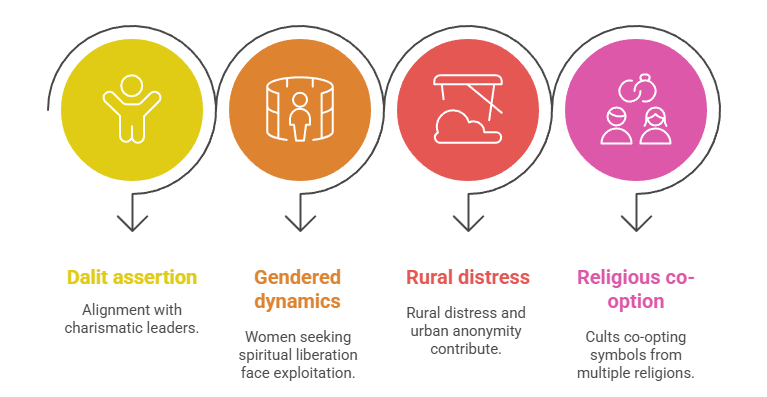
In India, the intersection of caste, religion, and deprivation provides fertile ground for cults:

  • Dalit assertion movements have sometimes aligned with charismatic leaders.
  • Gendered dynamics show women joining cults for spiritual liberation, only to face exploitation.
  • Rural distress and urban anonymity both contribute to cult membership.
  • Cults often co-opt symbols from multiple religions, promoting hybrid ideologies (e.g., Dera movements mixing Sikh and Hindu traditions).

Charisma and Political Cults:

Cultism is not confined to religion. In political sociology, charismatic populist leaders such as Narendra Modi or Arvind Kejriwal have also built strong personal brands. Although they function within democratic frameworks, their appeal often resembles cult-like devotion.

This shows how charismatic leadership, when combined with media, propaganda, and identity politics, can transcend formal institutions.

Dangers of Charismatic Cults

  • Erosion of rational thinking
  • Exploitation (sexual, economic, emotional)
  • Undermining democratic institutions
  • Violence and criminality

Erich Fromm called such phenomena “escape from freedom,” where individuals submit to authoritarian figures to avoid the burden of autonomy.

Conclusion

The charismatic personality of cult leaders reflects a deep sociological truth: that in time of uncertainty, people seek meaning, guidance, and belonging. However, when such charisma is unchecked, it transforms into manipulation, exploitation, and abuse. The solution lies in strengthening institutional trust, promoting rational inquiry, and ensuring legal safeguards against cult exploitation.

Previous Year Questions

Paper I

  • “What is charismatic authority? Explain with examples.” (2018)
  • “Critically evaluate Weber’s theory of authority.” (2016)

Paper II

  • “Discuss the changing nature of religion in India with reference to new cults and sects.” (2020)
  • “Explain the role of sectarian and charismatic leaders in Indian social movements.” (2015)

To Read more topicsvisit: www.triumphias.com/blogs

Read more Blogs:

Strategic Ripples: India-China Tensions over the Brahmaputra

Understanding Charismatic Personality

One comment

Leave a Reply

Your email address will not be published. Required fields are marked *