Introduction
The plight of Indigenous Peoples, often referred to as Adivasis or Scheduled Tribes (STs) in India, continues to be a glaring issue of social injustice and marginalization. The United Nations has recently reiterated that the systemic challenges they face are “an affront to dignity and justice”.
With over 104 million tribal individuals in India (Census 2011), this issue is not just humanitarian but also profoundly sociological. The alienation of tribals, land dispossession, cultural suppression, and institutional neglect are key topics of concern for Sociology aspirants, making this theme highly relevant for Sociological analysis.
Key Challenges Faced by Indigenous Peoples in India
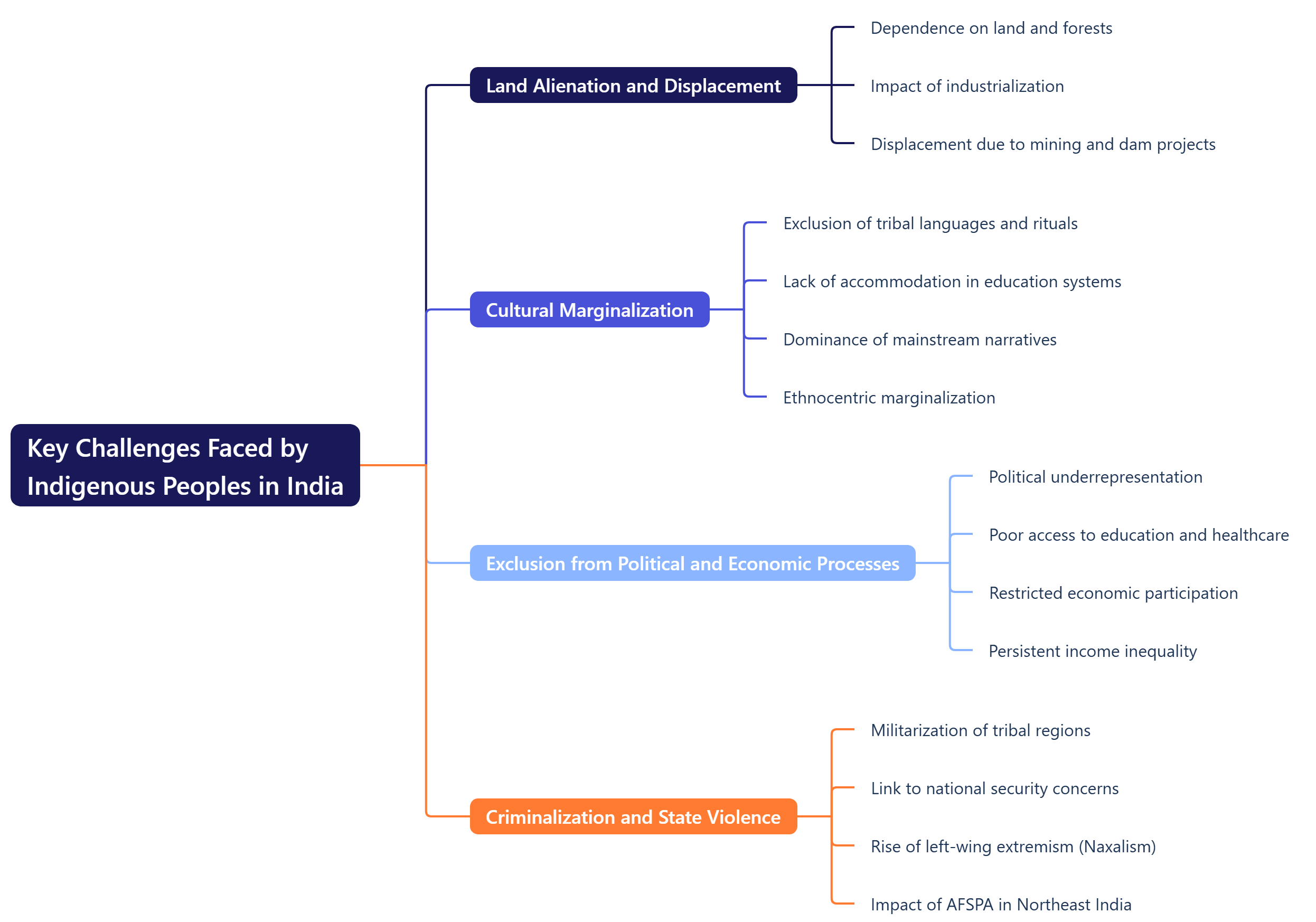
- Land Alienation and Displacement: Tribal communities have historically been dependent on forests and land for their livelihood and identity. However, industrialization, mining projects, and dam construction have displaced millions without adequate rehabilitation. For example, projects like the Sardar Sarovar Dam and mining in Chhattisgarh and Jharkhand have uprooted entire communities.
- Cultural Marginalization: Tribal languages, rituals, and social norms are often excluded from mainstream discourse, leading to cultural erasure. Education systems do not accommodate tribal knowledge systems, and the dominant-culture narrative overrides indigenous practices, leading to ethnocentric marginalization.
- Exclusion from Political and Economic Processes: Despite constitutional safeguards like Fifth and Sixth Schedule, tribals remain politically underrepresented. Their economic participation is restricted due to poor access to education, healthcare, and employment opportunities, leading to persistent income inequality.
- Criminalization and State Violence: Tribal regions are often militarized under the guise of national security. The rise of left-wing extremism or Naxalism is linked to decades of neglect and exploitation. The use of force under laws like AFSPA in tribal-dominated Northeast India has worsened their alienation.
Sociological Analysis of Indigenous Marginalization
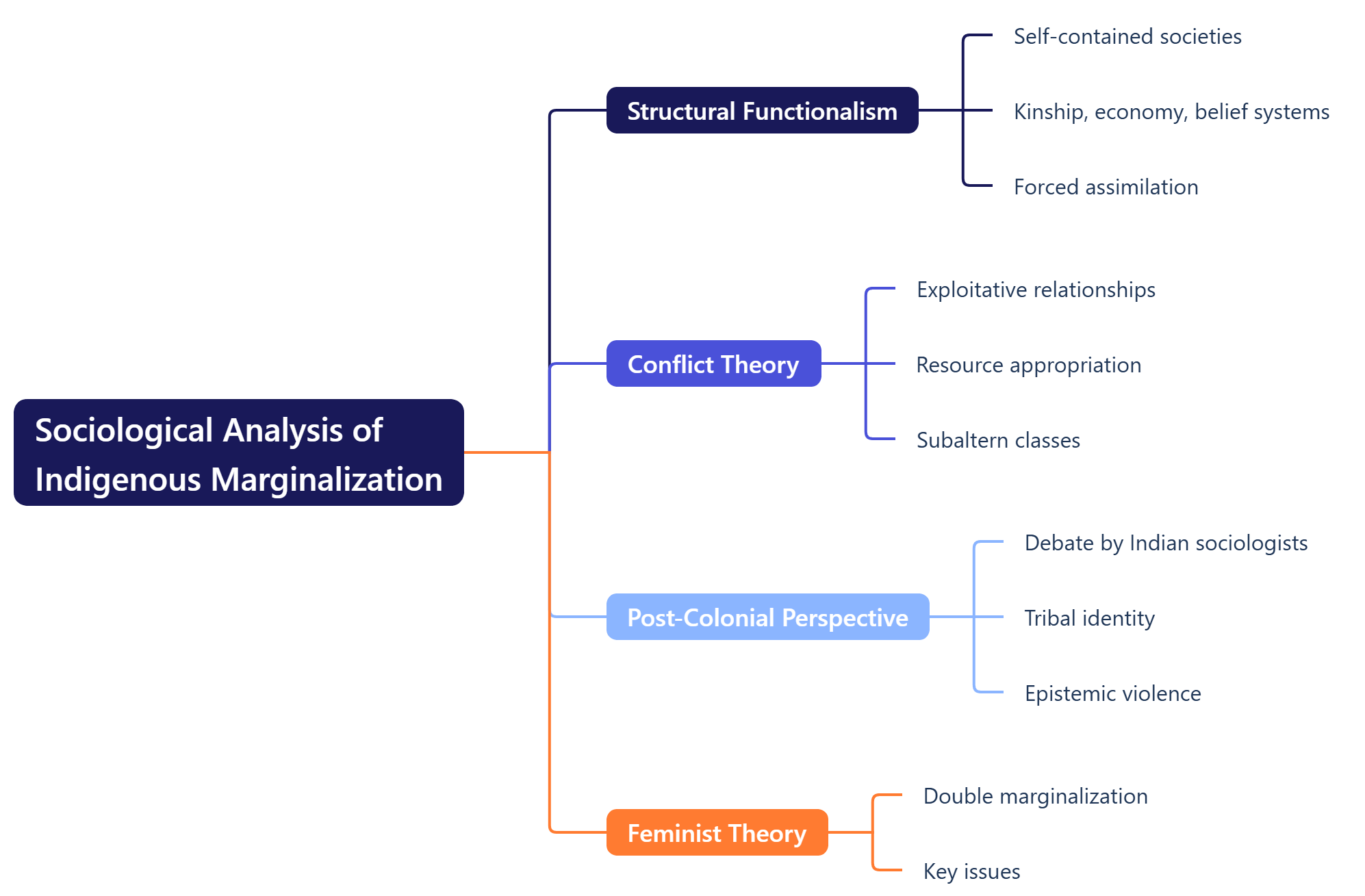
- Structural Functionalism: Tribes are seen as self-contained societies with their own systems of kinship, economy, and belief. Disrupting their ecosystem through forced assimilation leads to social disintegration, making it difficult for them to adapt to modern institutions.
- Conflict Theory: As per this theory, the relationship between dominant capitalist classes and indigenous people is inherently exploitative. The acquisition of tribal lands for profit exemplifies resource appropriation, turning tribals into the subaltern classes, echoing the ideas of Antonio Gramsci’s cultural hegemony.
- Post-Colonial Perspective: Indian sociologists like R. Desai and G.S. Ghurye debated whether tribals should be seen as ‘backward Hindus’ or as autonomous entities. Post-colonial theory highlights how colonial categories and post-independence development discourse have perpetuated epistemic violence against indigenous communities.
- Feminist Theory: Tribal women face double marginalization—due to both patriarchy and ethnic discrimination. Issues like sexual violence during armed conflicts, lack of maternal healthcare, and exclusion from political decision-making remain largely ignored.
Government Initiatives and Constitutional Safeguards
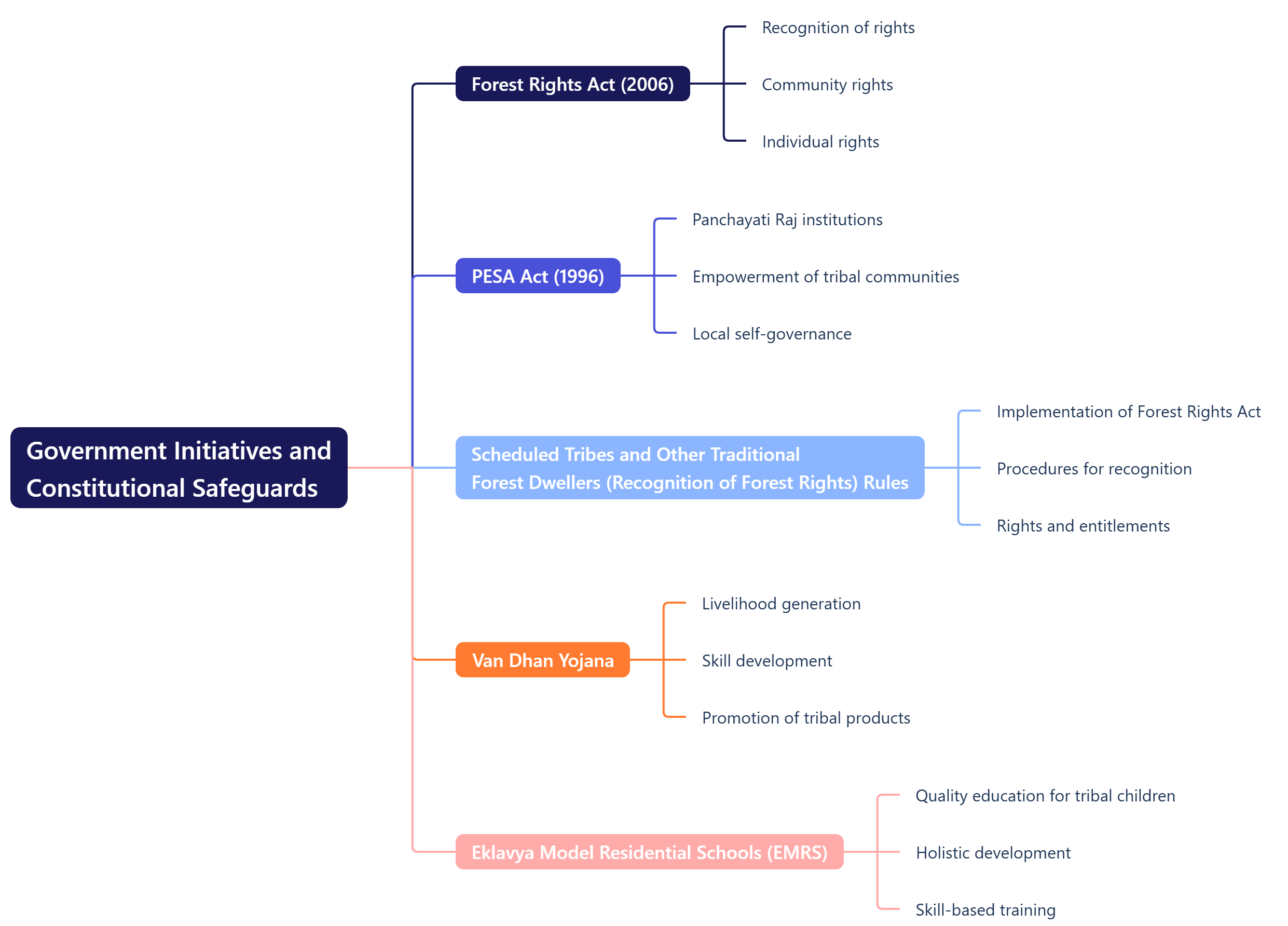
- Forest Rights Act (2006)
- PESA Act (1996)
- Scheduled Tribes and Other Traditional Forest Dwellers (Recognition of Forest Rights) Rules
- Van Dhan Yojana
- Eklavya Model Residential Schools (EMRS)
However, the implementation gap remains vast. Awareness, bureaucratic hurdles, and elite capture of resources continue to hinder their effectiveness.
Way Forward
- Decentralized Development: Respect for tribal autonomy and traditional self-governance systems.
- Inclusive Education: Culturally sensitive curricula and use of tribal languages.
- Participatory Governance: Ensuring genuine representation of tribals in planning and policymaking.
- Sociological Sensitization: Training bureaucrats and planners in tribal sociology to avoid top-down policies.
Conclusion
The challenges faced by Indigenous peoples in India go beyond economic deprivation—they strike at the core of dignity, justice, and cultural identity. Recognizing these communities as equal stakeholders, and not mere beneficiaries, is essential. A sociological lens—rather than just administrative logic—can help in achieving equity, sustainability, and social justice.
PYQs
Paper I –
- Discuss how ethnicity and race contribute to social stratification in contemporary societies. (2014)
- Critically examine the relevance of tribes and their integration into mainstream society using concepts of assimilation and acculturation. (2015)
- How does conflict theory explain tribal unrest in postcolonial societies? (2016)
- Examine the marginalization of ethnic minorities in the context of nation-building. (2017)
- How can the structural-functional approach be used to understand the challenges faced by tribal communities in India? (2018)
- Examine the role of tribal movements in resisting state-led development. (2019)
- Explain subaltern perspective in sociology. How does it help understand the marginalization of indigenous communities? (2020)
- Discuss the role of cultural hegemony in the domination of tribal societies by mainstream cultures. (2021)
- How do sociologists explain development-induced displacement? Discuss with reference to tribal populations. (2022)
- Analyze the relationship between globalization and cultural erosion in tribal societies. (2023)
Paper II –
- Describe the problems of tribal communities in India with respect to land alienation and displacement. (2013)
- Examine the impact of developmental policies and programs on the socio-economic conditions of Scheduled Tribes in India. (2014)
- Discuss the integration vs isolation debate in tribal policy. Which approach do you think is more sustainable? (2015)
- What are the causes of tribal insurgency in India? Examine the state’s response to such movements. (2016)
- Examine the impact of globalization on tribal economies and social structures. (2017)
- Write a note on PESA Act and tribal self-governance. What are the implementation challenges? (2018)
- Discuss the changing nature of tribal identity movements in India. (2019)
- Explain the concept of Indigenization of modernity with reference to Indian tribal communities. (2020)
- Examine the role of state and civil society in ensuring justice for indigenous people. (2021)
- Analyze how climate change and environmental degradation are emerging as new threats to tribal livelihoods in India. (2022)
|

One comment