

Centenary of the Self-Respect Movement: Reclaiming Dignity, Resisting Caste
(Relevant for Sociology Paper 2- social movements in india)
IntroductionThe year 2025 marks 100 years since the launch of the Self-Respect Movement, one of the most transformative and radical anti-caste movements in modern Indian history. Initiated by E.V. Ramasamy, popularly known as Periyar, the movement emerged not just as a reaction to Brahminical hegemony but as a revolutionary call for rationalism, gender equality, and human dignity in a deeply stratified society. In the context of contemporary debates on caste census, affirmative action, and social justice, the centenary provides an opportunity to revisit the Self-Respect Movement not merely as a historical phenomenon but as a sociological lens to understand the ongoing struggles against caste hierarchy, patriarchy, and cultural domination. Historical Context: Rise of Anti-Caste Consciousness in Colonial IndiaThe Self-Respect Movement did not emerge in isolation. It was part of a broader anti-caste mobilization in colonial India, led by figures like Jyotirao Phule, B.R. Ambedkar, M.C. Rajah, and Periyar. Key Catalysts:
In this backdrop, Periyar’s Self-Respect Movement (1925) became a defining force in South India, particularly Tamil Nadu, articulating a Dravidian response to Aryan-Brahminical domination. Ideology and Objectives of the Self-Respect MovementCore Ideals:
These ideas were laid out in pamphlets such as Namathu Kurikkol and Tiravitak Kalaka Lateiyam, and further propagated through Periyar’s Tamil weekly, Kudi Arasu (Republic). The movement was profoundly influenced by Phule’s Satyashodhak Samaj and Ambedkar’s early writings, but it took a distinct cultural and regional shape in Tamil society by linking Dravidian identity with anti-caste resistance. Key Features and Contributions
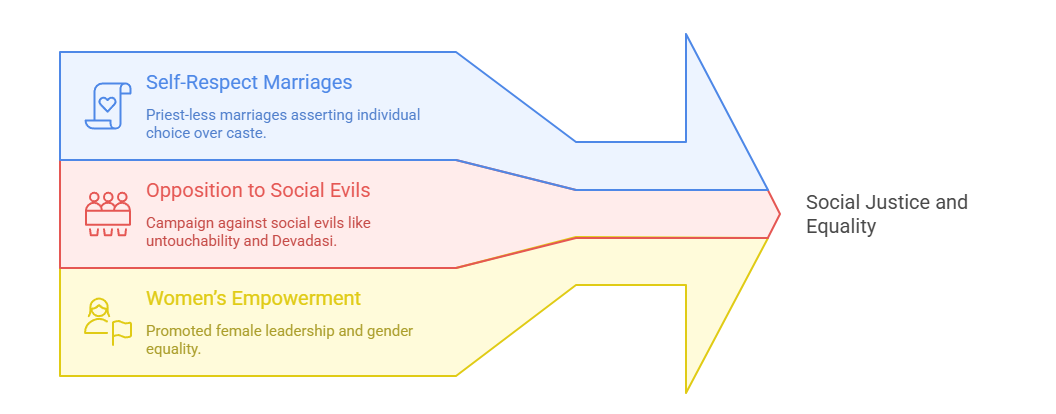
These were priest-less, non-ritualistic ceremonies that rejected Brahminical authority in matrimonial affairs. Legalized later, they remain a powerful assertion of individual choice over caste diktats.
The movement actively campaigned against:
Unique among its contemporaries, the movement promoted female leadership and gender equality. Figures like Annai Meenambal played a leading role, and were recognized by both Periyar and Ambedkar. “My sister Meena” – Ambedkar’s recognition of Meenambal signifies the interconnectedness of anti-caste and feminist struggles. Periyar’s Legacy: More Than a Social ReformerPeriyar’s contribution went beyond social reform. He built a cultural counter-narrative to Brahminical history, often invoking Dravidian pride and Tamil identity. In 1944, he founded the Dravidar Kazhagam, which rejected electoral politics but profoundly influenced the Justice Party and later, Dravidian political movements such as DMK and AIADMK. His iconoclastic attacks on Hindu scriptures, idol worship, and caste-based gods were aimed at breaking the psychological chains of caste oppression. Comparative Perspectives: Periyar, Phule, Ambedkar
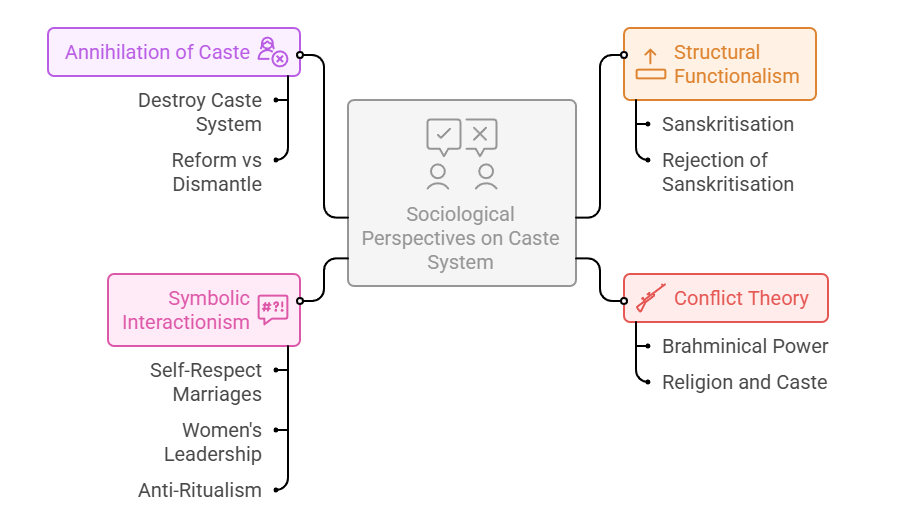
Their strategies differed, but their objectives overlapped—dismantling caste, uplifting the oppressed, and reimagining Indian society on egalitarian terms. Sociological Significance: Theoretical Frameworks
While Srinivas spoke of ‘Sanskritisation’ as a form of upward mobility within the caste system, the Self-Respect Movement rejected sanskritisation and sought a complete overhaul of caste hierarchy.
Periyar’s critique of Brahminical power can be seen through a Marxian lens—where religion and caste act as tools of domination by the ruling class (in this case, Brahmins).
Self-Respect marriages, women’s leadership, and anti-ritualism were symbolic rejections of hegemonic values, creating a new set of cultural practices and norms that challenged traditional meanings associated with caste and purity.
Periyar’s efforts paralleled Ambedkar’s call to “destroy the caste system root and branch.” Both believed that caste was not a social system that could be reformed, but a system that had to be dismantled. Legacy and Contemporary Relevance
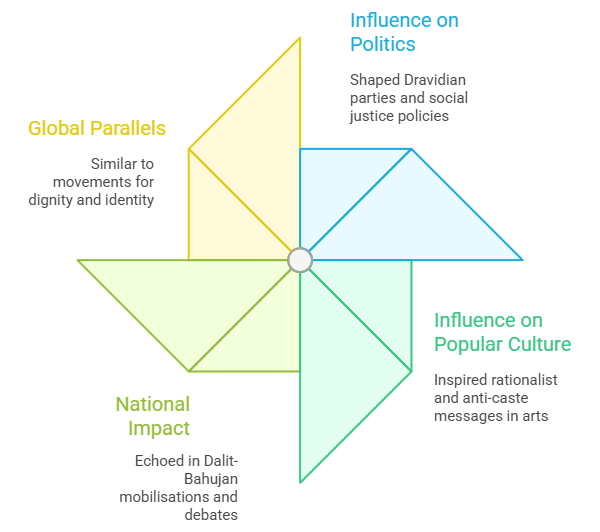
Influence on Politics:
Influence on Popular Culture:
National Impact:
Global Parallels:
Caste Today: 100 Years LaterDespite legal protections and affirmative policies, caste continues to permeate education, marriage, employment, housing, and politics. The demand for caste census, resistance to reservation, and rising incidents of caste-based violence indicate that structural inequalities persist. The centenary is a reminder that legal equality is not sufficient; cultural and psychological decolonisation is equally necessary. The Self-Respect Movement was a powerful attempt at this decolonisation. ConclusionThe Self-Respect Movement was not just a regional or cultural revolution—it was a profound assertion of human dignity, social equality, and individual freedom in a deeply hierarchical society. As India reflects on 100 years of this movement, its core message remains as relevant as ever: freedom is incomplete without dignity, and equality is hollow without self-respect. In a country where caste continues to shape everyday life, the centenary of the Self-Respect Movement should not just be commemorated—it should be revived in spirit, adapted to contemporary contexts, and institutionalised into education, policy, and public consciousness. |
To Read more topics, visit: www.triumphias.com/blogs
2 comments