Introduction
When Indians migrate abroad, many believe they are leaving behind rigid social hierarchies and embracing progressive ideals. Yet caste, one of the oldest forms of stratification in Indian society, continues to thrive even outside India. Surprisingly, it often resurfaces in subtle but powerful ways—most notably through surnames. Asking someone’s last name may appear harmless, but in many cases, it is a veiled way of establishing caste identity.
This blog explores how caste travels with the Indian diaspora, why it thrives through surnames.
Caste beyond Borders
Caste was historically tied to rituals, occupations, and endogamy in India. One might assume that in countries where caste has no official recognition, it would lose relevance. However, caste practices are sustained in diasporic settings through:
- Surname inquiries that reveal caste location.
- Matrimonial platforms that filter partners by caste.
- Cultural rituals such as thread ceremonies or community festivals.
- Diaspora associations organized along caste lines.
Thus, caste becomes a part of what sociologists call a “diasporic habitus”—a set of dispositions, norms, and practices that migrants carry with them, consciously or unconsciously, across borders.
The Role of Habitus in Sustaining Caste
Pierre Bourdieu’s concept of habitus explains how caste remains entrenched even outside India. Habitus refers to the socialized norms and practices that guide behavior. Caste habitus manifests when individuals instinctively ask surnames, prefer same-caste marriages, or take pride in upper-caste ancestry.
- For upper castes, this habitus reinforces status, power, and symbolic capital.
- For Dalits and marginalized castes, it often reproduces discrimination, humiliation, and fear of exposure.
In this way, caste is not simply a relic of Indian soil but a transnational identity marker.
Caste and the Diaspora: Case Studies
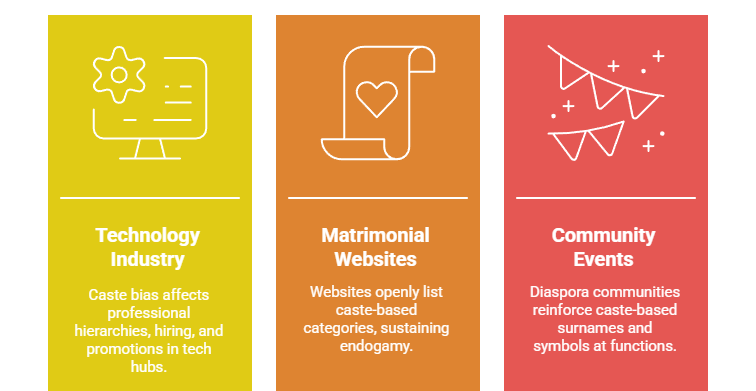
- Technology Industry in the West: Reports of caste-based discrimination in tech hubs abroad reveal how caste bias can affect professional hierarchies, hiring, and promotions.
- Matrimonial Websites: Sites like Shaadi.com openly list caste-based categories for prospective matches, sustaining endogamy.
- Community Events Abroad: Diaspora communities often organize functions where caste-based surnames and symbols are reinforced.
These practices highlight how caste persists, even in societies that claim to be post-caste.
Surnames as Markers of Caste
Surnames are not just names; they are carriers of history, hierarchy, and power. In India, many surnames historically indicated caste location—whether someone was a Brahmin, Kshatriya, Vaishya, or Shudra. Dalits, meanwhile, were often denied dignified surnames or forced into degrading ones.
Even in modern settings:
- Upper-caste surnames evoke pride and status.
- Lower-caste surnames carry stigma, leading many to adopt neutral or assertive alternatives.
- Diaspora youth are often socialized into retaining caste pride under the guise of “cultural identity.”
Thus, surnames become a subtle yet powerful mechanism of caste reproduction abroad.
Historical Roots of Caste and Surnames
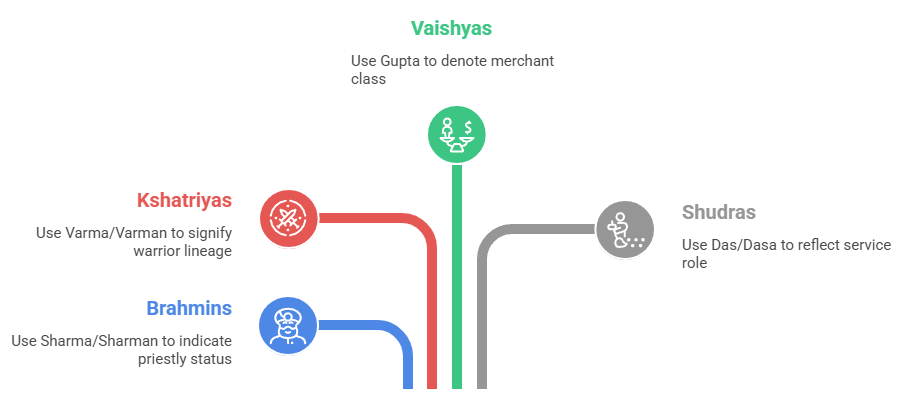
Caste-linked surnames have ancient origins:
- Vedic and post-Vedic texts prescribed caste-based naming conventions.
- Brahmins often ended names with Sharma/Sharman.
- Kshatriyas used Varma/Varman.
- Vaishyas used Gupta.
- Shudras were relegated to Das/Dasa.
Later, colonial rule solidified this practice by categorizing Indians by caste and community in official records. This legacy continues in the diaspora, where surnames remain powerful indicators of identity.
Caste, Identity Politics, and Assertion
While caste surnames reproduce hierarchy, they have also been tools of resistance and assertion:
- Dalits adopting surnames like Jatav, Yadav, or Bhagat to reject humiliating ones.
- Sikhism historically attempted to abolish caste distinctions by giving all men the surname Singh and women Kaur.
- Anti-caste activists have dropped surnames altogether to embrace an egalitarian identity.
This reflects the dialectic of caste and counter-caste politics—while surnames can reproduce discrimination, they can also challenge it.
Sociological Implications
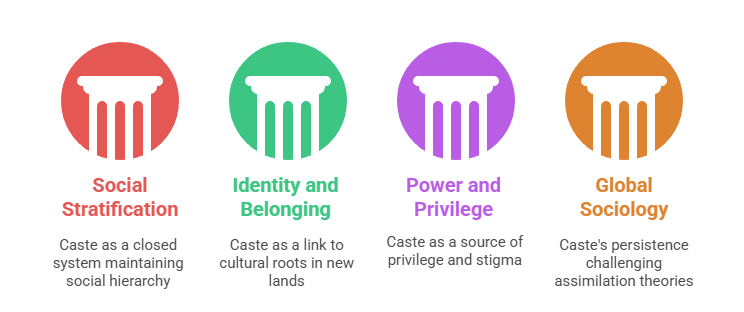
From a sociological perspective, caste in the diaspora raises several issues:
- Social Stratification: Caste continues to act as a form of closed social stratification, even in multicultural societies.
- Identity and Belonging: Caste becomes a way of negotiating diasporic identity, linking migrants to their “roots.”
- Power and Privilege: For upper castes, caste becomes symbolic capital that reinforces privilege, while marginalized groups carry the burden of stigma.
- Global Sociology: The persistence of caste abroad challenges the idea that migration leads to assimilation. Instead, it shows how inequalities are globalized.
Towards a Caste-Free Diaspora:
To move toward equality, diasporic Indians need to critically interrogate the privileges attached to surnames and caste markers. Some measures include:
- Awareness campaigns on caste discrimination abroad.
- Diaspora laws and policies that explicitly recognize caste as a category of discrimination.
- Encouraging intercaste marriages and non-caste-based identities.
- Dropping surnames or choosing egalitarian alternatives.
Ultimately, dismantling caste in the diaspora requires not just individual awareness but also collective action, laws, and cultural reform.
Conclusion
Casteism among Indians abroad, sustained through surnames, highlights how deep-rooted hierarchies travel across borders. While many in the diaspora pride themselves on being modern and progressive, caste habitus often surfaces in everyday practices, conversations, and community life.
If sociology teaches us one thing, it is that structures of inequality persist unless consciously dismantled. Caste may be thousands of years old, but it continues to thrive in new forms. The challenge before us is not just to critique it but to reimagine a future where identity is not shackled by hierarchy.
PYQs
Paper 1
- Discuss the persistence of caste in modern society. (2014)
- Examine the relevance of caste in contemporary Indian society. (2015)
- How far is caste system changing in the age of globalization? (2016)
- What do you understand by Pierre Bourdieu’s concept of habitus? Illustrate with reference to caste. (2017)
- Explain the intersection of caste, class, and gender in stratification systems. (2018)
- Discuss the concept of status groups in Weber’s theory. How does it apply to caste in India? (2019)
- Critically examine whether caste should be understood as a system of hierarchy or a system of differentiation. (2020)
- Explain the concept of social closure with reference to caste endogamy. (2021)
- How does identity politics reshape caste in contemporary times? (2022)
- Discuss the impact of globalization on traditional social institutions like caste. (2023)
- Examine the relevance of surnames as a sociological category in understanding caste identity. (2024)
Paper 2
- Examine the persistence of caste consciousness among Indians settled abroad. (2014)
- “Despite modernization, caste continues to influence Indian diaspora communities.” Discuss. (2015)
- Comment on the role of endogamy in sustaining caste identity in India and abroad. (2016)
- Critically analyze the impact of migration on caste dynamics. (2017)
- Do you agree that diaspora Indians carry caste with them as cultural capital? Substantiate. (2018)
- Discuss the relevance of caste in matrimonial practices both in India and among diaspora communities. (2019)
- Examine the implications of caste discrimination in workplaces abroad for global Indian communities. (2020)
- “Caste is not just an Indian phenomenon, but a transnational reality.” Discuss with suitable examples. (2021)
- Assess the role of digital platforms in reproducing caste identities in India and among the diaspora. (2022)
- Discuss how diaspora associations and community events sustain caste habitus. (2023)
- Critically examine the role of caste surnames in shaping identity politics among the Indian diaspora. (2024)
- Which measures would you suggest for preventing caste conflicts in India? Justify your argument. (2025)
|

2 comments