
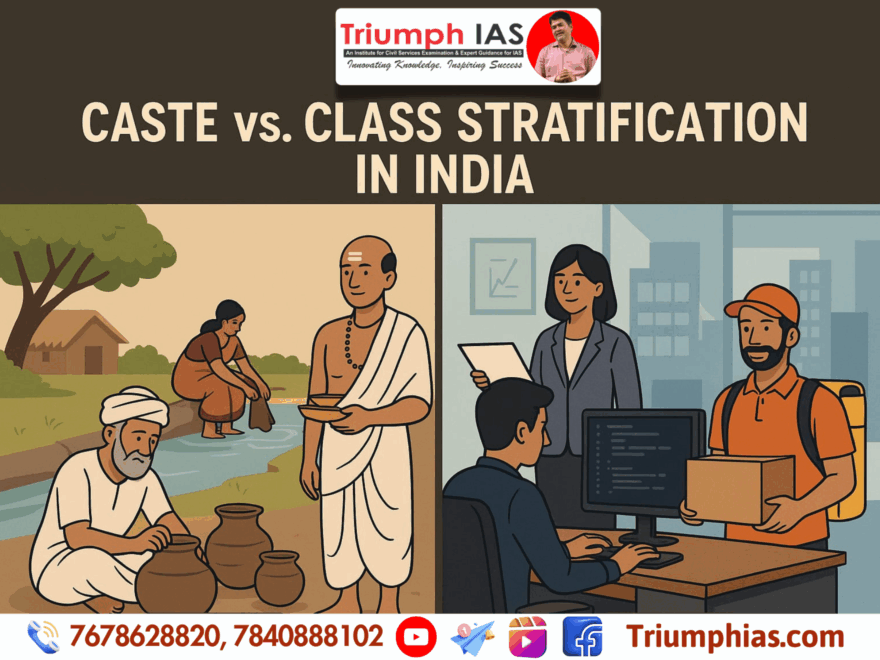
Caste vs. Class Stratification in India
(Relevant for Sociology Paper I: Stratification and Mobility and Sociology Paper II: Caste System; Social Problems)
IntroductionSocial inequality is an enduring feature of Indian society. Among the various axes of stratification, caste and class remain two of the most debated categories in both sociology and public discourse. Though distinct in origin and structure, caste and class often intersect and reinforce each other in complex ways. Understanding their dynamics is critical for UPSC aspirants and also for anyone seeking clarity on the nature of inequality in contemporary India. Caste Stratification: A Tradition-Bound HierarchyCaste, a form of closed stratification, is unique to South Asia and particularly rigid in India. It divides people into hierarchical social groups, traditionally linked with occupation and purity.
Class Stratification: Economic Divides in a Modern ContextUnlike caste, class is a modern, open form of stratification that arises from economic relations rather than birth.
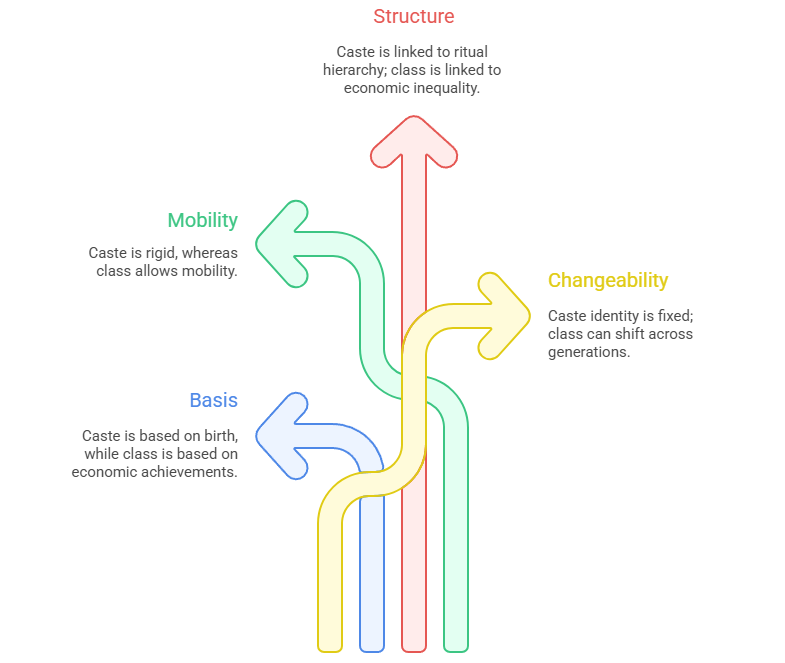
Key Differences between Caste and Class
Though both lead to social inequality, caste and class differ in several respects:
These distinctions become blurred in India’s context where caste identity often determines one’s class position. The Caste-Class Nexus in IndiaIn India, caste and class are deeply intertwined. The caste system has historically determined access to economic opportunities, leading to a caste-based class structure.
This convergence of economic and social exclusion makes India’s inequality more complex than in purely class-based societies. Sociological Analysis
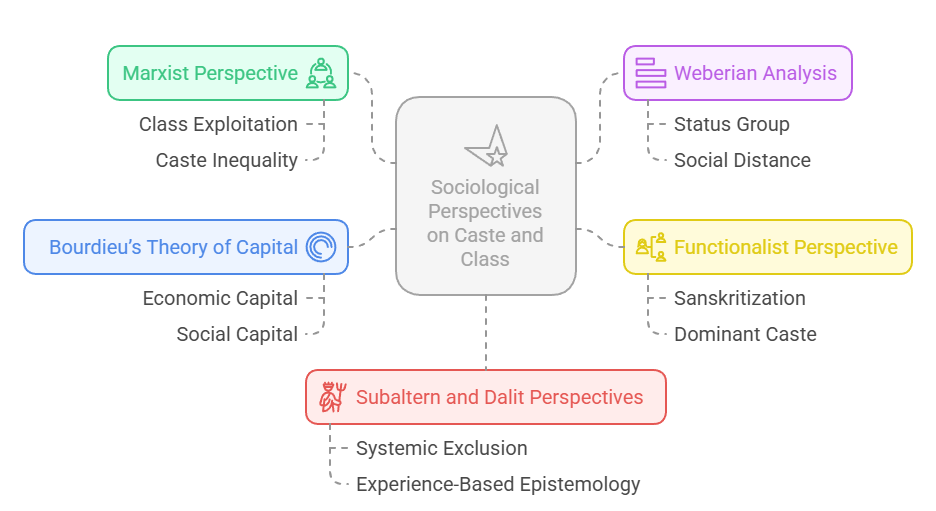
Marxist theorists argue that class relations of production shape all forms of social inequality. A.R. Desai, a prominent Indian Marxist sociologist, emphasized that caste inequality is embedded in class exploitation. He argued that capitalist development in India has led to new class formations among castes but did not eliminate caste oppression. In rural India, land-owning dominant castes continue to exploit Dalit laborers—a continuation of both class and caste hierarchies. Desai saw the caste system as functional to capitalist interests.
Weber’s multidimensional view of stratification—class, status, and party—is crucial for understanding caste. He saw caste as a status group, closed by nature, where honor and lifestyle create social distance. Andre Béteille extended Weberian analysis to the Indian context. In Caste, Class and Power, Béteille demonstrated how Tanjore society in Tamil Nadu shows overlapping yet distinct class and caste dynamics. He argued that while economic changes create class mobility, caste identities and discrimination often persist, especially in cultural and political domains.
Functionalist thinkers like Davis and Moore believed in role differentiation as necessary for the functioning of society. M.N. Srinivas provided a nuanced view through his concepts of:
Srinivas’s work challenges the purely rigid view of caste, showing mobility within the caste system in specific socio-economic contexts.
Pierre Bourdieu’s ideas on economic, social, and cultural capital are relevant to caste-class relations. In the Indian context, caste can be seen as a form of inherited social capital. Indian scholars like Surinder S. Jodhka have applied Bourdieu’s framework to show how caste continues to shape access to resources, networks, and markets, even among educated or urban individuals. His work also highlights how caste reproduces inequality through informal practices and elite networks in modern institutions.
Dalit sociologists like Gopal Guru and Anand Teltumbde critique mainstream sociological frameworks for marginalizing Dalit voices. They assert that caste is not just a form of social stratification but also historical humiliation and systemic exclusion. Teltumbde links caste discrimination to capitalist accumulation, arguing that modern neoliberal India still exploits Dalit labor in informal sectors. Gopal Guru emphasizes experience-based epistemology, arguing that lived experiences of Dalits must be central to any analysis of caste-class dynamics. Contemporary Trends:
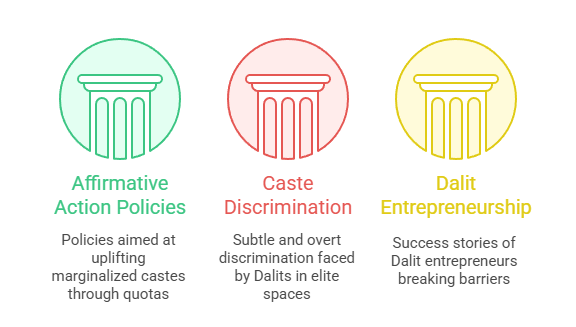
Real-life Examples
Way Forward:
ConclusionThe caste-class distinction is central to understanding social inequality in India. While caste represents historical and ritualistic exclusion, class reflects economic disparity. In practice, they overlap—creating a double disadvantage for many. Any attempt at reform must address both caste injustice and class poverty to ensure inclusive development. Previous Year QuestionsPaper I:
Paper II:
|

To Read more topics, visit: www.triumphias.com/blogs
2 comments