Introduction: The New Battleground of Caste
In the 21st century, technology is reshaping India’s age-old social structures, and caste is no exception. While the caste system in India has been a persistent theme in Sociology Paper 2, the emergence of digital platforms like Twitter, Instagram, and YouTube has created a dual effect—both reinforcing and challenging caste hierarchies. The digital sphere has evolved into a powerful site for caste assertion, resistance, and political mobilization.
Hashtags as New-Age Symbols of Resistance
Movements like #DalitLivesMatter, #JusticeForRohith, and #SmashBrahmanicalPatriarchy have gone viral, symbolizing the new tools of digital caste activism. These hashtags do not merely trend—they mobilize, provoke debates, and hold power structures accountable.
This aligns with M.N. Srinivas’s concept of dominant caste—today, dominance is contested not just through land and politics, but through virtual visibility and narrative control.
Caste in Digital Spaces: Double-Edged Sword
Digital platforms democratize expression, but they also reproduce caste-based abuse and exclusion. Online trolling of Dalit voices is a stark reminder of caste prejudice migrating to virtual domains. This reflects Louis Dumont’s notion of hierarchy, where purity and pollution are now articulated through likes, shares, and algorithmic visibility.
Furthermore, cyberbullying, caste slurs in comment sections, and the digital divide create a neo-digital untouchability—a term now explored by digital sociologists.
From Identity Assertion to Political Mobilization
Caste-based digital mobilization has transformed identity politics into cyber movements. Youth-led Dalit YouTubers, bloggers, and influencers are now challenging Savarna narratives and rewriting cultural capital in their own voice—echoing Bourdieu’s theory of symbolic power.
In political terms, digital campaigns have influenced electoral outcomes, especially in caste-sensitive states like Uttar Pradesh and Bihar. These campaigns act as virtual pressure groups, amplifying subaltern voices and influencing mainstream party agendas.
The Sociological Lens: Bridging Digital Sociology and Indian Society
- Manuel Castells’ concept of the “Network Society” is particularly relevant here. In a world where communication flows determine power, Dalit and Bahujan communities have begun to form their own digital networks, creating alternative narratives and resisting dominant caste discourse. These networks have enabled the growth of issue-based solidarities across geographies, especially among marginalized youth, who are now asserting their identity through digital means.
- Pierre Bourdieu’s theory of cultural capital further enriches our understanding. In the digital realm, fluency in English, access to digital tools and tech-literacy become new forms of cultural capital. Historically disadvantaged groups are challenging the symbolic dominance of upper castes by producing content in regional languages, amplifying local stories, and reshaping digital discourse. This symbolic reversal aligns with Bourdieu’s idea of contesting the structures that define social power.
- McKim Marriott’s framework of the “Great Tradition” and “Little Tradition” can also be applied to analyze this digital shift. While the Great Tradition represents mainstream, often upper-caste narratives, the Little Tradition encompasses the lived realities of marginalized groups. Through YouTube channels, reels, podcasts, and folk art shared on Instagram, Dalit youth are asserting their voices—bringing local customs, rituals, and struggles into the digital mainstream, which had long been dominated by elite representation.
- Erving Goffman’s concept of the “presentation of self” helps explain how individuals now negotiate their caste identities online. Social media has become a stage where people either conceal or assert their caste identity, depending on context. For many, it becomes a space of deliberate resistance—using bios, hashtags like #ProudDalit, or digital art to challenge imposed labels and reconstruct their identities with pride.
- Antonio Gramsci’s theory of hegemony also offers valuable insight. In the Indian context, upper-caste narratives have long shaped public discourse through educational institutions, media, and cultural production. However, social media platforms now enable counter-hegemonic narratives to thrive. Dalit content creators, artists, and scholars are creating spaces of resistance by questioning historical injustices and reclaiming their histories through digital storytelling.
Digital Mobilization and Political Consequences
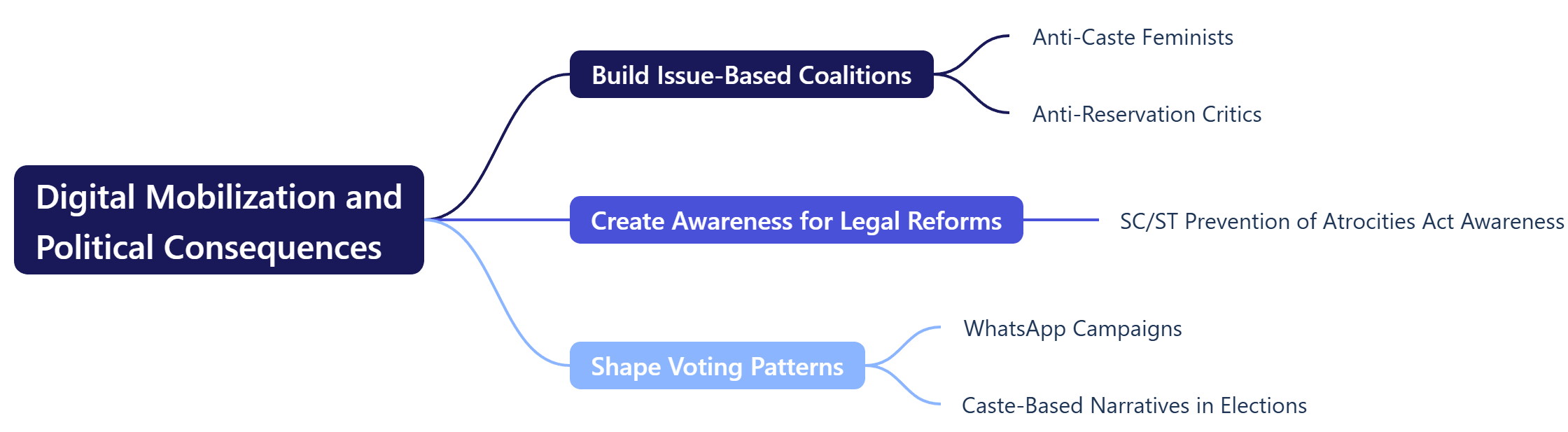
Caste today is not just a social category—it is a political force, and social media has amplified that. The digital world helps:
- Build issue-based coalitions (e.g., anti-caste feminists, anti-reservation critics)
- Create awareness for legal reforms (e.g., SC/ST Prevention of Atrocities Act awareness)
- Shape voting patterns through WhatsApp campaigns and caste-based narratives in elections
Conclusion: A Digital Revolution in the Caste Debate
As India moves toward a digital-first future, caste has neither disappeared nor diminished—it has simply migrated and morphed. The internet is both a battleground and a platform, enabling new voices while amplifying old prejudices. India’s policymakers should recognize this intersection of caste, technology, and politics is vital for building inclusive digital policies.
PYQs
Paper 1
- Examine how caste influences social mobility in contemporary India. (2014)
- Discuss the changing nature of caste in India with reference to Louis Dumont and Andre Béteille. (2015)
- Explain the role of media in the process of social change. (2016)
- Discuss the relevance of Marx’s class theory in the context of contemporary Indian society. (2017)
- Examine the role of digital media in shaping identities and social relationships in the network society. (2020)
- Explain how marginality and resistance are linked in social movements. (2021)
- Do you agree that social media has created a new form of cultural hegemony? Discuss with examples. (2023)
Paper 2
- Discuss the changing nature of caste system in India in the context of growing Dalit assertion. (2013)
- Examine the role of caste associations in the process of social and political mobilization in India. (2014)
- How have social movements changed in India in the era of liberalization and globalization? (2015)
- Discuss the emergence of Dalit literature and its role in challenging caste hierarchy in Indian society. (2016)
- How far has the internet democratized caste discourse in India? Illustrate with examples. (2017)
- Examine how media and information technology are influencing identity formation among Indian youth. (2018)
- Discuss how caste has become an instrument of political bargaining in modern India. (2019)
- Critically examine the use of social media by caste-based movements in contemporary India. (2020)
- Discuss the role of digital platforms in strengthening subaltern voices in India. (2021)
- In what ways is the digital divide reinforcing caste inequalities in India? (2022)
- Evaluate the use of new media for Dalit empowerment in India. (2023)
|


