Introduction
In a historic shift, the Union Government has approved the inclusion of caste enumeration in the upcoming Population Census, reversing its 2011 and 2021 stand. This decision comes amid increasing demands from political parties and social justice groups, and it promises to impact India’s affirmative action policies, reservation quotas, and political representation mechanisms.
This blog decodes the implications of a Caste Census in India, linking it with Sociology syllabus.
What is a Caste Census?
A Caste Census involves the enumeration of different caste groups during the decennial population census. The last such exercise was partially conducted in 1931 and more recently attempted in 2011 through the Socio-Economic and Caste Census (SECC), which faced issues regarding data reliability and was not officially published in full. The recent approval by the Cabinet Committee on Political Affairs (CCPA) marks a crucial policy shift, enabling an empirical basis for social justice policies.
Sociological Analysis
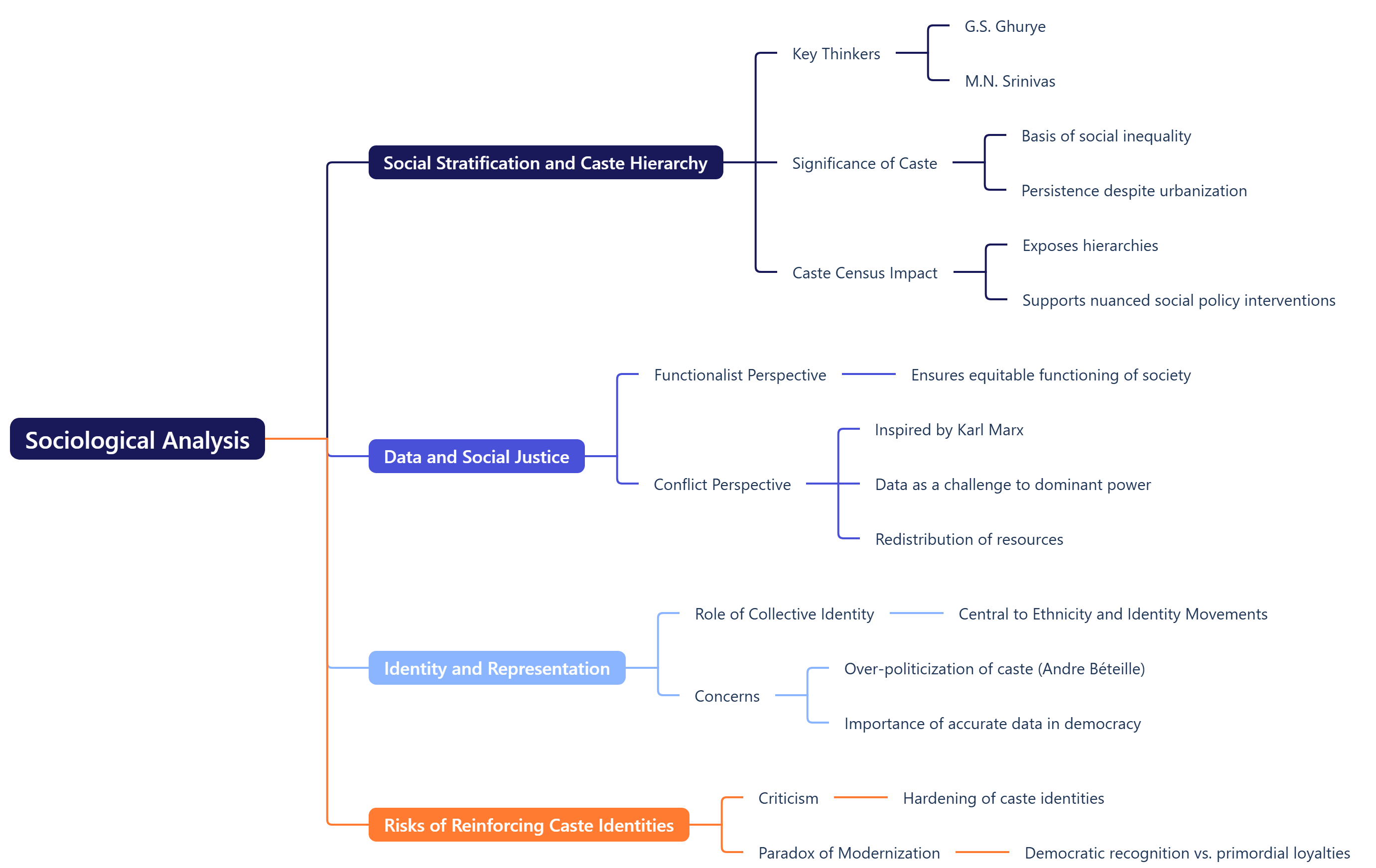
- Social Stratification and Caste Hierarchy: According to G.S. Ghurye and M.N. Srinivas, caste remains a significant basis of social inequality, despite urbanization and modernization. A caste census exposes how these hierarchies persist; enabling more nuanced social policy interventions.
- Data and Social Justice: From a Functionalist Perspective, data collection ensures that all parts of society function equitably. On the other hand, a Conflict Perspective (inspired by Karl Marx) argues that data can challenge power held by dominant castes and redistribute resources more justly.
- Identity and Representation: The caste census recognizes the role of collective identity, which is central to Ethnicity and Identity Movements in India. Sociologist Andre Béteille has warned of over-politicization of caste, but even he acknowledges the importance of accurate data in a democracy.
- Risks of Reinforcing Caste Identities: Critics argue this could harden caste identities rather than dissolve them. This reflects the Paradox of Modernization, where democratic recognition of identities can also reinforce primordial loyalties.
Why the Demand for a Caste Census?
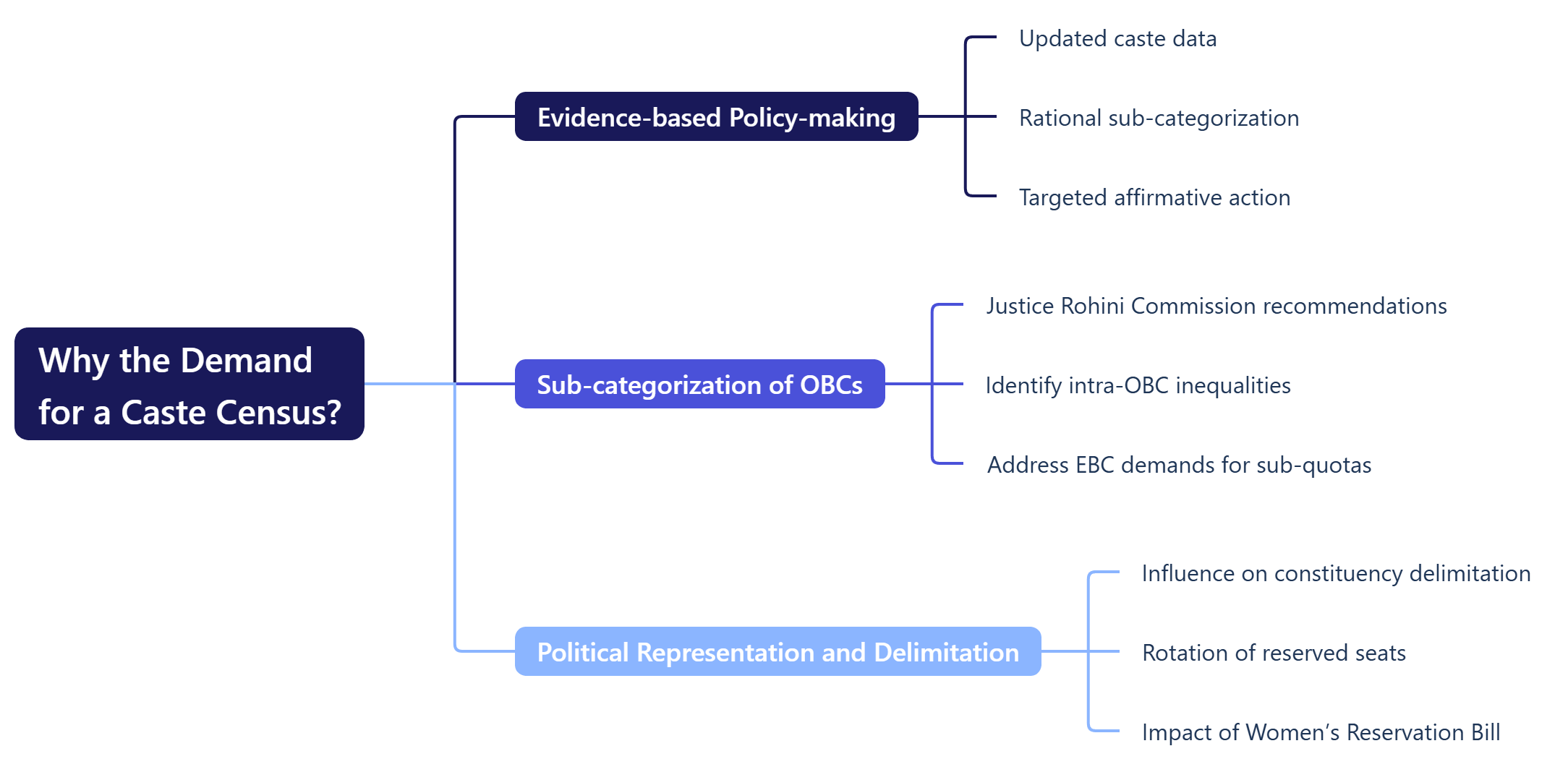
- Evidence-based Policy-making: Without updated caste data, reservation policies and welfare schemes often rely on outdated assumptions. Updated data allows rational sub-categorization and targeted affirmative action.
- Sub-categorization of OBCs: As recommended by the Justice Rohini Commission, a caste census helps in identifying intra-OBC inequalities. This will address demands by marginalized Extremely Backward Classes (EBCs) for sub-quotas within the OBC reservation.
- Political Representation and Delimitation: Data will likely influence constituency delimitation and may lead to rotation of reserved seats, especially under the recently passed Women’s Reservation Bill, which mandates reservation based on Census data.
Conclusion
The approval of the caste census is not merely an administrative decision but a sociopolitical milestone. It brings data-based governance to the center of India’s social justice framework. While it may provoke identity politics, it also opens the door for more inclusive and rational policies. For aspirants, this development offers rich analytical ground for both static and dynamic portions of the sociology syllabus.
PYQs
Paper 1
- Discuss the changing nature of caste and class in India. (2013)
- Explain how caste as a social institution has changed over time in India. (2015)
- How far do you agree that caste is still a dominant factor in Indian politics? (2016)
- Discuss the impact of social movements on the transformation of caste in India. (2017)
- Is caste system changing, weakening or disintegrating in India? Analyze with suitable examples. (2019)
- Examine the idea of caste as a form of social stratification. (2020)
- To what extent is caste a basis for political mobilization in contemporary India? (2021)
- Explain Louis Dumont’s concept of purity and pollution in the context of Indian caste system. (2022)
- Examine the changing trends in caste stratification with reference to affirmative action policies. (2023)
Paper 2
- Write a note on Mandal Commission and its impact on Indian society. (2014)
- Discuss the role of caste in contemporary Indian politics. (2015)
- What are the main features of Backward Class Movements in India? (2016)
- Critically examine the demand for sub-categorization of OBCs in the context of social justice. (2017)
- Examine the impact of caste-based reservation on social mobility and equality. (2018)
- Analyze the relationship between caste and class in contemporary India. (2019)
- Discuss the implications of caste data in census for formulation of social policies. (2020)
- How do identity-based politics shape social justice movements in India? (2021)
- Critically assess the role of caste census in empowering marginalized communities. (2022)
- Do you think the present reservation policy adequately addresses historical injustices? Justify. (2023)
|


One comment