Introduction
The recent controversy in Rajasthan IAS cadre allocation has sparked debates on caste bias in bureaucracy, meritocracy vs social justice, and the persistence of institutional discrimination. Reports allege that 14 eligible SC/ST/OBC officers were sidelined, and all four vacancies were filled by candidates from the General category. This raises critical questions about the credibility of the selection process, the structural inequalities in Indian society, and the role of the state in ensuring social justice.
Understanding the Controversy
According to reports, during the IAS cadre allocation in Rajasthan (2025), the Departmental Promotion Committee (DPC) allegedly overlooked eligible SC/ST/OBC candidates despite their seniority and performance. Instead, all appointments were made from the General category, reviving concerns that “merit” is being used as a cover for caste privilege.
This reflects a larger debate in Indian society:
- Is bureaucracy truly neutral and based on merit?
- Or does it reproduce existing caste hierarchies under the guise of meritocracy?
Historical Context
Colonial Bureaucracy
- During British rule, bureaucracy was dominated by upper castes, especially Brahmins and Baniyas in provinces like Madras, Bombay, and Bengal.
- The colonial state institutionalized an elitist bureaucracy, where caste privilege became intertwined with access to English education and government jobs.
Post-Independence Reforms
- The Indian Constitution aimed to democratize bureaucracy through reservation policies (Articles 15, 16, 335).
- Mandal Commission (1980s) highlighted the underrepresentation of OBCs and recommended 27% reservations in public employment.
- Despite legal safeguards, upper castes have often retained dominance in administrative structures.
Sociological Analysis
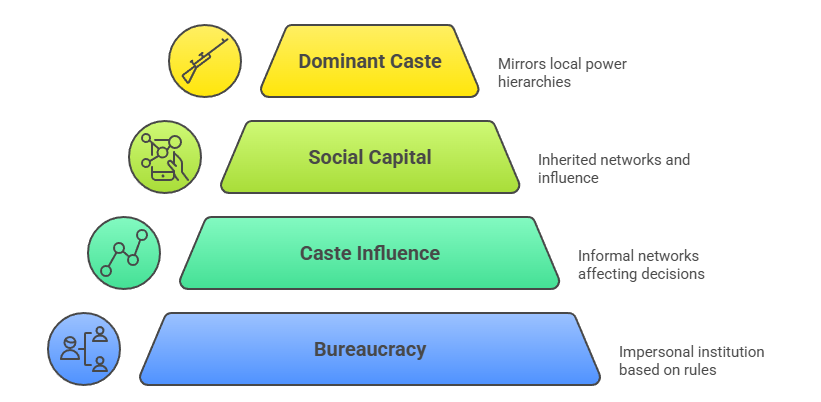
- Max Weber described bureaucracy as an impersonal and rational institution based on rules, not personal bias. However, in India, bureaucracy intersects with caste, making it far from neutral. The Rajasthan case shows how informal caste networks influence supposedly rational decisions.
- Pierre Bourdieu’s theory helps us understand how upper-caste candidates benefit from inherited social capital (networks, influence) and cultural capital (elite education, communication skills). Even when rules are neutral, these hidden advantages shape outcomes.
- A.R. Desai argued that the Indian state, despite constitutional commitments, largely serves the interests of dominant castes and classes. The sidelining of SC/ST/OBC officers reflects how state apparatuses reproduce social inequality.
- M.N. Srinivas’ concept of the dominant caste explains how bureaucracy often mirrors local power hierarchies. In Rajasthan, upper-caste dominance in politics and administration is reproduced in cadre allocation.
Merit vs Social Justice:
The Argument for Merit
- Proponents of the current system argue that seniority alone cannot be the basis for promotion, and performance should matter.
- They claim that reservations have already provided entry into the service, and promotions should be “merit-based”.
The Argument for Social Justice
- Critics argue that “merit” is socially constructed, often privileging those with caste-based advantages.
- Performance metrics themselves may be biased, undervaluing the contributions of SC/ST/OBC officers.
- Ambedkar warned that without real representation, democracy becomes a tyranny of the majority.
Thus, the Rajasthan case is not merely about four officers but about the structural exclusion of backward groups from positions of power.
Broader Sociological Implications
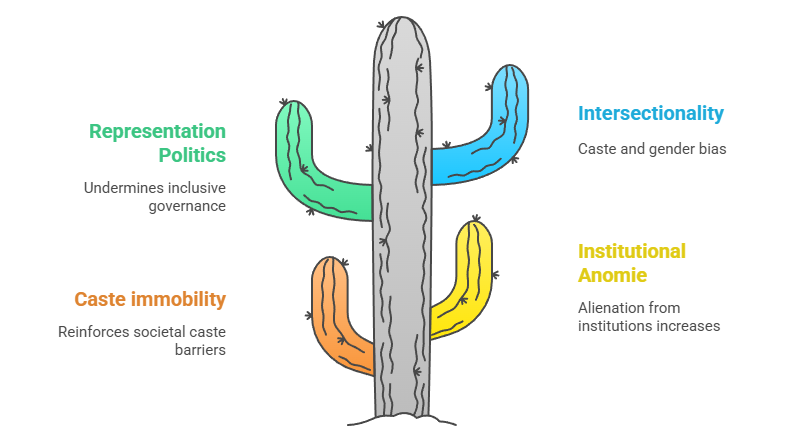
- Caste and Social Mobility: The IAS is often seen as a vehicle of upward mobility for marginalized groups. Denial of promotions undermines this mobility, reinforcing caste barriers.
- Anomie and Frustration (Durkheim): Repeated sidelining of SC/ST/OBC officers creates anomie (normlessness), leading to alienation from institutions. This weakens faith in bureaucracy as a fair system.
- Politics of Representation: Bureaucracy is not just about governance; it also reflects the symbolic representation of democracy. Excluding marginalized groups undermines inclusive governance and deepens trust deficit between state and citizens.
- Intersectionality (Caste, Class, and Gender): Dalit and OBC officers often face multiple discriminations, especially women officers. They encounter both caste bias and gender bias, making their bureaucratic journey even more challenging.
Case Studies
- Dalit IAS Officers’ Experiences: Studies show that Dalit officers often face “glass ceilings” where they can enter but not rise beyond a certain level.
- Supreme Court Judgments: The court has upheld reservations in promotions for SC/STs (M. Nagaraj vs Union of India, 2006) but with conditions. Implementation has remained weak, leading to continued underrepresentation.
- Mandal Politics and Bureaucracy: Despite Mandal reforms, data shows that upper castes are still disproportionately represented in top bureaucratic posts.
Way Forward
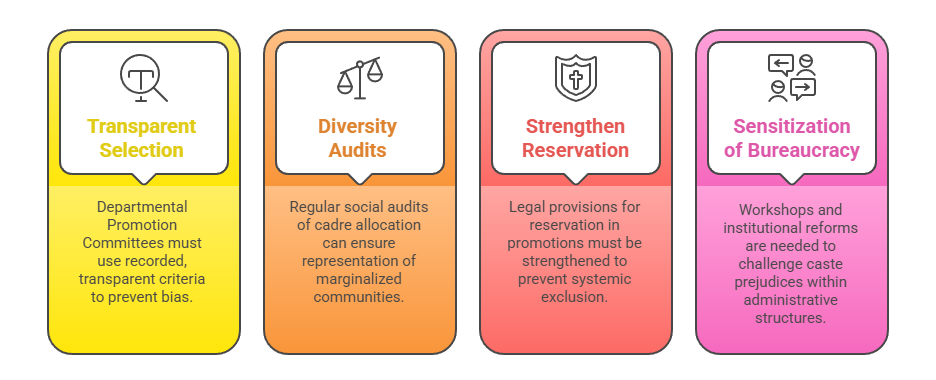
- Transparent Selection Processes: All Departmental Promotion Committees must function with recorded, transparent criteria to prevent bias.
- Diversity Audits in Bureaucracy: Regular social audits of cadre allocation can ensure representation of marginalized communities.
- Strengthening Reservation in Promotions: Legal provisions for reservation in promotions must be strengthened to prevent systemic exclusion.
- Sensitization of Bureaucracy: Workshops and institutional reforms are needed to challenge caste prejudices within administrative structures.
Conclusion
The Rajasthan IAS cadre controversy is more than an isolated case. It highlights the deep-rooted caste bias in Indian bureaucracy and the clash between meritocracy and social justice. It underscores how sociology is not just theory but a lens to analyze ongoing realities.
Until bureaucracy ensures fair representation, India’s democratic promise of equality will remain unfulfilled. As Ambedkar reminded us, “Political democracy cannot last unless there lies at the base of it social democracy.”
PYQs
Paper 1
- How are hierarchy and exclusion the major impediments in the transformation of societies? Discuss. (2020)
- Critically assess social mobility in closed and open systems. (2020)
- Why is gender a dimension of social stratification? How does gender intersect other dimensions of inequality based on caste, class, race and ethnicity? (2019)
- Modernisation presupposes class society; however caste, ethnicity and race are still predominant. Explain. (2019)
Paper 2
- Which is more significant, the principle of ‘hierarchy’ or the principle of ‘difference’, in inter-caste relations in the present day? (2017)
- Has caste system hindered democracy and adult franchise in India? Discuss. (2018)
- Elaborate various forms of Dalit assertions in contemporary India. What are its implications on the Indian political system? (2018)
- What does Dr. B. R. Ambedkar mean by the concept of ‘Annihilation of Caste’? (2021)
- Is Indian society moving from ‘Hierarchy’ towards ‘Differentiation’? Illustrate with examples. (2021)
- Is social democracy a precondition for political democracy? Comment. (2021)
|

One comment