Introduction
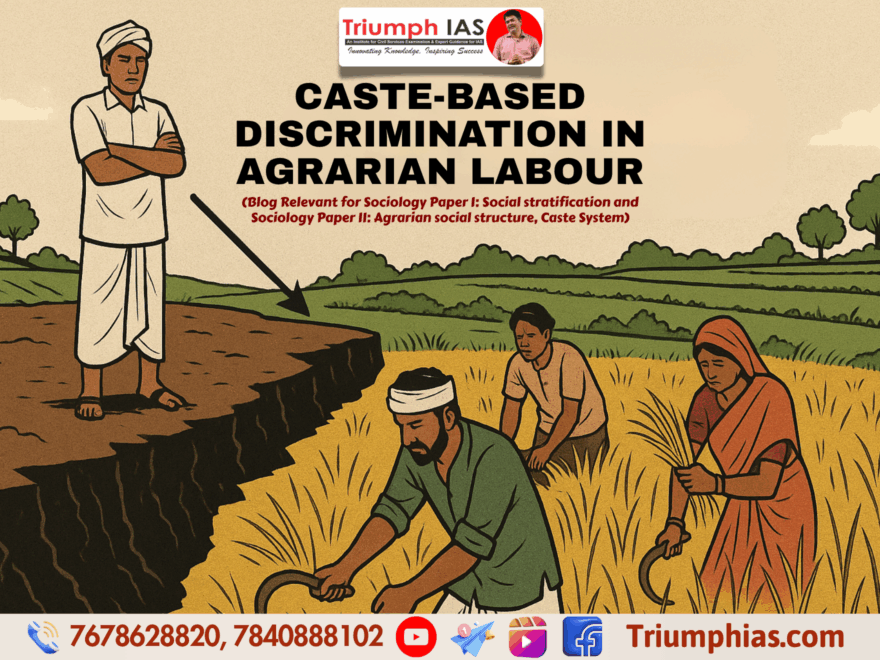
Agriculture remains the backbone of India’s rural economy, yet it is also a space marked by deep-rooted social hierarchies and exclusions. One of the most persistent and structurally entrenched issues in this sector is caste-based discrimination in agrarian labour. Despite constitutional guarantees of equality and multiple land reform initiatives, caste continues to govern access to land, nature of work, and social dignity in rural India.
This blog delves into the sociological dimensions of caste-based discrimination in agrarian labour, using theoretical frameworks and real-life examples.
Historical Roots of Caste and Agrarian Labour
- Historically, the varna system designated occupational roles with Shudras and Dalits relegated to manual and menial jobs, including agriculture and scavenging. Over time, these occupational divisions became rigidified into caste-based labour divisions, especially in rural India where land ownership often overlapped with caste hierarchy.
- The zamindari and jati-based division of labour during colonial times further solidified the socio-economic exclusion of Dalits and backward castes in rural areas. Post-independence land reforms, like the abolition of zamindari, failed to radically alter the landholding pattern, thereby perpetuating caste-based landlessness and dependence on upper-caste landlords.
Contemporary Forms of Caste-based Discrimination in Agrarian Labour
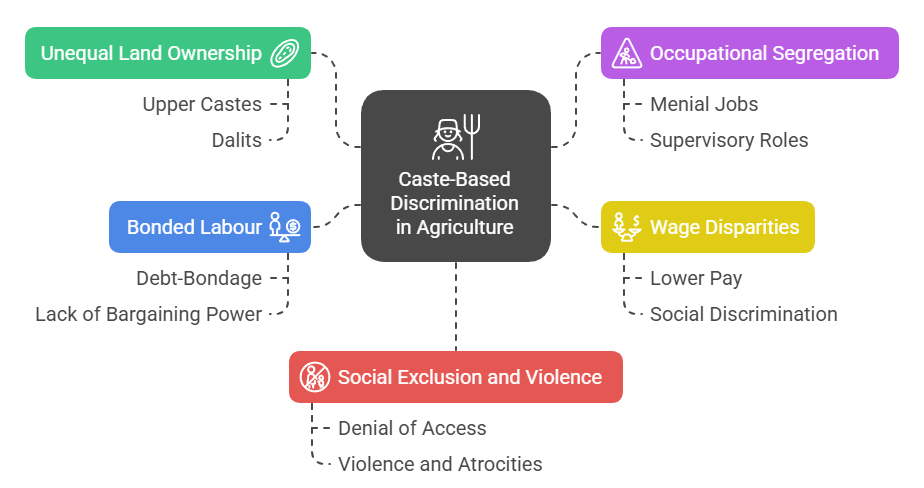
Despite modernization, caste continues to define the agrarian labour market in India:
- Unequal Land Ownership: Upper castes own a disproportionate amount of agricultural land, while Dalits constitute 71% of all landless agricultural labourers (Source: Agricultural Census). The lack of land ownership forces them into wage labour under exploitative conditions.
- Occupational Segregation: Even within agriculture, Dalits are often forced to undertake menial jobs like manual harvesting, pesticide spraying, or cleaning cattle sheds, while upper-caste labourers take supervisory or less strenuous roles.
- Wage Disparities: Studies reveal that Dalit labourers are paid less than their upper-caste counterparts for the same work. This economic disparity reflects broader social discrimination and exclusion from labour rights.
- Bonded and Semi-bonded Labour: In many parts of India, Dalits are trapped in debt-bondage due to historical indebtedness and lack of bargaining power. The practice, though legally abolished, thrives in rural pockets under different names.
- Social Exclusion and Violence: Dalit workers are often denied access to wells, temples, or village common spaces. In many cases, refusal to work under caste-dominated conditions has led to violence and atrocities, including public humiliation and lynching.
Theoretical Perspectives from Sociology
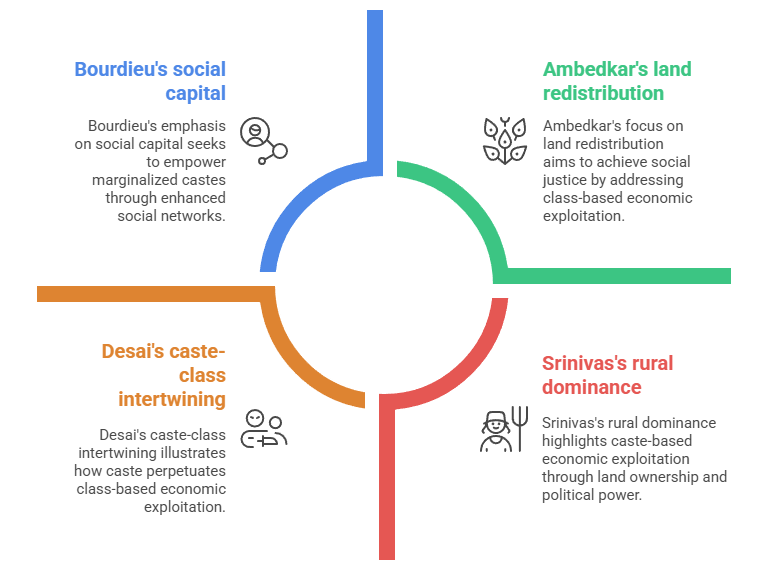
- M.N. Srinivas argued that rural dominance is achieved through a combination of land ownership, political power, and numerical strength. Dominant castes use this triad to subjugate agrarian labourers from marginalized castes, especially Dalits and Adivasis.
- A.R. Desai viewed caste as intertwined with class in India’s agrarian economy. According to him, Dalits form the agrarian proletariat, and caste becomes a tool for perpetuating class exploitation.
- B.R. Ambedkar highlighted how caste, more than class, dictates economic access and labour hierarchy. He emphasized land redistribution and dignity of labour as preconditions for true social justice.
- According to Pierre Bourdieu, Dalits and other backward castes lack access to social capital, which prevents them from forming influential rural networks that could enhance their bargaining power in labour markets.
Regional Case Studies
- Tamil Nadu: Dalit labourers are often forced into agricultural wage work and are denied access to higher-value crop production. Even today, they are subjected to untouchability practices, including separate drinking water pots and denial of temple entry.
- Punjab: In Punjab, 32% of the population are Dalits, but they own only 3.5% of land. The Zameen Prapti Sangharsh Committee (ZPSC) is fighting for Dalit rights over common village lands.
- Bihar and UP: In regions like Bhojpur (Bihar), refusal to accept exploitative agrarian relations has often led to violent reprisals from dominant castes, including attacks, sexual violence, and social boycott.
Government Policies and Their Gaps
While many state and central schemes aim to protect the interests of landless labourers (e.g., MGNREGA, Land Ceiling Acts, SC/ST Atrocities Act), implementation remains weak. Caste-blind policies often fail to address the specific vulnerabilities of Dalit agricultural workers, leading to their continued marginalization.
Way Forward:
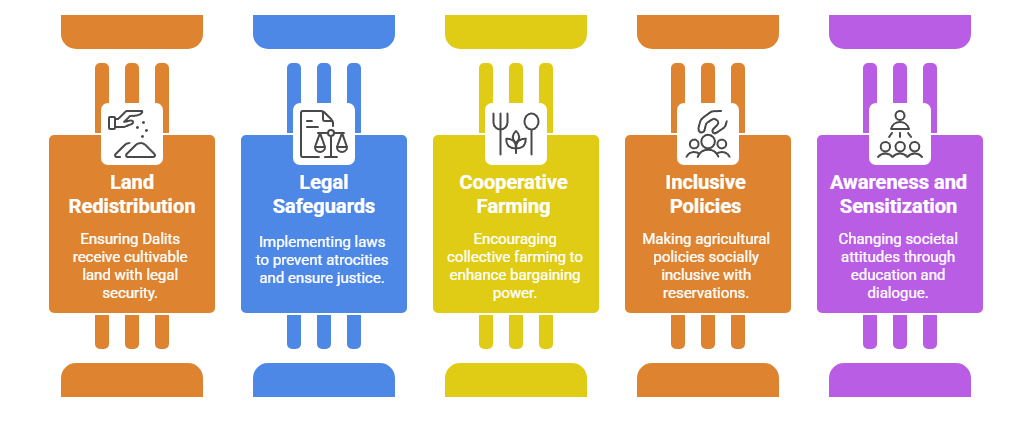
- Redistributive Land Reforms: Land redistribution must be accompanied by caste-sensitive identification of beneficiaries, ensuring Dalits receive cultivable land with legal security.
- Strengthening Legal Safeguards: Laws like The SC/ST (Prevention of Atrocities) Act must be implemented rigorously, especially in rural labour markets.
- Dalit Cooperatives and Collectives: Encouraging cooperative farming models among Dalits can enhance their bargaining power, reduce dependence on upper-caste landlords, and improve social dignity.
- Inclusive Agricultural Policies: Agricultural policies must be made socially inclusive, with reservation in schemes like PM-Kisan, agri-credit access, and skill development programs.
- Awareness and Sensitization: Civil society and government must work together to change societal attitudes toward caste-based labour discrimination, especially among youth and panchayat leaders.
Conclusion
Caste-based discrimination in agrarian labour is not just a socio-economic issue, but a structural injustice rooted in India’s historical and cultural fabric. It perpetuates inequality, restricts economic mobility, and undermines the dignity of labour for millions of Dalit and marginalized workers. A sociological understanding combined with targeted policy action is crucial to dismantling this hierarchy. As India envisions a more inclusive and equitable rural development model, addressing caste-based discrimination in agriculture remains a foundational step.
Paper I
- Distinguish between caste and class. How does each of them affect social mobility? (2015)
- How do you relate the agrarian social structure with the incidence of poverty in India? (2017)
- Critically examine A.R. Desai’s perspective on the relation between social structure and agrarian economy in India. (2020)
- Discuss the factors leading to the dominance of certain castes in rural India. (2016)
- Examine how caste has become an instrument of social exclusion in contemporary India. (2019)
- How is inequality of caste transformed into inequality of class in contemporary India? (2021)
- Critically examine how caste as a social category is undergoing transformation in rural India. (2023)
- Examine the relationship between caste and occupation as explained by different sociological perspectives. (2024)
Paper II
- Examine the impact of agrarian structure on the caste system in rural India. (2014)
- How far is it correct to say that caste system has led to the exploitation of the agrarian labourers in India? Substantiate your answer with examples. (2016)
- Discuss the impact of land reforms on the social structure in rural India. (2017)
- What are the structural constraints in the development of agrarian labourers in India? Illustrate with examples. (2018)
- Critically examine the issues of landlessness and poverty among Dalits in India. (2019)
- Dalit movements in independent India have mostly been about securing dignity rather than redistribution of resources. Comment. (2021)
- Discuss how caste-based discrimination in the labour market persists despite legal safeguards in India. (2020)
- Explain the linkage between caste violence and agrarian relations in rural India. (2022)
- What is the role of Panchayati Raj institutions in addressing caste-based inequities in agrarian regions? (2023)
- Examine how agrarian distress affects Dalit and Adivasi communities disproportionately in India. (2024)
|