

Bringing Global Education Home: A Sociological Analysis of Foreign University Campuses in India
(Relevant for Sociology Paper 1: Social Change in Modern Society)
IntroductionIndia’s higher education sector is undergoing a strategic shift with the formal entry of foreign universities establishing physical campuses within the country. This development, long anticipated under the National Education Policy (NEP) 2020, is now being operationalized through enabling regulations introduced by the University Grants Commission (UGC) in 2023. As of now, twelve foreign universities have received Letters of Intent to establish campuses, with one U.K. university scheduled to begin operations in Gurugram by the 2025–26 academic year. While often framed in terms of economic growth, global competitiveness, and educational quality, this policy move is also deeply sociological in nature. It intersects with questions of inequality, class mobility, cultural identity, institutional change, and global-local dynamics. This essay unpacks the key dimensions of this policy shift and then interprets them through a sociological lens to understand what it reveals about contemporary Indian society. Policy Foundation and Strategic Vision
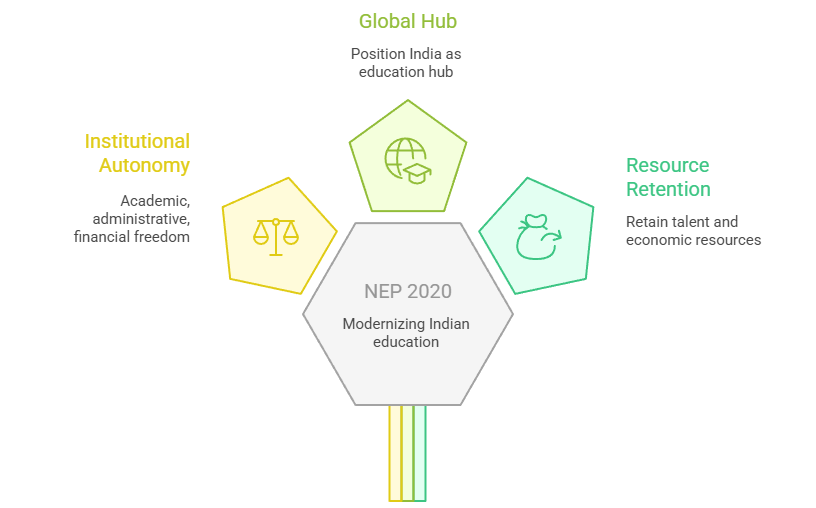
The recent surge in foreign universities entering India is rooted in the broader educational vision outlined in NEP 2020. The policy emphasizes the need to modernize Indian higher education through interdisciplinarity, internationalization, and institutional autonomy. Building on this, the UGC’s 2023 regulations provide foreign institutions the ability to operate with academic, administrative, and financial autonomy — a significant departure from India’s historically rigid regulatory framework. This move reflects the government’s strategic aim to position India as a global education hub. Simultaneously, it seeks to reverse the decades-long trend of Indian students going abroad for higher education — a process that has drained both talent and economic resources. Hosting foreign institutions domestically offers a solution that aligns with India’s aspiration to become a knowledge economy while also improving accessibility to global education for its own citizens. Why Now? A Convergence of Opportunity and DemandSeveral converging factors explain the timing of this shift. First, India is experiencing a demographic dividend, with a large and aspirational youth population seeking world-class education and global career pathways. Second, the Indian economy’s pivot toward technology, sustainability, and innovation has increased the demand for specialized skills in areas such as artificial intelligence, clean energy, and data science. Domestically, reforms such as hybrid learning, digital infrastructure upgrades, outcome-based assessments, and streamlined research funding (via the Anusandhan National Research Foundation) have made Indian higher education more hospitable to foreign collaboration. On the other side, Western universities — facing declining enrollments, financial strain, and geopolitical constraints — are eager to expand into stable, high-potential markets. India presents itself as both a market and a partner. Benefits to Indian Students and Families
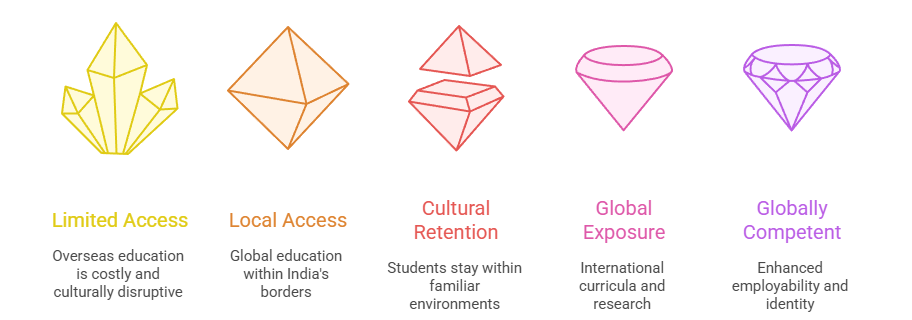
For students, the most immediate benefit is access to global education without having to migrate. This reduces the financial burden of overseas tuition and living costs, while also allowing students to remain within familiar cultural and familial environments. In a society where family remains a central institution, this is particularly meaningful. Moreover, students gain access to global curricula, cross-cultural exposure, and international research opportunities within Indian campuses. This blend of local grounding and global orientation enhances not just employability but also the formation of globally competent identities. For many families, especially those from urban middle-class backgrounds, this development enables them to aspire higher without leaving home. Raising the Bar for Indian InstitutionsThe arrival of foreign universities also has systemic implications for the broader academic ecosystem. It is expected to stimulate healthy competition, prompting Indian institutions to upgrade their curricula, adopt modern pedagogy, enhance faculty development, and invest more seriously in research and global collaborations. Already, institutions such as IITs, AIIMS, and IISERs are expanding partnerships in fields like renewable energy, biomedical engineering, and public health. Importantly, this reform is not a zero-sum game. The presence of foreign campuses can enrich the academic environment across the board by creating benchmarks, fostering cross-pollination of ideas, and developing joint research initiatives. This collaborative model can significantly boost India’s standing in global academic rankings and strengthen its contribution to global knowledge production. India’s Place in the Global Education OrderFor decades, India has been a net exporter of students and a passive consumer in the global academic economy. With this reform, the country aims to reclaim its historical legacy as an education hub — from ancient centers like Nalanda and Takshashila to modern models like Shantiniketan. However, unlike a simple imitation of Western models, the objective is to create a uniquely Indian academic environment that blends global excellence with local relevance. This vision aligns with the broader national goal of intellectual self-reliance and soft power projection. By redefining what it means to offer “world-class” education, India can move from being a participant to a co-creator of global academic norms. But this goal also requires careful attention to inclusivity, accessibility, and the preservation of India’s own intellectual traditions. Concerns: Accessibility, Stratification, and Regional Inequality
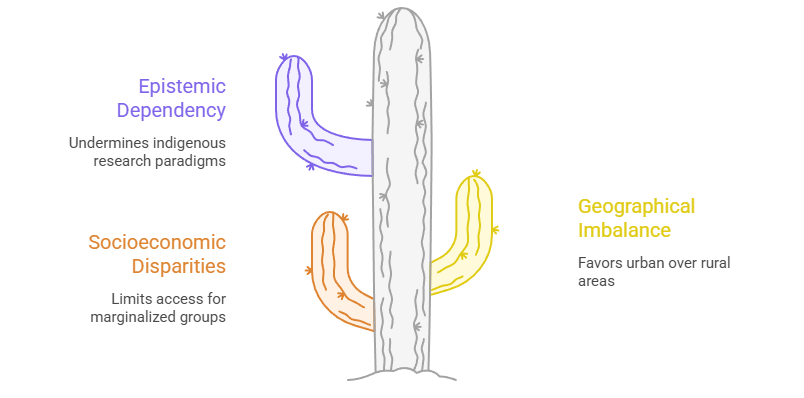
Despite its promise, the reform is not without its challenges. First and foremost is the question of who benefits. While foreign campuses may be located in India, their fees, admissions criteria, and cultural environment may cater primarily to urban, English-speaking, upper-middle-class students. Students from rural areas, lower-income backgrounds, or marginalized communities may find these spaces symbolically and materially inaccessible. Moreover, as most foreign campuses are expected to be set up in urban centers, this could worsen the existing educational divide between metropolitan and non-metropolitan regions. Unless deliberate policies are put in place to ensure inclusivity, foreign universities may become elite enclaves within a highly stratified system. There is also the risk of epistemic dependency. If these institutions merely replicate Western curricula without engaging with Indian realities, they may undermine the development of indigenous research paradigms. The transformation must be dialogic, not one-directional. Sociological Insights: Theoretical Perspectives at Play
ConclusionThe entry of foreign universities into India represents more than a policy innovation — it is a societal transformation. It promises to redefine how education is accessed, valued, and experienced in a country of vast demographic and cultural diversity. The initiative addresses both domestic aspirations and global positioning, aiming to make India not just an educational consumer but a knowledge producer and collaborator on the world stage. Yet, as with all structural reforms, its success will depend on the inclusivity of its implementation. Education must be a vehicle for social mobility and empowerment, not a new form of elite consolidation. If properly regulated, equitably designed, and socially embedded, this transformation could reshape India’s educational future — not by mimicking global standards, but by co-authoring them. |
To Read more topics, visit: www.triumphias.com/blogs
One comment