
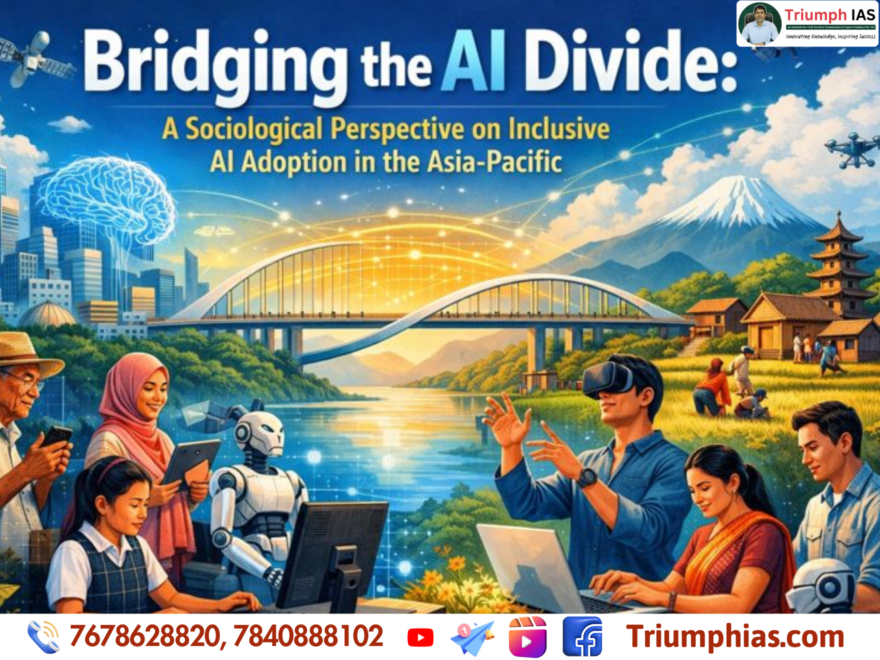
Bridging the AI Divide: A Sociological Perspective on Inclusive AI Adoption in the Asia-Pacific
(Relevant for Sociology Paper 1: Stratification and Mobility and Social Change in Modern Society)
|
In the last few years, Artificial Intelligence (AI) has emerged as one of the most transformative technologies in human history. From personalized learning in schools to real-time flood forecasting in Northeast India, AI promises to revolutionize economies and societies. However, despite the global fascination with AI, its adoption across countries, particularly in the Asia-Pacific region, is marked by stark inequalities. According to the United Nations Development Programme (UNDP), over 70% of AI users are in developing countries, but the usage rate in these countries still lags behind the affluent nations, where nearly two-thirds of people already use AI tools. While AI holds the potential to drive economic growth and enhance social development, it could also exacerbate existing social and economic divides. From a sociological perspective, these inequalities are not just technological—they are deeply embedded in structural issues of access, power, and privilege The Digital Divide: Structural Inequality in AI AdoptionThe digital divide is a critical issue in understanding the uneven spread of AI technologies. In a highly globalized world, the promise of AI as a tool for universal development is overshadowed by the stark socio-economic divide that exists within and between nations. This divide is not just about access to technology but about the unequal distribution of resources and infrastructure. In the Asia-Pacific region, low-income countries score below 20% on the AI Preparedness Index, reflecting their lack of reliable electricity, internet connectivity, and data systems. Advanced economies like Singapore, South Korea, and China, by contrast, have already established strong digital infrastructure and regulatory frameworks, making them better positioned to leverage the AI revolution. This divide represents a deeper social inequality in terms of access to education, economic opportunities, and technological literacy. Sociologists have long studied how structural inequalities—such as those based on class, race, gender, and geography—shape access to resources. The advent of AI, without addressing these underlying structural factors, risks entrenching technological apartheid. As AI adoption becomes increasingly crucial for future economic and social success, the question arises: how do we ensure that these technologies do not leave behind already marginalized populations? AI and Economic Inequality: Disruption or Opportunity?AI has the potential to significantly boost economic productivity, but it also poses substantial risks in terms of job displacement. In many low-income and developing nations, economies rely heavily on sectors like agriculture, manufacturing, and service industries, all of which are vulnerable to automation. A sociological lens on this issue focuses on the human cost of such economic transitions. In countries like India and Indonesia, informal labor constitutes a large portion of the workforce. Informal workers often lack the protection of labor laws, making them especially vulnerable to job displacement due to automation. This creates a precarious social condition where millions of workers, especially from rural or marginalized communities, face economic insecurity without the safety nets of formal employment or retraining opportunities. Gender inequality compounds this challenge. The UNDP report highlights that female workers are twice as exposed to automation risks compared to their male counterparts. In many developing nations, women are overrepresented in sectors most vulnerable to AI-induced job losses, such as textiles and retail. This gendered dimension of AI disruption reveals a double burden for women in the Global South, where technological progress exacerbates both economic and gender-based inequality. Furthermore, as AI tools become integral to sectors like finance, healthcare, and education, the economic divide between those who have access to AI technologies and those who don’t becomes more pronounced. Wealthy elites and multinational corporations in high-income countries are more likely to capture the AI dividend, while the marginalized and low-income populations in poorer nations risk being left out, contributing to global wealth disparities. AI and Social Exclusion: Data Bias and Marginalized CommunitiesAt the heart of the AI revolution is data—the raw material that powers machine learning algorithms. However, data exclusion is a significant issue, particularly for marginalized communities in the Asia-Pacific region. Rural populations, ethnic minorities, and women in South Asia are often underrepresented in the datasets used to train AI models. This exclusion leads to AI systems that may not only be ineffective for these groups but may actively perpetuate social inequalities. For example, women in South Asia are 40% less likely than men to own a smartphone, which directly limits their access to AI-powered services and technologies. Similarly, rural populations in countries like India and Vietnam are often absent from AI training datasets, leading to systems that fail to account for the unique challenges they face in areas like healthcare, education, and agriculture. The marginalization of certain groups in AI systems also has profound sociological implications. Exclusion from digital systems translates into social exclusion, where marginalized communities are denied access to opportunities for economic advancement, political participation, and social mobility. Bias in AI algorithms—whether it’s in hiring practices, credit scoring, or public service delivery—reinforces existing power imbalances and systemic discrimination. AI Governance: Power and Control in the Digital AgeThe power dynamics of AI governance are another sociological concern. Who controls AI technology, and who benefits from it? In countries like China, Singapore, and South Korea, AI is increasingly integrated into governance—from traffic management in Bangkok to urban flood simulation in Beijing. However, these advancements also raise questions about surveillance and authoritarianism. Sociologists like Michel Foucault have explored the concept of power in relation to technological control. In the context of AI, the state’s role in regulating and using AI is critical. For example, the Traffy Fondue platform in Bangkok processes 600,000 citizen reports efficiently, but it also gives the government a tool to monitor and control public behavior. Similarly, China’s digital twin systems model urban environments in real time, but they also raise concerns about surveillance and state control over the lives of citizens. The opacity of many AI systems, especially those used by private corporations and governments, raises further sociological concerns about accountability and transparency. Who is responsible when AI systems make biased decisions or fail to account for diverse populations? Without strong governance frameworks, AI has the potential to concentrate power in the hands of a few global tech companies and authoritarian states, perpetuating social inequality and disempowerment. Building an Inclusive AI Future: A Sociological PerspectiveTo build a truly inclusive AI future, we must address both the technological and sociological barriers to equitable AI adoption. This requires a multi-faceted approach:
Conclusion: Bridging the AI Divide for an Equitable FutureThe future of AI holds both promise and peril for the Asia-Pacific region. While AI has the potential to transform societies and economies, it also risks exacerbating existing social divides if not adopted inclusively. From a sociological perspective, the challenge lies not only in the technology itself but in the social structures that shape access to and benefits from AI. To ensure that AI serves as a tool for social equity and economic inclusion, policymakers, technologists, and civil society must work together to bridge the AI divide and create a future that works for everyone, especially the most marginalized communities. By addressing the structural inequalities that underlie the digital divide, we can ensure that AI fulfills its potential as a force for inclusive growth, social justice, and sustainable development in the Asia-Pacific region and beyond. |
To Read more topics, visit: www.triumphias.com/blogs
Read more Blogs:
Mahatma Jyotiba Phule: Reimagining Social Justice, Caste, and Education in 19th-Century India
One comment