Introduction:
On May 1, International Labour Day, while the world reflects on the dignity of work, India’s dark underbelly of bonded labour reveals the grim reality of exploitation and systemic failure. According to the International Labour Organization (ILO), India is home to over 8 million bonded and forced labourers, many of whom are from marginalized communities such as Scheduled Castes (SCs), Scheduled Tribes (STs), and other backward classes. This blog explores the structural reasons behind the persistence of bonded labour in India, presents a real-life account, and provides a sociological analysis.
Case Study: Santosh’s Story from a Brick Kiln
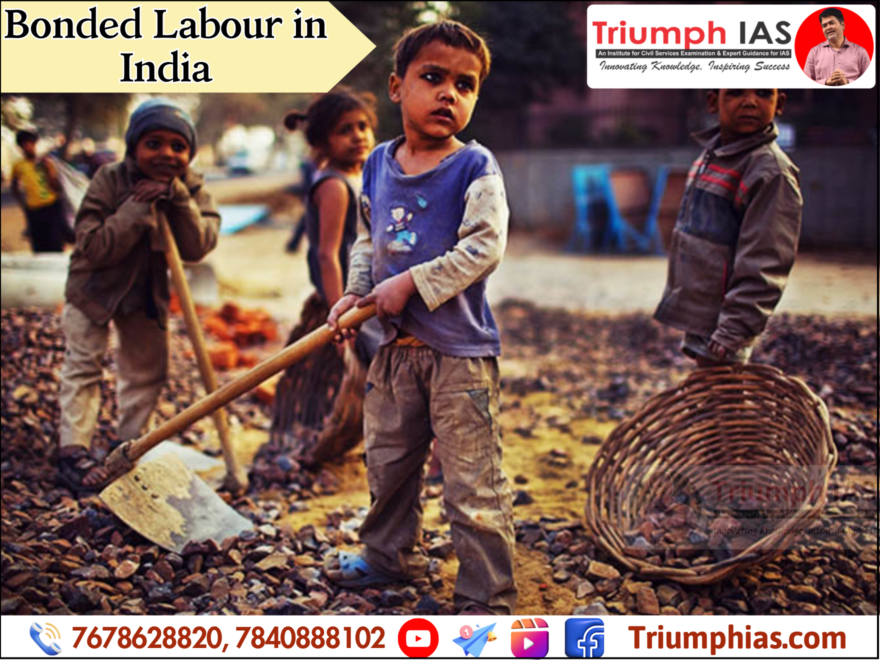
In 2022, Santosh, a minor from Chhattisgarh, was trafficked along with 25 others to a brick kiln in Uttar Pradesh under the promise of decent wages. Once there, he was made to work 16 hours a day in hazardous conditions, with barely two meals and no pay. He suffered respiratory problems and physical abuse when he tried to protest. He was rescued after a local NGO intervened, but the trauma and health damage were already severe. His story is one among thousands that go unreported.
The story of Santosh, a 14-year-old boy rescued from a brick kiln in Uttar Pradesh, reflects the structural inequalities and socio-economic vulnerabilities that sustain forced and bonded labour in India, especially among Dalits, Adivasis, and the rural poor.
What is Bonded Labour?
Bonded labour (debt bondage) occurs when a person is forced to work to repay a loan or advance, often under coercive conditions, with little or no wages, and without freedom to leave. The Bonded Labour System (Abolition) Act, 1976 criminalizes this practice, but enforcement remains poor.
Sociological Analysis
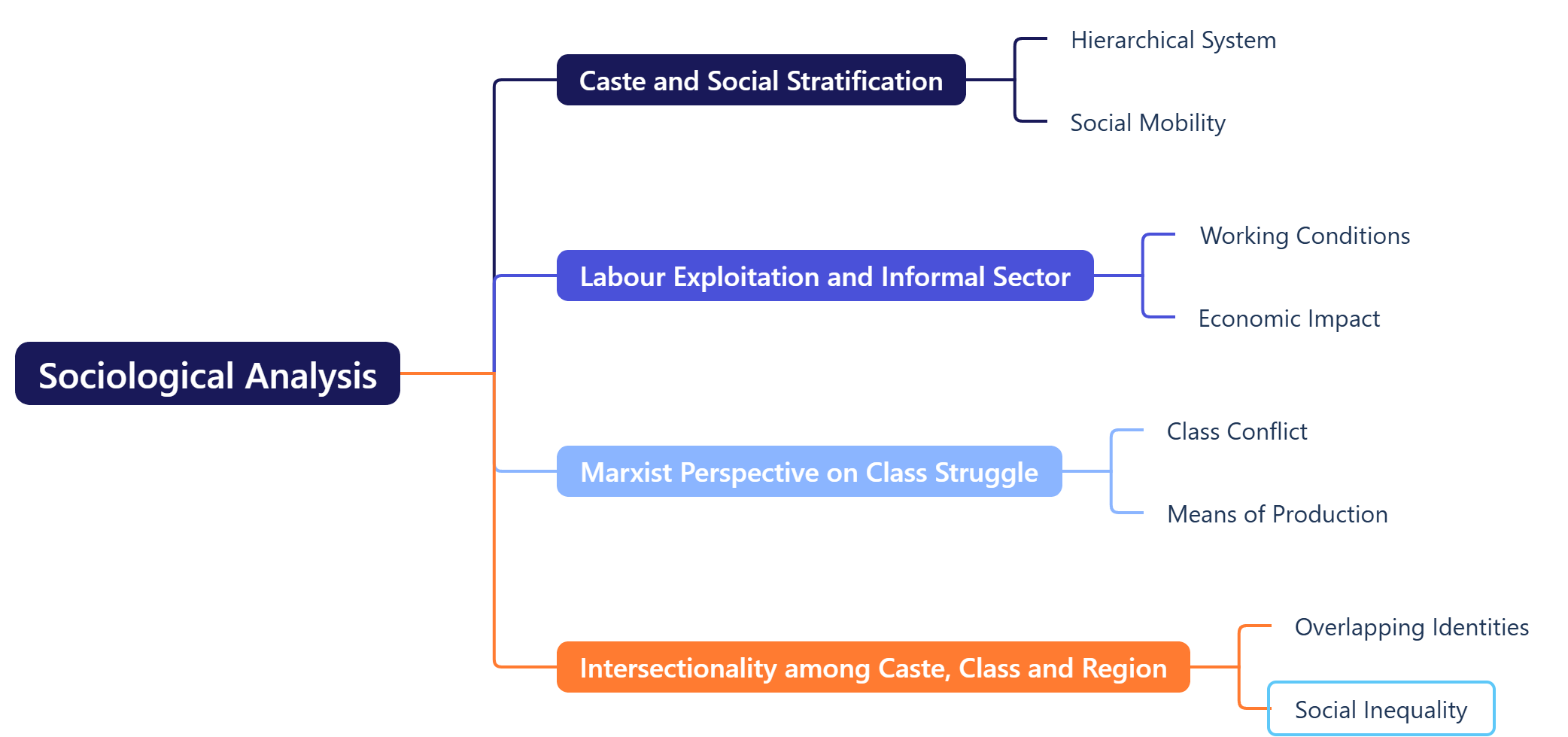
- Caste and Social Stratification: Bonded labour is disproportionately prevalent among Dalits and Adivasis, reflecting how traditional caste hierarchies continue to influence occupational roles and access to resources.
- Labour Exploitation and Informal Sector: Most bonded labour occurs in the informal economy — brick kilns, farms, construction — where labour laws are not enforced. Workers lack written contracts, social security, and bargaining power.
- Marxist Perspective on Class Struggle: A.R. Desai and other Marxist sociologists argue that bonded labour is a form of economic exploitation where capitalists maximize profit by reducing labour to a commodity. Workers, alienated from the means of production, are trapped in perpetual poverty.
- Intersectionality among Caste, Class and Region: Bonded labour often emerges at the intersection of caste-based discrimination, class-based poverty, and regional disparities. Tribal regions with poor infrastructure and lack of employment are especially vulnerable.
Legal Protection vs. Ground Reality
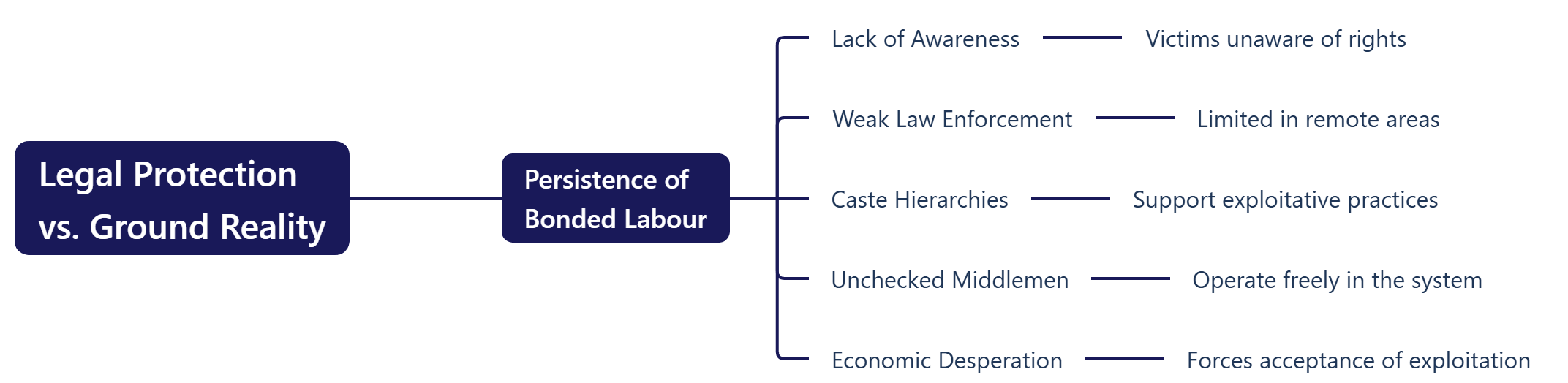
- Despite legal abolition, bonded labour persists because:
- Victims are unaware of their rights
- Law enforcement is weak, especially in remote areas
- Caste hierarchies and feudal structures support exploitative practices
- Middlemen and labour contractors operate unchecked
- Economic desperation forces individuals to accept exploitative conditions
State Response and Policy Gaps
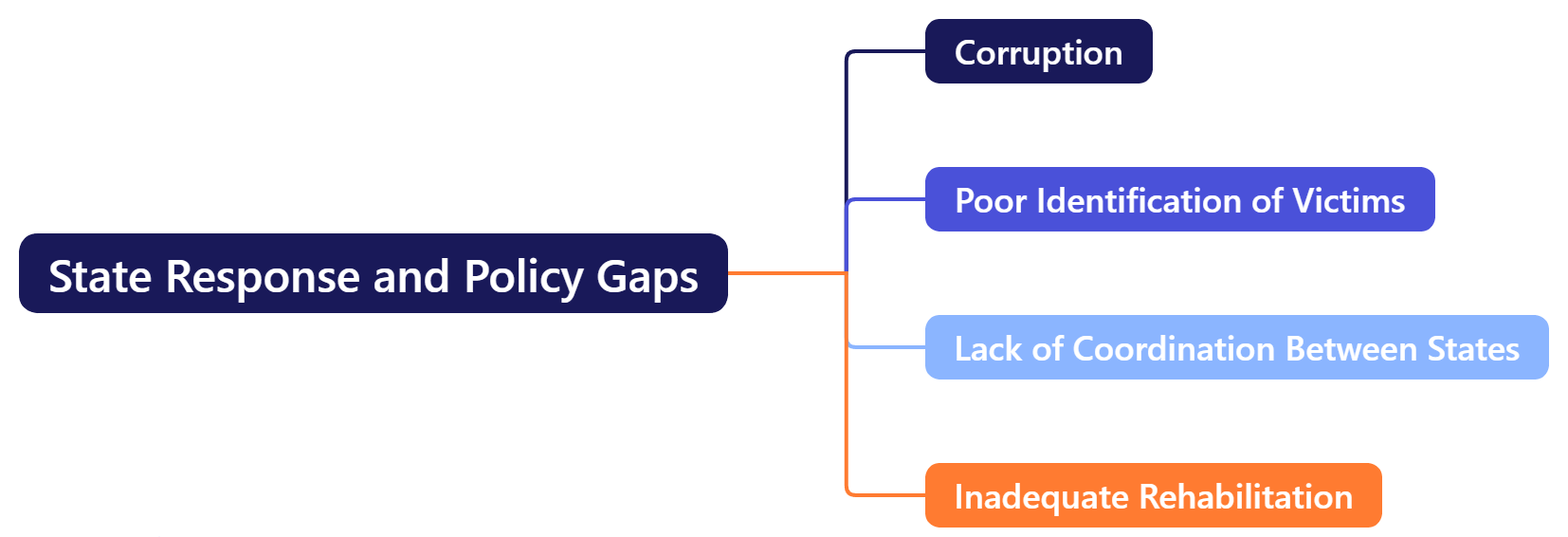
While schemes like the Central Sector Scheme for Rehabilitation of Bonded Labourers exist, implementation lags due to:
- Corruption
- Poor identification of victims
- Lack of coordination between states
- Inadequate rehabilitation
Conclusion
Bonded labour is not merely a relic of feudal India; it is a continuing reality rooted in caste oppression, rural poverty, and state neglect. Aspirants, as future policymakers and administrators, must understand the complex interplay of social structures and economic deprivation that sustains this injustice. To address bonded labour effectively, India needs inclusive development, strong grassroots governance, community empowerment, and empathetic implementation of labour laws.
PYQs
Paper 1 –
- Critically examine the relevance of Marx’s theory of class struggle in understanding contemporary forms of labour exploitation. (2014)
- Discuss the features of informal sector employment in developing countries with special reference to India. (2015)
- Analyse how alienation affects labour in capitalist societies. Illustrate with suitable examples. (2017)
- Critically examine the impact of globalisation on the labour market in India. (2019)
- Explain the concept of social mobility. How does caste as a closed system affect mobility in India? (2021)
- Evaluate the significance of informal labour in the Indian economy in the context of recent labour reforms. (2022)
- Analyse the impact of economic inequality on the realisation of citizenship rights in India. (2023)
Paper 2 –
- Discuss the impact of land reforms on agrarian structure and bonded labour in rural India. (2013)
- What are the major issues of tribal development in India? Illustrate with examples from bonded or seasonal labour practices. (2014)
- Write a short note on: Unorganised labour and its problems. (2015)
- Discuss the linkages between caste, poverty, and bonded labour in rural India. (2016)
- Examine the role of caste and class in perpetuating bonded labour in contemporary India. (2017)
- Write short notes on: Labour migration and informal sector. (2018)
- Discuss the relationship between rural poverty and forms of labour exploitation like debt bondage and human trafficking. (2019)
- Evaluate the impact of interstate migration and contract labour system on the conditions of workers in urban India. (2021)
- Analyse how caste-based occupation and regional disparities continue to reinforce labour exploitation in rural and tribal India. (2022)
|


One comment