
Beti Bachao Beti Padhao: A Sociological Decode of India’s Gender Transformation
(Relevant for Sociology Paper 2: Challenges of Transformation)
Beti Bachao Beti PadhaoThe completion of a decade of the Beti Bachao Beti Padhao (BBBP) scheme offers more than just statistics—it provides a living laboratory to observe the mechanics of deep-rooted social change. The measurable progress, from an improved sex ratio at birth (919 to 929) to higher female school enrolment, is not merely a policy success. It is a dramatic case study of a society actively, and painfully, renegotiating its foundational values around gender, family, and power. By viewing this transformation through the lens of sociological giants, we can move beyond the numbers to understand the profound restructuring of the Indian social fabric. Durkheim and the Shift from Mechanical to Organic SolidarityÉmile Durkheim would identify the pre-BBBP mindset as a feature of mechanical solidarity—a society bound by traditional, collective consciousness where roles were rigidly prescribed. The question, “Beti padhegi toh kya karegi?” (What will a daughter do by being educated?), was a symptom of this. A daughter’s value was functionally defined by her future role within the patriarchal household (ghar), not the public sphere (bahir). Education was seen as irrelevant, even disruptive, to this predefined order. The success of BBBP signals a potential shift towards organic solidarity, where social cohesion is based on interdependence arising from the specialization of roles. As campaigns have reshaped the perception of a girl from a ‘liability’ (paraya dhan) to an ‘asset’—a future doctor, pilot, or entrepreneur—her education becomes functionally necessary for the health of the modern economy and society. The societal “whole” now begins to see value in the specialized potential of its female “parts.” This is a fundamental, Durkheimian transformation of the collective conscience, moving from a culture of neglect to one of aspiration. Weber: Social Action, Authority, and the Power of Symbolism
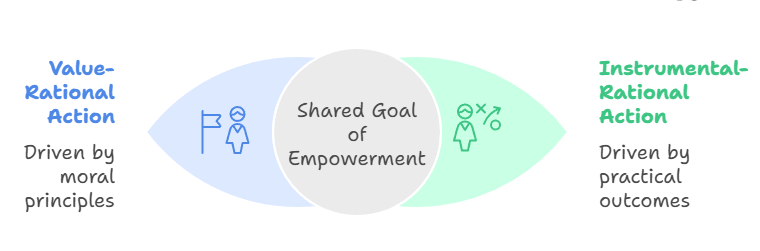
Max Weber would direct our attention to the types of social action and authority that fueled this change. The movement is a powerful mix of:
Crucially, Weber would highlight the role of charismatic authority and symbolism. When political leaders and influencers publicly champion the cause—by auctioning gifts for girls’ education or personally inaugurating school drives—they lend their charismatic legitimacy to the movement. These are not just policy implementations; they are powerful symbolic actions that signal a shift in what society deems prestigious and important, turning a private family burden into a public, celebrated priority. Parsons and the Transformation of Gender RolesTalcott Parsons, a structural-functionalist, would analyze this through the lens of the family and its functions. The traditional Indian family operated on a rigid instrumental (male-breadwinner) and expressive (female-homemaker) role segregation. This structure was functional for an agrarian society but has become dysfunctional for a modern, industrializing economy. The BBBP scheme, and the broader cultural shift it represents, is a societal adaptation. By pushing for female education and workforce participation, society is creating a new, more flexible social structure where women can take on instrumental roles. The visible success stories of women as fighter pilots, CEOs, and scientists are not just inspirations; they are new role models that help redefine the “social role” of a woman, reducing the strain on the old system. This is a functionalist reading of how society evolves its structures to maintain equilibrium in a changing world. The Feminist Lens: Challenging the Patriarchal Dividend
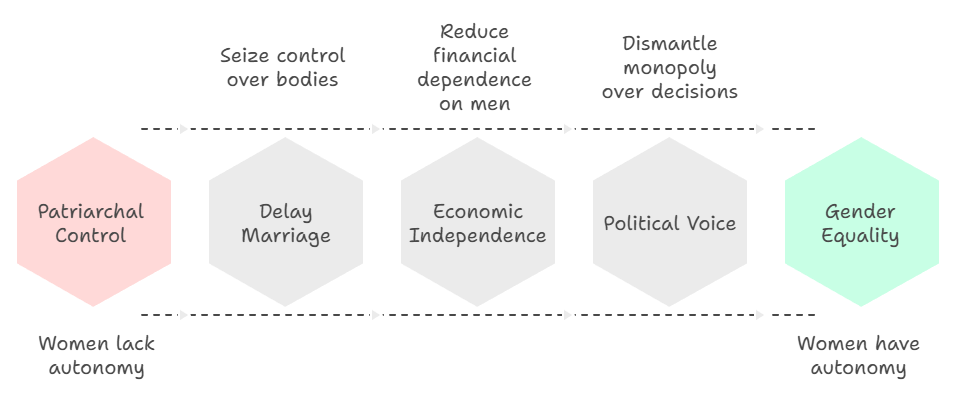
Feminist sociologists like Sylvia Walby would offer a more critical, yet hopeful, perspective. They would argue that BBBP is a state-led intervention directly challenging the patriarchal dividend—the systemic advantage men gain from the subordination of women. The very existence of a scheme to “save” and “educate” the girl child is an admission of a deep-seated patriarchal bias manifesting in sex-selective abortion and educational neglect. The scheme’s ripple effects are a direct assault on patriarchal structures:
Feminists would caution, however, that the journey is far from over. The focus must now shift from access to education to tackling the hidden curriculum in schools, ensuring safety in public spaces, and addressing the second shift of domestic labor that working women still disproportionately bear. Robert Merton and the Unintended Consequences of Social ChangeRobert K. Merton’s concept of manifest and latent functions is brilliantly illustrated here. The manifest function of BBBP is clear: to improve sex ratios and increase girls’ school enrolment. However, the latent functions—the unintended but beneficial consequences—are where the true social revolution lies:
Conclusion: A Society in Flux, A Future ReimaginedA decade of Beti Bachao, Beti Padhao reveals that the most significant changes are not just in enrollment sheets or gender ratios, but in the silent, stubborn corridors of the Indian mind. It represents a collective, multi-layered social action—driven by value shifts, rational calculations, charismatic authority, and a functional adaptation to modernity—all while directly confronting patriarchal structures. The journey is incomplete. Deep-seated son preference, safety concerns, and gendered social norms persist. Yet, the transformation of girls’ education has ignited a chain reaction that is reshaping families, the economy, and the demographic future of the nation. As sociology teaches us, when you change the status of women, you do not just add to society; you transform it. In educating its daughters, India is not just saving girls; it is, fundamentally, re-imagining and rebuilding itself. |
To Read more topics, visit: www.triumphias.com/blogs
Read more Blogs:
Feminisation of Indian Agriculture: The Sociological Paradox of Unpaid Labour
Rituals, Habits, and Social Norms: A Sociological Exploration
The BBBP scheme is an incredible example of a social intervention that directly challenges the patriarchal dividend. It’s exciting to see how much progress has been made in just a decade, but also important to remember the long road ahead to address systemic gender biases.