
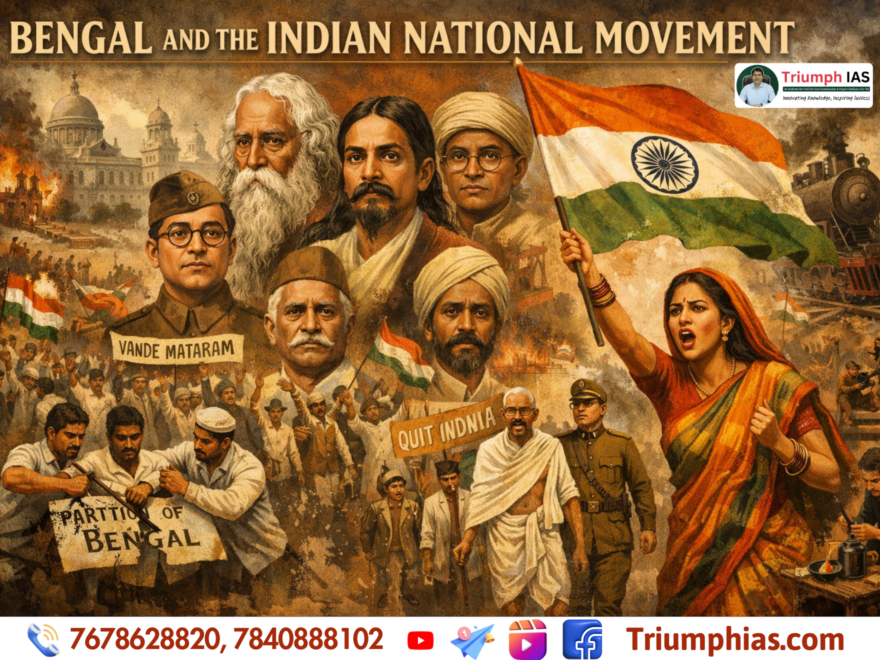
Bengal and the Indian National Movement
(Relevant for Sociology Paper 2: Social Movements in Modern India)
|
The recent political controversy surrounding the alleged marginalisation of Bengal’s national icons—Rabindranath Tagore, Netaji Subhas Chandra Bose, and Bankim Chandra Chattopadhyay—has reopened an old but unresolved question: Who owns the national narrative? The debate is not merely historical; it is deeply sociological, touching upon issues of nationalism, cultural hegemony, regional identity, and the politics of memory. Bengal’s role in the Indian National Movement was not just prominent—it was formative. To understand this, we must move beyond chronology and examine how Bengal shaped the ideas, symbols, and emotions that constituted Indian nationalism. Bengal and the Birth of Modern Indian ConsciousnessSocial Reform and the Making of the “Modern Indian” The intellectual awakening in Bengal during the 19th century marked what sociologists call a transition from traditional to reflexive society. Raja Rammohan Roy’s Brahmo Samaj challenged superstition, caste rigidity, and patriarchy, embodying Max Weber’s idea of rationalization—the spread of reason into social life. This reformist tradition created a modern, educated middle class (bhadralok), which became the backbone of early Indian nationalism. Weber would argue that this class possessed not only economic resources but also cultural authority, enabling it to articulate political demands in the language of rights, reason, and reform. Cultural Nationalism and the Power of SymbolsBankim Chandra and “Vande Mataram” Bankim Chandra Chattopadhyay’s Vande Mataram was not merely a song—it was a symbolic mobilizer. Émile Durkheim’s concept of collective effervescence helps explain its power. When people sang Vande Mataram together, they experienced a shared emotional energy that transformed individual sentiment into collective national consciousness. However, contemporary debates around the song also reveal how symbols are contested, not fixed. Sociologically, this reflects what Antonio Gramsci called a struggle for cultural hegemony—the attempt by dominant groups to define which symbols represent the nation. Swadeshi Movement: Nationalism as Mass MobilisationThe Partition of Bengal (1905) was a turning point that transformed nationalism from an elite discourse into a mass movement. Gramsci and Counter-Hegemonic Politics The Swadeshi Movement challenged colonial economic domination through boycott, indigenous enterprise, and national education. Gramsci would interpret this as a counter-hegemonic movement, where culture, economy, and politics merged to challenge imperial power. Leaders like Bipin Chandra Pal and Aurobindo Ghosh represented what sociology calls radical nationalism, rejecting gradual reform in favor of direct confrontation. This period also saw the emergence of revolutionary groups such as Anushilan Samiti and Jugantar, illustrating how nationalism diversified into both constitutional and militant forms. Revolutionary Nationalism and the Sociology of SacrificeSubaltern Agency and Armed Resistance Acts like the Chittagong Armoury Raid (1930) led by Surya Sen, and the martyrdom of Pritilata Waddedar and Bina Das, exemplify what Ranajit Guha’s Subaltern Studies framework emphasizes: the agency of actors outside elite leadership. These revolutionaries were not merely political actors; they were moral symbols. Their willingness to sacrifice life resonates with Durkheim’s idea that societies sanctify certain actions to reinforce collective values. Women revolutionaries in Bengal also challenge patriarchal assumptions. Feminist sociologists argue that their participation disrupted the gendered division between private and public spheres, redefining women as political subjects. Literature, Media, and the Imagining of the Nation Benedict Anderson and Print Capitalism Bengal’s contribution to nationalist literature and journalism illustrates Benedict Anderson’s concept of “imagined communities.” Newspapers like Amrita Bazar Patrika, plays like Neel Darpan, and novels like Tagore’s Ghare Baire created a shared narrative of colonial injustice. Through print and performance, nationalism became imaginable across distances, binding diverse populations into a common political identity. Rabindranath Tagore: A Critical Nationalist Tagore represents a reflexive nationalism. Unlike militant nationalists, he warned against blind nationalism, emphasizing humanism over chauvinism. Sociologically, Tagore aligns with cosmopolitan theory, which critiques exclusionary nationalism while supporting cultural self-respect. His position complicates contemporary political appropriation, reminding us that icons are intellectually diverse, not ideologically uniform. Bengal and Gandhian Mass PoliticsDespite ideological differences, Bengal played a crucial role in Gandhian movements—Non-Cooperation, Civil Disobedience, and Quit India. Partha Chatterjee and the “Inner Domain” Partha Chatterjee argues that Indian nationalism created an “inner domain” of cultural sovereignty, even under colonial rule. Bengal exemplified this through institutions like the Tamralipta Jatiya Sarkar (1942–44), a parallel government that exercised real administrative power. This shows that nationalism was not only symbolic but also institutional and experiential. Politics of Memory and Regional Identity Today The current controversy over Bengal’s icons reflects what sociologists call memory politics. Maurice Halbwachs argued that collective memory is socially constructed, shaped by present interests rather than past realities. When certain regional contributions are foregrounded or sidelined, it reveals ongoing struggles over:
This tension between regional pride and national integration is not a threat but a feature of plural societies. Conclusion: Bengal as the Cultural Laboratory of Indian NationalismBengal’s role in the Indian National Movement was not limited to events or personalities—it shaped the very grammar of Indian nationalism. From reformist rationalism to revolutionary sacrifice, from cultural symbolism to mass politics, Bengal functioned as a sociological laboratory where ideas of nationhood were imagined, debated, and lived. Contemporary debates over Bengal’s icons remind us that nationalism is not a finished project. It is an ongoing social process, constantly renegotiated across regions, cultures, and generations. As sociology teaches us, a nation survives not by erasing differences, but by remembering them honestly. |
To Read more topics, visit: www.triumphias.com/blogs