Introduction: Assimilation vs. Isolation
India, with its vast ethnic diversity, is home to over 700 tribal communities constituting about 8.6% of the population (Census 2011). The discourse on the assimilation vs. isolation of tribes remains a central debate in Indian sociology and public policy. The question is—should tribal communities be absorbed into the mainstream society through assimilation, or should they be allowed to retain their distinct identity through isolation? This blog delves into the competing approaches, drawing from sociological perspectives and policy frameworks, and evaluates their relevance in contemporary India.
Understanding Assimilation and Isolation
What is Assimilation?
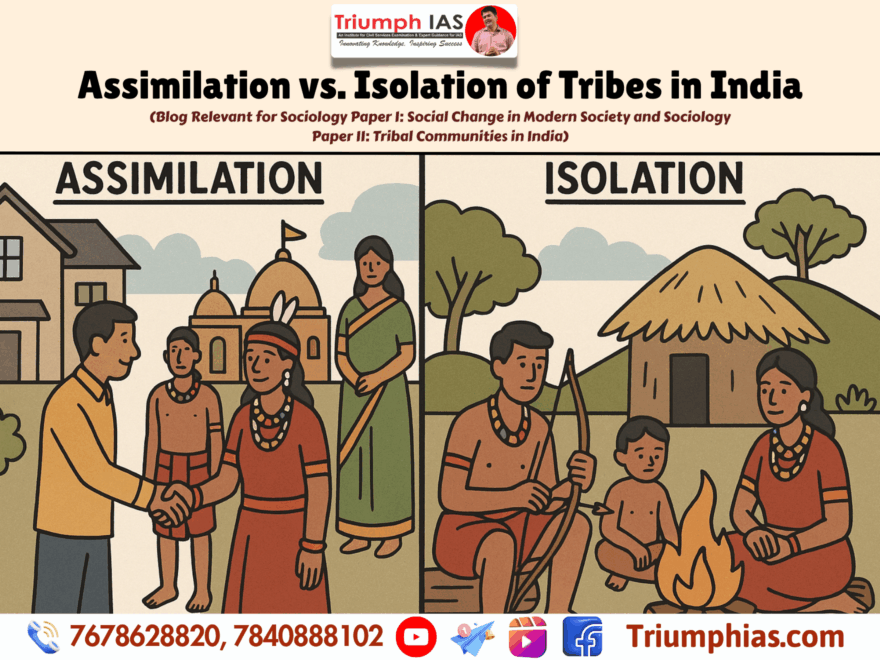
Assimilation refers to a process by which individuals or groups of differing ethnic heritage are absorbed into the dominant culture of a society. In the context of tribes, assimilation entails:
- Adopting mainstream values, language, and lifestyle.
- Losing distinct tribal cultural traits.
- Integration into the caste-based social structure.
What is Isolation?
Isolation, on the other hand, advocates for safeguarding the tribal way of life by:
- Preserving cultural autonomy.
- Limiting external influences (e.g., market economy, religions, and media).
- Protecting tribal lands and resources from exploitation.
Sociological Analysis
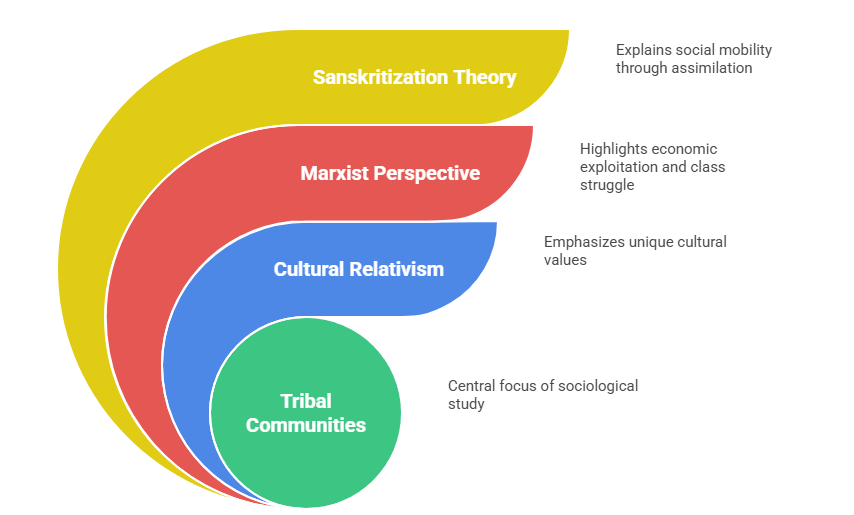
- M.N. Srinivas’s theory of Sanskritization explained how lower castes and tribes adopt upper-caste customs to improve their social status. While this theory helps understand cultural change, it has been critiqued for assuming assimilation into the caste hierarchy as the only route to mobility, often neglecting the unique identity and agency of tribal communities.
- A.R. Desai, through a Marxist lens, highlighted how tribes are structurally oppressed by capitalist and state interests. He argued that so-called development often leads to displacement, marginalization, and resource alienation of tribal people. According to him, tribal issues are fundamentally rooted in class struggle and economic exploitation.
- Verrier Elwin’s approach reflects cultural relativism, asserting that every culture should be understood on its own terms. He rejected the idea of tribal inferiority and instead celebrated their social institutions, ecological knowledge, and lifestyles. His view supported isolation as a means of protecting tribal diversity from cultural erosion.
Tribal Policy Debates in India
Two prominent figures in Indian anthropology—G.S. Ghurye and Verrier Elwin—embody the opposing views on tribal policy.
- G.S. Ghurye: Assimilationist Perspective
G.S. Ghurye, a prominent Indian sociologist, believed that tribes were not distinct entities but “backward Hindus” who should be assimilated into the Hindu social fold. He advocated Sanskritization as a path for tribal upliftment, arguing that integration into mainstream society would ensure national unity and socio-economic progress.
- Verrier Elwin: Isolationist Perspective
In contrast, British anthropologist Verrier Elwin emphasized preserving tribal culture and autonomy. He believed in minimal state interference and supported the idea that tribes should be allowed to live according to their traditional customs. Elwin’s approach was rooted in cultural relativism, valuing tribal ways of life as equally legitimate.
Constitutional Provisions for Tribes
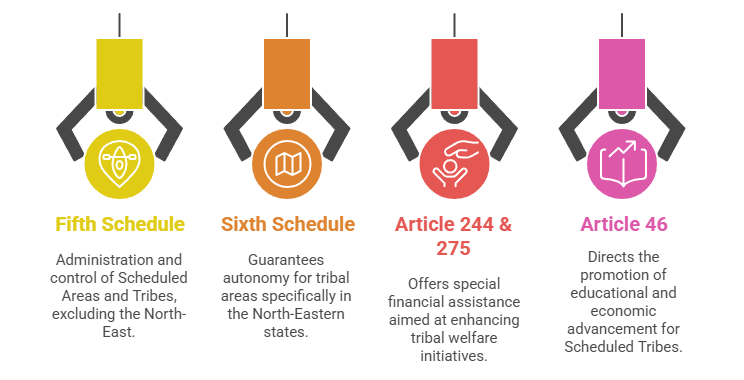
- Fifth Schedule: Provides for the administration and control of Scheduled Areas and Scheduled Tribes in any state except the North-East.
- Sixth Schedule: Ensures autonomy for tribal areas in the North-Eastern states.
- Article 244 & 275: Special assistance for tribal welfare.
- Article 46: Directive to promote educational and economic interests of Scheduled Tribes.
Assimilation: Pros and Cons
Advantages
- Promotes national integration.
- Facilitates access to education, jobs, and modern healthcare.
- Helps bridge the economic gap through mainstream development schemes.
Disadvantages
- Loss of indigenous culture, languages, and customs.
- Disruption of traditional economies and lifestyles.
- Increased exploitation through displacement and land alienation.
- Imposition of caste hierarchy on egalitarian tribal societies.
Example: The introduction of market economies in tribal areas led to the marginalization of forest-based livelihoods.
Isolation: Pros and Cons
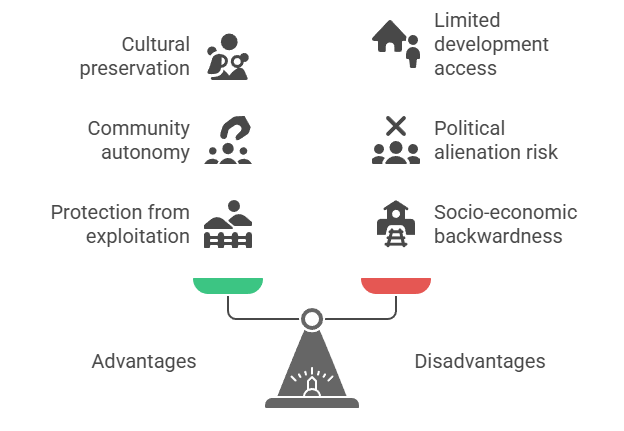
Advantages
- Cultural preservation and identity safeguarding.
- Autonomy in governance through community-led decision-making.
- Protection from external exploitation (g., mining, industrialization).
Disadvantages
- Limits exposure to modern education and healthcare.
- Perpetuates socio-economic backwardness.
- May lead to political and geographical alienation.
Example: PVTGs (Particularly Vulnerable Tribal Groups) in Andaman (e.g., Jarwas) are largely isolated but face challenges in accessing healthcare and development support.
Contemporary Tribal Policies:
The Indian state has gradually adopted a middle path approach—neither complete assimilation nor complete isolation. This is reflected in:
- Tribal Sub-Plan (TSP): Development plans within tribal-majority areas.
- PESA Act (1996): Empowers Gram Sabhas in Scheduled Areas to manage natural resources and local governance.
- Forest Rights Act (2006): Recognizes traditional forest rights of tribal communities.
- Eklavya Model Residential Schools: Provide quality education while preserving cultural identity.
Current Affairs
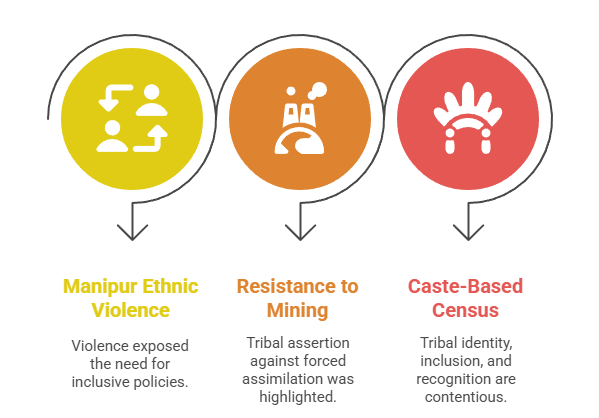
- Manipur Ethnic Violence (2023): Exposed fault lines between tribal and non-tribal communities, showing the need for inclusive policies.
- Resistance to Mining in Dantewada and Niyamgiri: Highlighted tribal assertion against forced assimilation via industrial projects.
- Caste-Based Census and ST Sub-categorization Debate: Questions of tribal identity, inclusion, and recognition are still contentious.
The Way Forward:
A progressive tribal policy must balance cultural preservation with development.
Key steps include:
- Promoting intercultural education that respects tribal history and knowledge systems.
- Ensuring land and forest rights through effective implementation of FRA and PESA.
- Enabling community-led development via decentralized planning.
- Strengthening tribal political representation and local self-governance.
- Using technology and media sensitively to amplify tribal voices without commodifying their culture.
Conclusion
The debate on assimilation vs. isolation of tribes in India is not merely academic—it shapes the lived realities of millions of tribal citizens. A nuanced approach that fosters participatory development, cultural dignity, and social justice is essential. The state must act not as an assimilator or isolator, but as a facilitator of tribal empowerment.
Previous Year Questions
Paper I
- Explain the concept of Sanskritization and its impact on tribal identity. (2017)
Paper II
- Discuss the policy of isolation versus integration with reference to tribes in India. (2015)
- Critically examine the role of the PESA Act in tribal self-governance. (2021)
|

One comment