

Artificial Intelligence: Boom, Bubble, or Social Transformation?
(Relevant for Sociology Paper 1: Social change in Modern Society)
|
The global economy is witnessing an unprecedented surge in Artificial Intelligence (AI) investment. Spending is projected to reach $375 billion this year and $500 billion by 2026. Headlines tout AI as the defining technological revolution of the 21st century, promising automation, productivity gains, and transformative social and economic change. Yet, alongside the excitement, voices of caution question whether AI’s soaring valuations reflect genuine technological potential—or a speculative bubble reminiscent of the late-1990s dot-com era. Understanding this requires a blend of economic analysis, sociological insight, and historical comparison. Learning from the Dot-Com BubbleThe dot-com bubble provides a cautionary tale. In the late 1990s, internet companies enjoyed sky-high valuations despite minimal revenues. Investor enthusiasm, easy access to venture capital, and the belief that “growth will eventually translate into profits” drove the bubble. Many firms failed spectacularly when interest rates rose or earnings disappointed. Only companies that built durable business models—Amazon, Microsoft, and Google—survived. The AI landscape today exhibits some familiar patterns:
These indicators suggest a bubble-like element. Yet, there are key differences that make AI distinct from the dot-com scenario. Why the AI Boom May Be More Than a BubbleUnlike the dot-com era, today’s AI investment is not purely speculative. Massive capital is being deployed into physical infrastructure—data centres, semiconductor fabrication, and AI training hardware. These are tangible, capital-intensive assets that can enhance productivity, rather than virtual websites with little intrinsic value. This suggests that the AI boom may have a solid technological and economic foundation, not just speculative appeal. Moreover, AI applications—ranging from natural language processing to automation of logistics—have measurable real-world impact, unlike early dot-com startups that often lacked scalable products. This difference implies that even if valuations are inflated, the technology itself is unlikely to vanish; the bubble may correct without derailing progress. Sociological Dimensions: Technology and Inequality
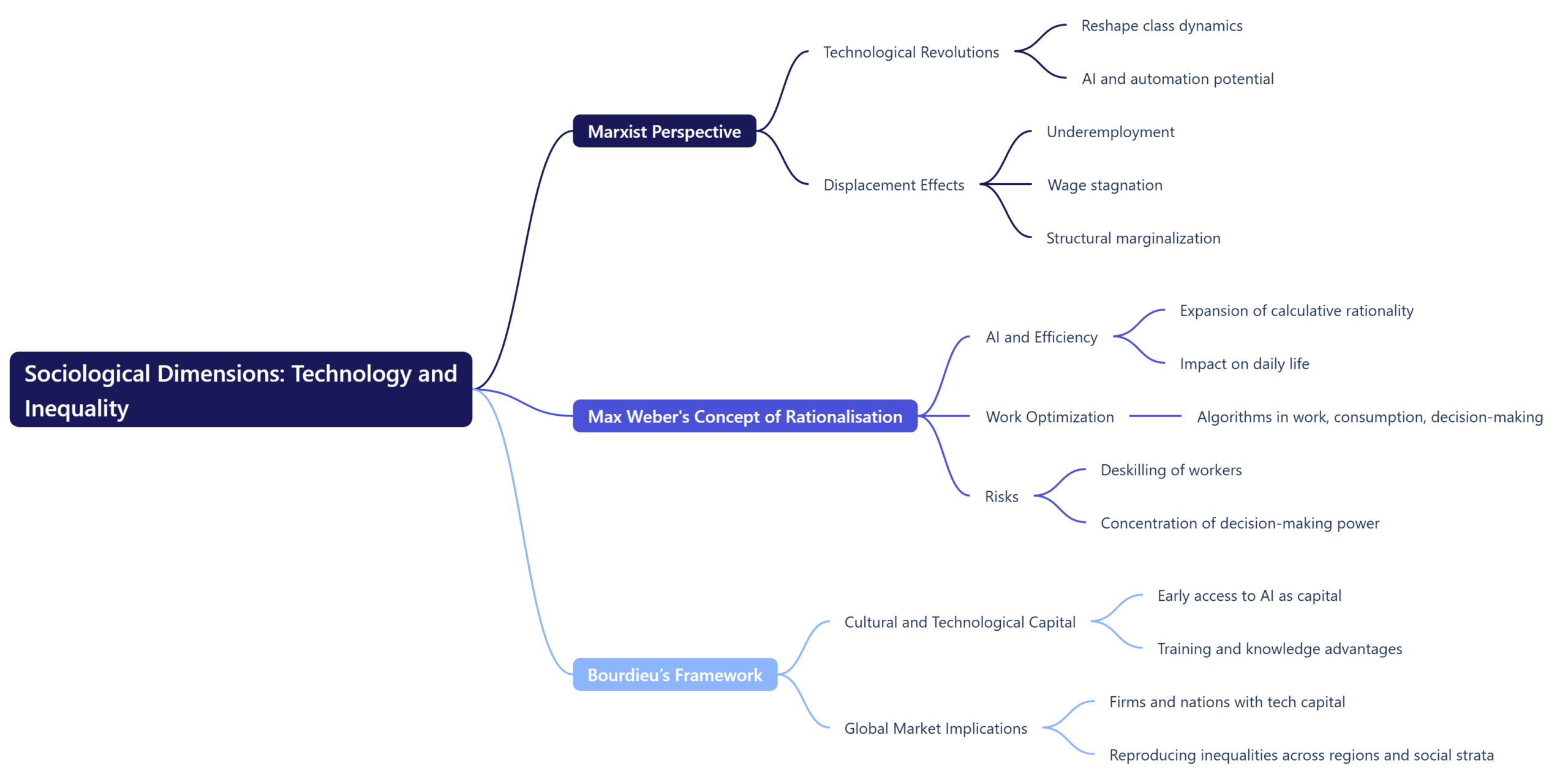
Sociology provides insight into how technological booms affect social structures and power relations. Marxist scholars argue that technological revolutions reshape class dynamics. AI, with its promise of automating routine labour, could exacerbate inequality if the benefits accrue mainly to capital owners, investors, and highly skilled professionals. Those displaced from traditional work may face underemployment, wage stagnation, or structural marginalisation. Max Weber’s concept of rationalisation is also relevant. AI exemplifies the expansion of efficiency-oriented, calculative rationality into everyday life. Algorithms optimize work, consumption, and decision-making. While this increases productivity, it also risks deskilling workers and concentrating decision-making power in the hands of tech elites and corporations. Bourdieu’s framework of cultural and technological capital is equally illuminating. Early access to AI tools, training, and knowledge becomes a form of capital that amplifies social advantage. Firms and nations with greater technological capital are positioned to dominate global AI markets, potentially reproducing inequalities across regions and social strata. The Risk of Concentration and Systemic VulnerabilityA small set of firms—sometimes dubbed the “Magnificent Seven”—dominates AI investment and infrastructure. From a sociological perspective, this concentration raises concerns about power asymmetry and economic dependency. The failure of these firms could disrupt supply chains, displace workers, and stall technological diffusion. The consequences are not merely financial—they have social implications, including employment volatility and the reinforcement of existing hierarchies. Foucault’s concept of governmentality can be applied here: the governance of knowledge and technology extends beyond laws to shaping how people work, learn, and consume. AI is not merely a product; it is a regulatory force that structures human behaviour, institutional priorities, and labour markets. The social impact of an AI “correction” or bubble burst could extend far beyond stock prices. Lessons from Economic SociologyEconomic sociologists highlight that markets are socially embedded. Karl Polanyi emphasized that unchecked markets can generate social dislocations if commodification outpaces regulation. The AI market illustrates this: while venture capital flows at unprecedented speed, regulatory frameworks, labour protections, and equitable access lag behind. If left unchecked, this could produce wealth concentration, social discontent, and mismatched expectations between technological potential and societal benefit. Navigating the Boom: Policy and Social Strategy
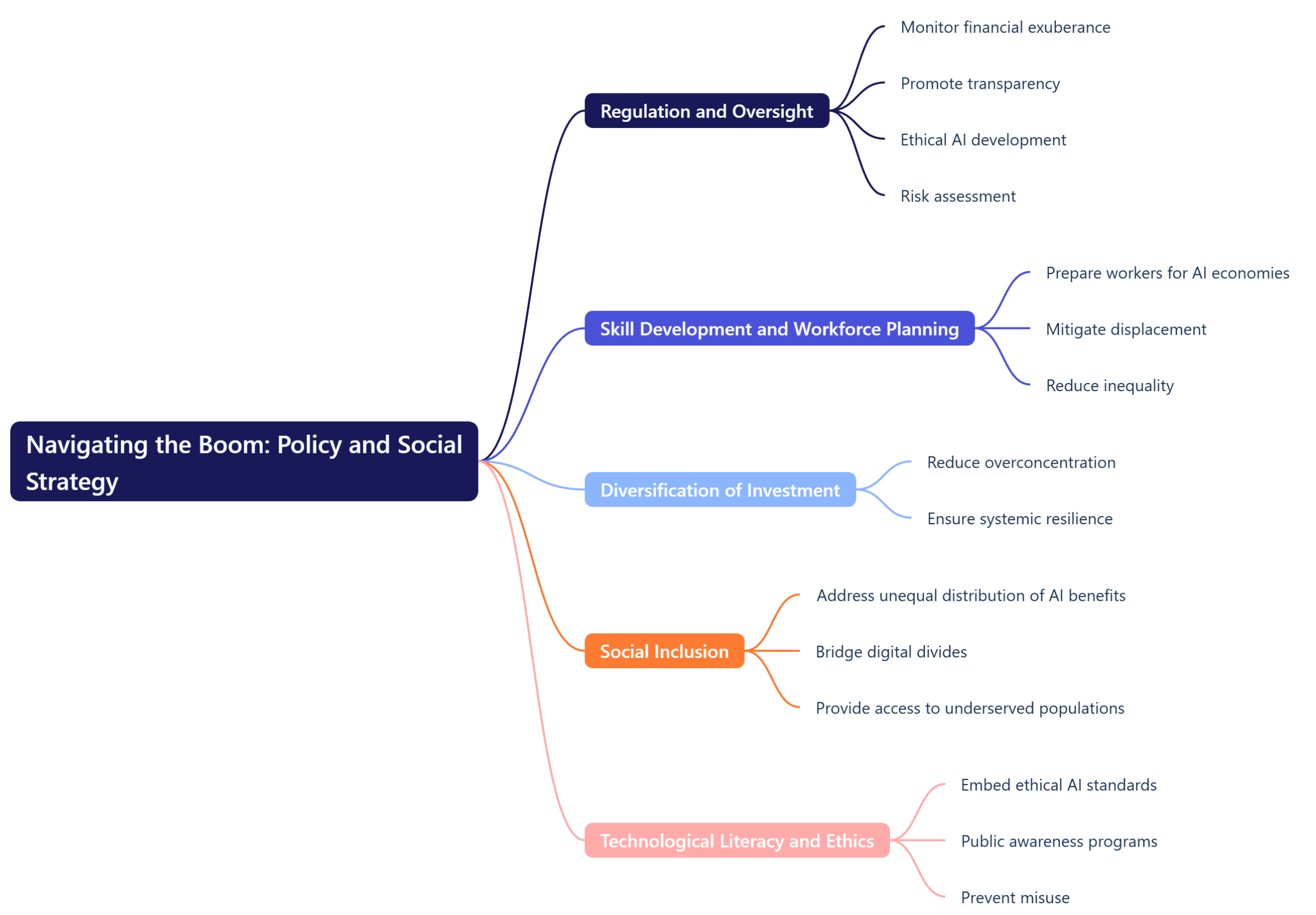
Even if an AI bubble exists, it does not undermine the transformative potential of the technology. The key challenge is alignment—ensuring that AI innovation is paired with sustainable business models, robust regulation, and inclusive social policies. Several strategies emerge:
Conclusion: Boom, Bubble, or Both?AI represents a genuine technological revolution with the potential to transform economies, productivity, and social structures. Yet, signs of a speculative bubble are real: valuations outpace current earnings, capital concentration is extreme, and expectations may exceed achievable outcomes. From a sociological lens, AI is not just an economic phenomenon—it is a force shaping labour markets, social hierarchies, and power relations. A market correction may prune unsustainable ventures, but the technology itself will likely continue to advance. The real challenge lies in aligning innovation with ethical regulation, inclusive skill development, and equitable access. Ultimately, whether the AI boom becomes a bubble or a foundation for sustained societal progress depends less on investor enthusiasm and more on how societies govern, distribute, and adapt to technological power. AI can be a transformative asset—or a disruptive wedge—depending on the structures and policies that guide its integration into everyday life. |
To Read more topics, visit: www.triumphias.com/blogs
Read more Blogs:
Towards an Inclusive India: A Sociological Perspective on Disability Rights and Empowerment
sir please post an article on impact of new labour codes on infromal sector labours.
I think the discussion on inequality and AI is especially relevant. As we push for automation, we must consider the social consequences—whether it’s wealth concentration or job displacement, these need to be addressed in the AI discourse.