Introduction: Artificial Intelligence and Employment
Artificial Intelligence (AI) is transforming every sector—from agriculture to education, manufacturing to healthcare—by automating processes, enhancing efficiency, and driving innovation. However, as machines become more intelligent and capable of performing tasks previously handled by humans, concerns around job displacement, social exclusion, and ethical governance have become central to public discourse.
The debate is no longer about whether AI will disrupt employment but about how deeply it will alter the labor market and social structure. For UPSC aspirants, understanding the sociological implications of Artificial Intelligence (AI) is crucial, especially in the light of Ulrich Beck’s Risk Society, Durkheim’s Division of Labour, and Marx’s concept of alienation.
What is Artificial Intelligence?
Artificial Intelligence refers to machine systems that can simulate human intelligence, including learning, reasoning, problem-solving, and decision-making. AI includes:
- Machine Learning
- Natural Language Processing (NLP)
- Robotics
- Computer Vision
Industries are using AI to automate functions such as customer service (chatbots), data analysis (predictive modeling), logistics (automated supply chains), and manufacturing (robotic assembly lines).
The Impact of AI on Employment:
Global Scenario
- A World Economic Forum report (2023) predicts that 85 million jobs will be displaced by automation by 2025, but 97 million new roles may emerge.
- Jobs requiring routine manual and cognitive tasks are at higher risk, while roles needing emotional intelligence, creativity, and critical thinking may grow.
Indian Context
- NITI Aayog’s National Strategy on AI promotes AI for inclusive growth, yet acknowledges sectoral disruption.
- In India, sectors like IT-BPO, finance, retail, logistics, and even agriculture are integrating AI tools.
- Gig and platform workers are most vulnerable due to low bargaining power and skill redundancy.
Sociological Analysis:
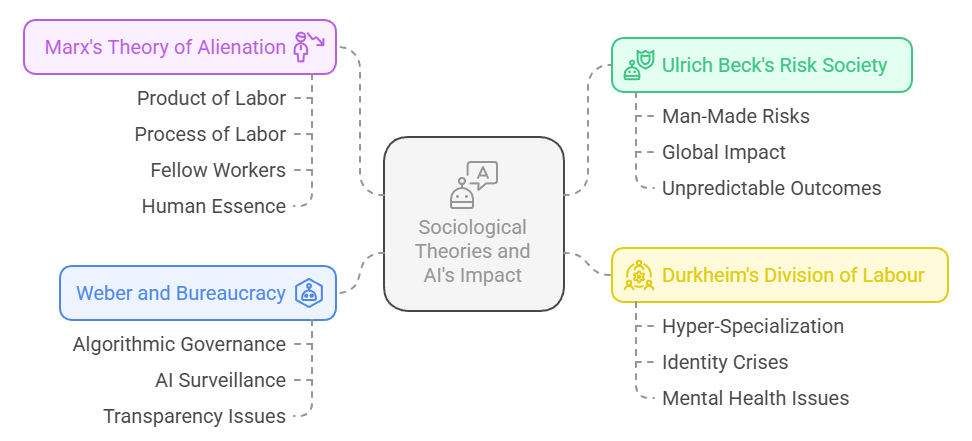
- Ulrich Beck’s Risk Society
Beck argues that modernity is producing new types of risks, unlike the traditional risks of nature. These are man-made, global, and invisible—like climate change or AI-led job loss.
AI introduces “manufactured uncertainty”—we know automation may harm employment, yet we continue on that path.
Risk Characteristics:
- Unpredictable long-term impacts
- Unequal risk distribution (low-skilled workers most affected)
- Institutional failure to regulate emerging technologies
- Marx’s Theory of Alienation
Karl Marx warned that capitalism, with its relentless drive for productivity, alienates workers from:
- The product of labor
- The process of labor
- Fellow workers
- Human essence
AI-driven workplaces deepen this alienation:
- Workers become appendages to machines.
- Algorithmic management tracks every move (e.g., in warehouses).
- Gig workers lack autonomy and dignity in labor.
- Durkheim’s Division of Labour
Emile Durkheim viewed specialization as a source of social solidarity. However, excessive division without integration can lead to anomie—a state of normlessness. AI creates new forms of hyper-specialization, where workers perform narrowly defined, tech-mediated roles. This can:
- Disrupt traditional work roles
- Create identity crises
- Deepen mental health issues and job dissatisfaction
- Weber and Bureaucracy
Max Weber’s rational-legal model of bureaucracy is now being replaced or supplemented by algorithmic governance. Decision-making is increasingly automated:
- AI decides job promotions, hiring, and productivity metrics.
- Bureaucratic authority is now being challenged by AI-based surveillance systems.
This transition reflects a shift from human rationality to machine logic—raising issues of transparency and accountability.
AI and Job Displacement:
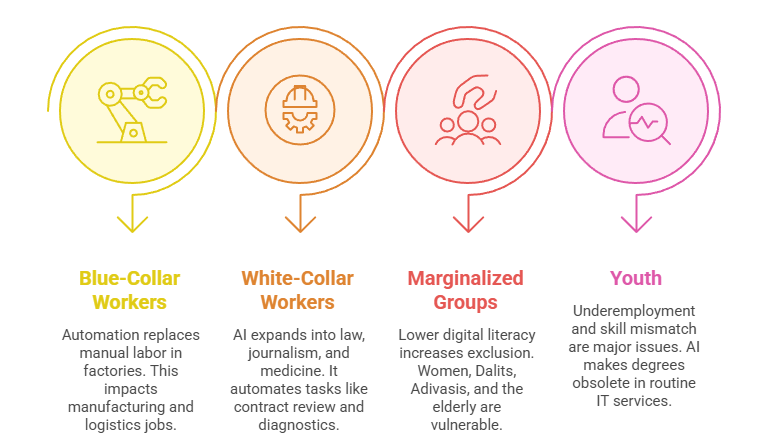
- Blue-Collar Workers: Factory automation and robotic process automation (RPA) are replacing manual jobs in manufacturing and logistics.
- White-Collar Workers: AI is now encroaching into white-collar domains such as law (contract review), journalism (auto-generated reports), and even medicine (diagnostics).
- Women and Marginalized Groups: Due to lower digital literacy and social constraints, women, Dalits, Adivasis, and the elderly are more vulnerable to exclusion from the digital economy.
- Youth: Youth in India face a dual crisis of underemployment and skill mismatch. AI is making many degrees obsolete, especially in fields like routine IT services.
Government Initiatives and Policy Responses
- Digital India Programme: Promotes digital literacy and AI integration but lacks focus on employment protection.
- Skill India Mission: Aims to re-skill the workforce, but most training modules are not aligned with AI-driven jobs.
- National AI Strategy (NITI Aayog): Encourages AI in sectors like agriculture, education, and healthcare, with an emphasis on AI for All, yet implementation is skewed.
- Code on Social Security, 2020: Acknowledges gig and platform workers, but fails to provide job security amidst AI disruptions.
Way Forward
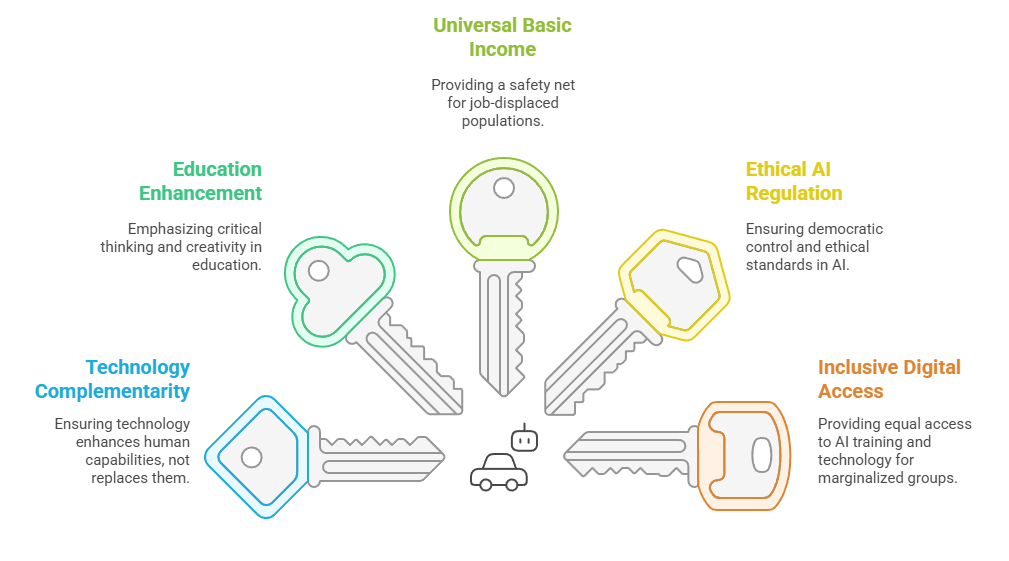
- Technology with Human Face: Technology should enhance human capabilities, not replace them. Policies must aim for complementarity, not substitution.
- Reskilling and Education: Education must emphasize critical thinking, emotional intelligence, and creativity—areas where AI lags behind.
- Universal Basic Income (UBI): Guy Standing has proposed UBI as a safety net for job-displaced populations. India should experiment with pilot models, especially in AI-heavy sectors.
- Ethical AI and Regulation: Democratic control over algorithms is essential. Regulations must ensure data privacy, algorithmic transparency, and labor protection.
- Inclusive Digital Transformation: Marginalized groups must be given preferential access to AI training, internet connectivity, and gig worker protections to prevent deepening inequalities.
Conclusion
Artificial Intelligence, while revolutionary, represents a double-edged sword—offering growth and efficiency on one side and job loss and inequality on the other. From a sociological lens, AI is not just a technological challenge but a moral and structural one. It demands a rethinking of our economic institutions, educational systems, and social protections.
PYQs
Paper I
- Explain Ulrich Beck’s theory of risk society with reference to current technological developments. (2020)
- Discuss how technological changes have transformed the nature of work in modern societies. (2019)
Paper II
- Evaluate the social consequences of gig and platform-based economy in India.(2022)
|