Introduction:
Anti-rationalism refers to a critical stance against the supremacy of rational thought, reason, and logic as the only or highest forms of knowledge. It challenges the Enlightenment idea that rationality alone can lead to human progress and liberation. Instead, anti-rationalism argues that emotion, tradition, intuition, faith, and cultural experience also shape human understanding and action. In sociological discourse, anti-rationalism is not a rejection of reason per se but a critique of the excessive reliance on rationalism, especially in the Western tradition of modernity. This critique has far-reaching implications for understanding social change, cultural resistance, religious revivalism, nationalism, and identity politics in both Western and Indian contexts.
Historical Background:
The Age of Enlightenment (18th century) marked the rise of rationalism, emphasizing scientific reasoning, objectivity, and secularism. Rationalism laid the foundation for modern institutions such as bureaucracy, democracy, capitalism, and scientific research. However, by the 20th century, many sociologists and philosophers began to challenge this “rationalist hegemony”. The World Wars, environmental degradation, alienation, and technocratic control revealed the dark side of hyper-rational modernity. Thinkers began asking whether rationality alone can guide ethical decisions, maintain social cohesion, or protect human dignity.
Sociological Analysis
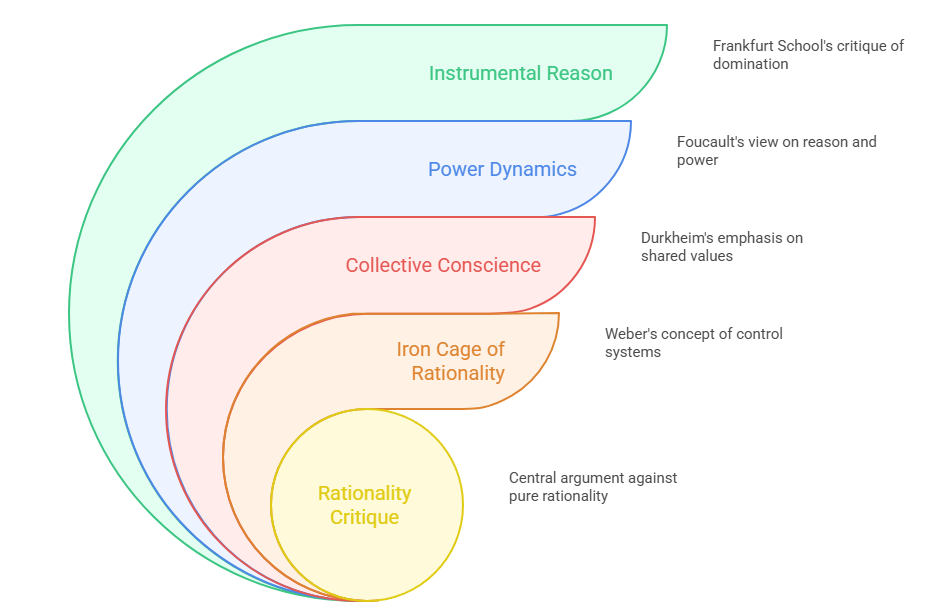
- Max Weber was not an anti-rationalist but highlighted the “iron cage” of rationality. He argued that bureaucracy and rational-legal authority trap individuals in systems of control and depersonalization. Rationalization, while efficient, undermines tradition, emotion, and individual creativity.
- Emile Durkheim emphasized the role of collective conscience, rituals, and religion in maintaining social order. For him, rationalism fails to explain the moral basis of society, which stems from shared beliefs and values, not logical deduction.
- Michel Foucault critiqued the Enlightenment project, arguing that reason is not neutral but entangled with power. Rational institutions such as hospitals, prisons, and schools regulate individuals through disciplinary mechanisms.
- Thinkers like Theodor Adorno and Max Horkheimer in the Frankfurt School argued that instrumental reason has become a tool for domination in capitalist societies. Rationality is used not to emancipate but to control labor, markets, and even desires.
Anti-Rationalism in Postmodern Thought
Postmodernism is deeply anti-rational in its essence. It questions meta-narratives, objective truths, and universal reason.
- Jean-François Lyotard defined postmodernism as “incredulity towards meta-narratives.”
- Jacques Derrida’s deconstruction shows that texts have multiple meanings, undermining the rational pursuit of one ‘truth.’
- Zygmunt Bauman’s liquid modernity reflects how rigid rational structures collapse under the pressure of fast-changing, fluid societies.
Dimensions of Anti-Rationalism
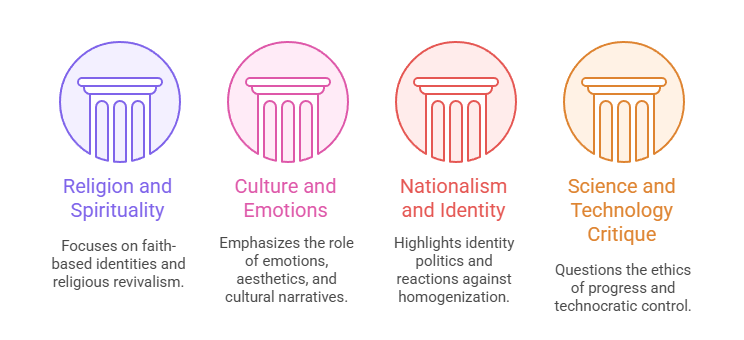
- Religion and Spirituality: Anti-rationalism finds fertile ground in religious revivalism, especially in India. Movements like ISCON, Ram Mandir Movement, or Neo-Buddhism reflect a shift away from secular rationality toward faith-based identities.
- Culture and Emotions: Rationalism often sidelines emotions, aesthetics, and cultural narratives. Anti-rationalism brings back the role of sentiment, storytelling, and mythology, particularly in post-colonial societies reclaiming their voice.
- Nationalism and Identity: The rise of identity politics—is it ethnic, religious, or caste-based—is a reaction against the homogenizing logic of rationalism. In India, the resurgence of Hindutva, Dalit assertion, and regionalism all express anti-rationalist sentiments grounded in history, memory, and affect.
- Science and Technology Critique: Movements like environmentalism or anti-GMO campaigns are also skeptical of pure scientific rationality. They question the ethics of progress, technocratic control, and disregard for traditional knowledge systems.
Anti-Rationalism in Indian Context:
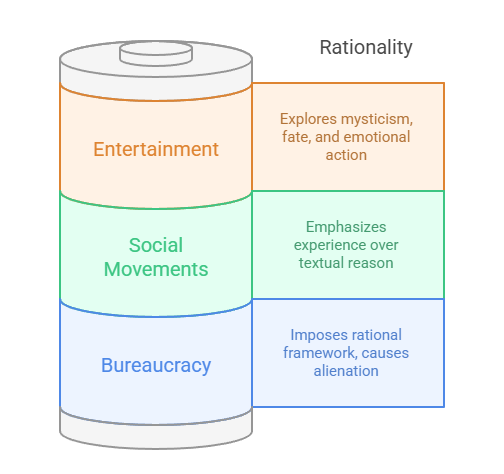
- Colonial Legacy and Rational Bureaucracy: British colonialism imposed a rational-legal framework that undermined traditional institutions like panchayats, kinship networks, and customary law. Post-independence India retained this framework, leading to alienation and inefficiencies. The bureaucratic inertia and red tape are seen by many as symptoms of over-rationalization.
- Rise of Subaltern Voices: Dalit and tribal movements in India emphasize experience and oral histories over textual reason. Anti-rationalism here becomes a tool for epistemic justice, challenging upper-caste dominated knowledge systems.
- Popular Culture and Anti-Rational Themes: Indian films, television, and literature often explore mysticism, fate, karma, and emotional over rational action. This reflects the cultural embeddedness of anti-rationalism in everyday life.
Implications of Anti-Rationalism in Contemporary Society
Positive Aspects
- Revival of cultural knowledge systems (g., Ayurveda, Indigenous medicine)
- Resistance to authoritarian rationalism and technocratic elitism
- Recognition of plural ways of knowing (narratives, emotions, faith)
Negative Aspects
- Rise in irrational populism and conspiracy theories
- Erosion of scientific temper and public reasoning
- Spread of pseudo-science and superstition
- Challenges in policy-making in areas like public health, education, and climate
Conclusion:
Anti-rationalism is a powerful critique of the limits of Enlightenment rationality, but it does not advocate abandoning reason altogether. Instead, it invites us to broaden our understanding of how societies work—recognizing emotion, culture, spirituality, and lived experiences as valid dimensions of human life.For sociologists and policy thinkers, this means moving beyond binaries like modern vs. traditional, rational vs. irrational, and embracing a pluralistic worldview where reason coexists with tradition, and logic with intuition.
PYQs
Paper 1
- ‘Tradition is not always anti-modern.’ Discuss with suitable examples.
–2022
- Critically examine the Frankfurt School’s critique of reason and instrumental rationality in capitalist societies.
–2021
- Explain the features of post-modernism and discuss how it challenges the foundational ideas of rationality and objectivity in sociology.
–2019
- Is sociology a science? Critically assess the nature and scope of sociological knowledge.– 2018
- How does Weber explain the process of rationalization in the Western context? Discuss its social consequences.–2017
- Examine the role of religion in the age of rationality and scientific progress.–2016
- What is ‘Verstehen’? Discuss its significance in understanding human behaviour.–2014
|


One comment