Introduction
Corruption has long been a persistent structural issue in India, eroding institutional integrity, distorting public services, and perpetuating poverty and inequality. As a response, anti-corruption movements in India have periodically risen to demand transparent governance, moral accountability, and democratic participation. These movements are not merely political agitations; they are sociological phenomena, deeply rooted in the evolving state-society relationship. This blog explores anti-corruption movements in India through a sociological framework.
What is Corruption?
Corruption is more than bribery or embezzlement—it reflects a breakdown in the moral economy of institutions and an erosion of public trust. From a sociological viewpoint, it is interlinked with:
- Inequality of power and resource access
- Patron-client networks and feudal remnants
- Weak institutional accountability
- Political culture of rent-seeking
Max Weber’s concept of rational-legal authority suggests that bureaucracies, when functioning without transparency, degenerate into corrupt institutions due to loss of formal rules and impersonality.
C. Wright Mills’ power elite theory explains how a small group controls major institutions, making corruption systemic and normalized.
Major Anti-Corruption Movements in India
- JP Movement (1974-75) – Precursor of People’s Struggle
- Led by Jayaprakash Narayan, this movement arose in Bihar and expanded nationally.
- It protested against rising inflation, unemployment, and “total corruption”.
- Considered a foundational civil society movement that shaped democratic discourse.
- India against Corruption (2011) – Urban Middle-Class Revolt
- Led by Anna Hazare, with key members like Arvind Kejriwal and Kiran Bedi.
- Demanded enactment of the Jan Lokpal Bill, a strong anti-corruption ombudsman.
- Used non-violent protest, fasts, and mass mobilization as tools.
Digital media revolutionized protests, enabling real-time mobilization and nationwide reach through platforms like Facebook and Twitter.
Legislative Outcomes:
| Movement |
Key Outcome |
| India Against Corruption |
Lokpal and Lokayuktas Act, 2013 |
| RTI Activist Networks |
Right to Information (RTI) Act, 2005 |
| MGNREGA Social Audits |
Institutionalized citizen-led audits |
| Whistleblower Protests |
Whistleblower Protection Act, 2014 |
Sociological Analysis
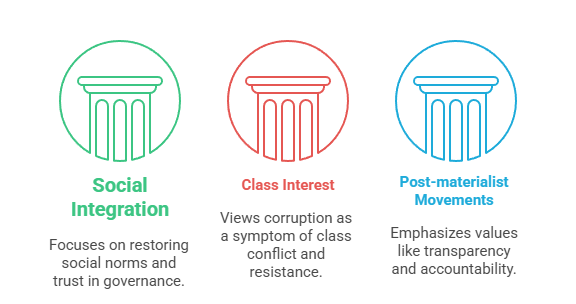
- Social Integration
Durkheim argued that deviance (like corruption) threatens collective conscience. Anti-corruption movements aim to restore social norms, build trust in governance, and re-establish moral order.
- Class Interest
Marxists view corruption as a symptom of class conflict. The ruling elite capture state machinery for private gain. Anti-corruption movements, then, become a form of resistance by the oppressed middle and lower classes demanding equitable governance.
- Post-materialist Movements
As theorized by Alain Touraine and Alberto Melucci, modern movements focus on:
- Values like transparency, dignity, accountability
- Urban, educated, and middle-class participants
- Emphasis on identity and ethics, not just material gain
The India against Corruption campaign exemplifies this shift.
Sociological Critique
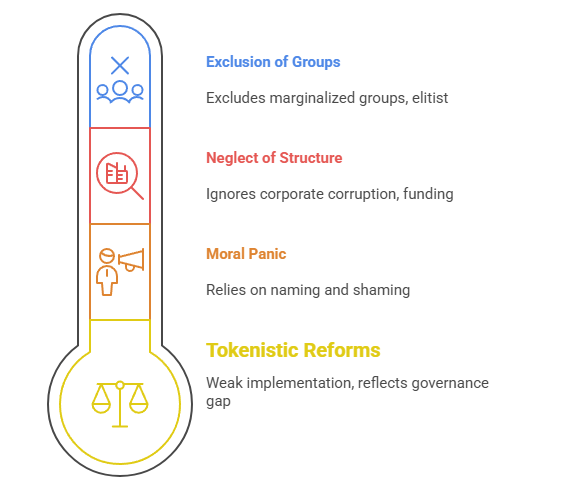
- Tokenistic Reforms: Laws like Lokpal may exist, but implementation remains weak—reflecting the “implementation gap” in Indian governance.
- Moral Panic and Media Hype: The movement often relied on naming and shaming rather than systemic change. It sparked moral panic, not always backed by facts.
- Neglect of Structural Corruption: Focused on petty corruption rather than corporate corruption, electoral funding, or judicial accountability.
- Exclusion of Marginalized Groups: Dalits, Adivasis, and rural poor were not visible actors, raising concerns about urban elitism.
Role of Civil Society and Media
- Civil society organizations (CSOs) such as MKSS, CHRI, and India against Corruption have led campaigns against political and bureaucratic corruption.
- Print, TV, and digital media shaped the public narrative, acting as watchdogs and amplifiers of citizen voices.
- Media trials, however, also raise concerns about populism and half-truths.
Habermas’ Public Sphere Theory suggests that anti-corruption activism rejuvenates public discourse and democratic deliberation.
Class and Caste Dynamics of Anti-Corruption Movements
While most anti-corruption campaigns are middle-class driven, their outcomes deeply affect lower castes and rural poor:
- RTI has empowered marginalized communities to question ration distribution, NREGA wages, and school schemes.
- However, dominant caste elites often control resources and bypass reforms using influence.
D.L. Sheth emphasized the role of intermediate castes and middle classes in redefining state accountability and participatory politics.
Challenges Faced by Anti-Corruption Movements
- Fragmentation of Leadership: Post-2012, differences emerged between Anna Hazare and Arvind Kejriwal, weakening the movement.
- Institutional Pushback: The Lokpal Act was passed, but its implementation remains lukewarm.
- Urban Bias: Movements like IAC did not fully connect with rural or Dalit constituencies.
- Token Reforms: Laws were enacted, but systemic loopholes remain unaddressed.
Case Studies
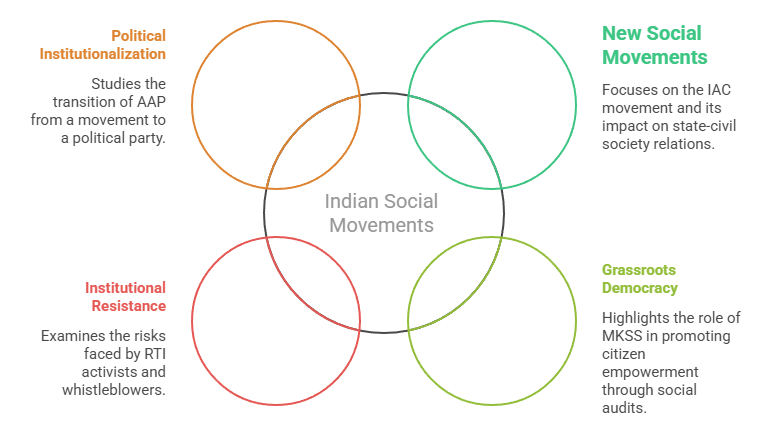
- Anna Hazare’s IAC Movement – Use as a case study in New Social Movements and State-Civil Society relations
- MKSS and Social Audits in Rajasthan – Relevant for grassroots democracy and citizen empowerment
- RTI Activism and Whistleblower Deaths – Reflect institutional resistance and risk to dissent
- AAP’s rise from Movement to Political Party – Study political institutionalization of movements
Contemporary Relevance
Anti-corruption discourse remains central in Indian democracy due to:
- Electoral Bond Transparency Issues
- Pegasus Spyware Surveillance
- Public Sector Recruitment Scams (e.g. Vyapam)
- Allegations against Corporate-State Nexus
These issues make it clear that citizen vigilance, transparency, and accountability mechanisms are more critical than ever.
Conclusion
Anti-corruption movements in India showcase the assertion of democratic citizenship. They reflect the transformation of passive political culture into active civil engagement. While they have achieved partial success in pushing legal reforms and awakening public consciousness, they must be complemented with institutional strengthening, grassroots mobilization, and inclusive participation.
PYQ
Paper I:
- Discuss the role of civil society in democracy. (2022)
- How do sociologists view the interface between state and social movements? (2021)
- How does the bureaucratic structure of the state affect social development? (2020)
- How do pressure groups influence the policymaking process in a democratic society? (2019)
- How are non-governmental organizations (NGOs) contributing to social development in India? (2018)
- How is modernization theory criticized in the context of development in the Global South? (2017)
- Examine the role of civil society in contemporary India. (2016)
- Discuss the relationship between state and civil society in the post-liberalization era. (2015)
- How do functionalist and conflict perspectives explain the role of the state in society? (2014)
- Critically examine the impact of globalization on rural institutions in India. (2013)
Paper II:
- Highlight the changing rural power structure in India. How is it impacting rural development? (2023)
- Discuss the role of Self-Help Groups (SHGs) in the socio-economic development of rural women in India. (2022)
- Critically examine the success and limitations of land reforms in India. (2021)
- Analyze the factors responsible for the growing informalization of rural labour in India. (2020)
- Explain how Panchayati Raj institutions have empowered rural women. (2019)
- Evaluate the impact of MGNREGA on rural labour market and poverty alleviation. (2018)
- What role do NGOs play in rural development and empowerment of marginalized groups in India? (2017)
- Discuss the implications of rural-to-urban migration on rural development and family structure. (2016)
- Examine the impact of the Green Revolution on the agrarian social structure. (2015)
- What are the sociological implications of the failure of rural development programs in India? (2014)
|

One comment