Introduction: Andhra Pradesh Labour Law Amendment
The recent decision by the Andhra Pradesh government to extend working hours in private factories and companies from 9 to 10 hours per day has sparked a nationwide debate. Framed as a measure to enhance industrial productivity and attract foreign direct investment (FDI), the move is being criticised by labour unions and civil society groups for undermining workers’ rights. The amended law also permits night shifts for women, provided there are safety measures in place.
This development brings to light larger issues surrounding labour market flexibility, capital-labour conflict, and gendered division of labour, making it a crucial case study for aspirants of UPSC Sociology and students of labour sociology.
Key Highlights of the New Labour Law Amendments
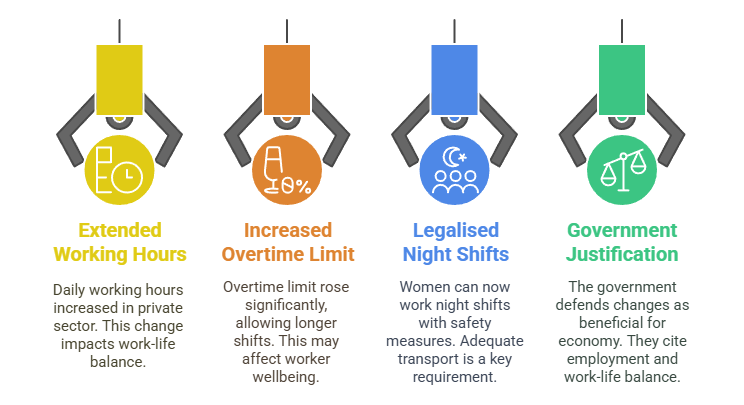
- Working Hours Extended: From 9 hours to 10 hours per day in private firms and factories.
- Overtime Limit Rose: Increased to 144 hours per quarter, with potential 12-hour shifts under certain conditions.
- Night Shifts for Women Legalised: Allowed from 7 PM to 6 AM, contingent on adequate safety and transport facilities.
- Justification by the Government: Framed as a policy for economic growth, employment generation, and work-life balance.
Sociological Analysis
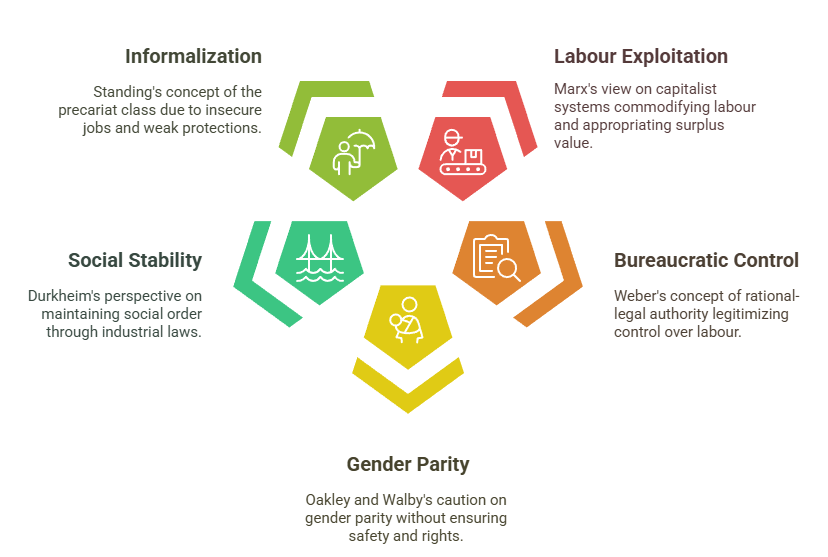
- Labour as Exploited Class: According to Karl Marx, under capitalist systems, labour is commodified, and the surplus value generated by workers is appropriated by capitalists. The extension of working hours without proportionate benefits or increased wages can be seen as a form of economic exploitation, intensifying alienation among workers. The state acting in favour of capital rather than labour echoes Marx’s notion of the state as an instrument of the ruling class.
- Bureaucratisation and Rationalisation: Max Weber’s idea of rational-legal authority and bureaucratisation helps us understand how the law is being used to legitimise increased control over labour. Framing longer working hours as “productivity enhancement” reflects instrumental rationality, where efficiency is valued over human well-being.
- Gender and Work Participation: Allowing women to work night shifts is being hailed as a step toward gender parity in the formal workforce. However, Ann Oakley and Sylvia Walby would caution that unless safety, reproductive rights, and gender-sensitive policies are ensured, such reforms may simply reproduce existing patriarchal structures in new forms. The risk of increased double burden—workplace plus domestic labour—also looms large.
- Stability vs Disruption: From a Durkheimian lens, industrial laws are part of the normative structure that maintains social order. Sudden changes in work hours without adequate consensus or protection could create anomie among workers, disrupting their routine social functions and weakening collective solidarity.
- Informalisation of Formal Work: This policy, under the guise of “flexibility,” reflects a broader trend of informalisation of formal sector jobs, leading to weaker protections, irregular hours, and erosion of collective bargaining. It reinforces what Guy Standing terms the “precariat” class—workers with insecure jobs and no social security.
Implications for Indian Society
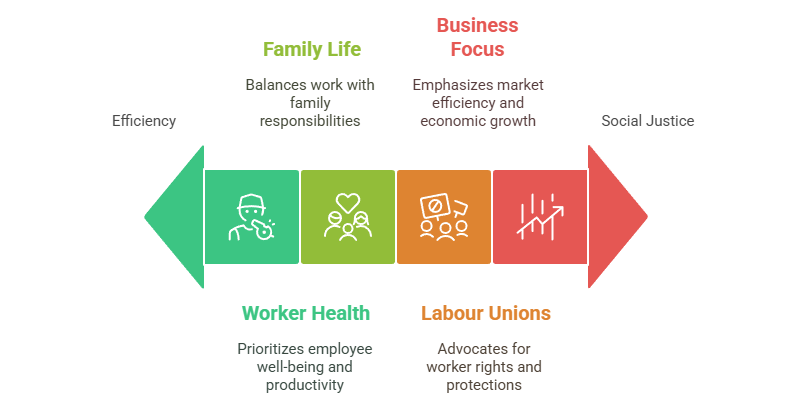
- Worker Health and Well-being: Long hours can result in physical exhaustion, mental health issues, and reduced productivity over time.
- Impact on Family Life: Extended work hours and night shifts may strain family relations, especially for working women who already face a second shift at home.
- Labour Union Resistance: The weakening of traditional labour protections could lead to a resurgence of labour movements and collective protests.
- Ease of Doing Business vs Social Justice: The tension between market efficiency and social justice becomes pronounced, revealing the limits of neoliberal governance.
Conclusion
While the aim of increasing investments and industrial growth is legitimate, it must not come at the cost of diluting labour protections that have taken decades to institutionalise. The move to extend working hours and allow night shifts for women might appear progressive, but without holistic policy safeguards, worker representation, and gender-sensitive infrastructure, such reforms may deepen social inequality and labour exploitation. For a society aiming for inclusive development, economic objectives must align with human dignity and justice.
PYQs
Paper I
- Discuss the changing nature of work and work processes in the capitalist society. (2023)
- Analyse how the concept of alienation is relevant in understanding the contemporary work environment. (2022)
- How do informal labour and casualisation affect industrial relations in India? (2020)
- Discuss how globalisation has affected the labour class in contemporary society. (2018)
- Critically examine the role of the state in labour welfare in the era of globalisation. (2021)
- Discuss the role of the state in promoting gender equality in the labour market. (2017)
- What are the features of post-industrial society and how do they affect labour relations? (2015)
Paper II
- Critically analyse the status of working women in the unorganised sector in India. (2023)
- Do you agree that the Indian working class has failed to develop class consciousness? Substantiate your answer with examples. (2022)
- Examine how state policies affect industrial labour in India. (2021)
- Explain the concept of feminisation of labour and its implications in India. (2020)
- Discuss the impact of labour reforms on working conditions in Indian industries. (2018)
- Highlight the challenges faced by trade unions in India in the post-liberalisation period. (2016)
- Assess the impact of night shifts and long work hours on the health and family life of women in Indian urban settings. (2017)
|



One comment