Introduction: Ethical Perspective on Poverty
Poverty is more than just an economic issue; it is a moral and ethical crisis that tests the conscience of society. Reducing poverty is not merely a policy target but a moral duty, rooted in the principles of justice, human dignity, compassion, and equality. From Mahatma Gandhi’s emphasis on Sarvodaya (the welfare of all) to the United Nations’ Sustainable Development Goals (SDG-1: No Poverty), tackling poverty requires an ethical lens to ensure no one is left behind.
Poverty as an Ethical Issue
Poverty:
- Violates human rights like food, health, education, and shelter.
- Creates structural injustices that disproportionately harm women, children, marginalized castes, and rural populations.
- Drives intergenerational poverty traps, weakening future generations and social cohesion.
Ethically, poverty is a shared responsibility of society and the state — calling for action rooted in empathy and fairness.
Ethical Theories and Poverty
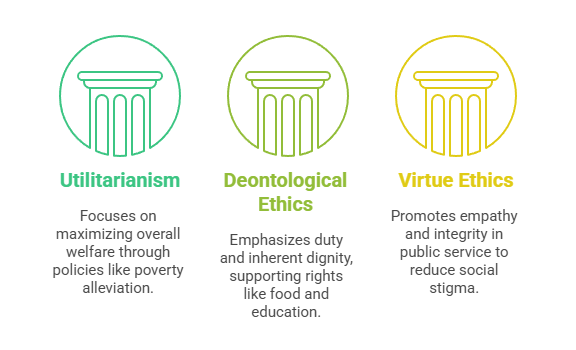
1.Utilitarianism
Goal: Greatest good for the greatest number.
Application: Poverty alleviation schemes like MGNREGA, PDS, and Direct Benefit Transfers improve aggregate welfare.
Challenge: Pure utility can overlook individual rights if they don’t maximize overall utility.
2.Deontological Ethics (Kantian)
Goal: Duty-based ethics emphasizing inherent dignity.
Application: Treating every person as an end in themselves supports unconditional entitlements like the Right to Food (NFSA, 2013) and the Right to Education.
Challenge: Rigid duties can be financially hard to implement in resource-strapped settings.
3.Virtue Ethics
Goal: Cultivate empathy, compassion, integrity.
Application: Ethical public servants must design schemes with sensitivity, transparency, and honesty — reducing aporophobia (social stigma against the poor).
Challenge: Virtue is subjective; ensuring consistent moral behavior across bureaucracies can be difficult.
Current Poverty Situation — Recent Data
Global (World Bank, June 2025):
- Global extreme poverty (at $2.15/day) is projected to decline to 9.9% in 2025 — down from 10.5% in 2022.
- Sub-Saharan Africa remains the most vulnerable region (~45% poor).
India (NITI Aayog MPI Index, 2024):
- Multidimensional poverty in India fell from 24.8% (2015-16) to 14.9% (2019-21) — lifting ~135 million people out of poverty.
- Extreme poverty at $2.15/day PPP declined to ~2.3% (2022–23), driven by food security (PM-GKAY), MGNREGA, and rural housing schemes.
- However, rural poverty (~7.2%) remains higher than urban (~4.6%), and inequalities persist across states and communities.
Climate Impact
- Poor communities face the harshest effects of climate change (droughts, floods), creating new poverty traps.
- Ethical justice requires wealthier nations to support climate adaptation under the principle of Common but Differentiated Responsibilities.
Ethical Policy Considerations
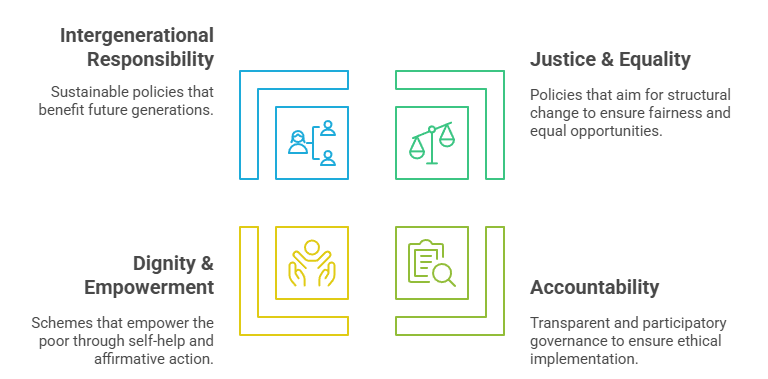
- Justice & Equality: Policies must go beyond charity — aim at structural change (land reform, education equity, skill-building).
- Accountability: Transparent implementation, grievance redressal (e.g. Social Audits in MGNREGA) and participatory decision-making uphold ethical governance.
- Dignity & Empowerment: Poverty schemes must empower the poor — through self-help groups, micro-credit, and affirmative action — rather than creating dependency.
- Intergenerational Responsibility: Sustainable policies (e.g. investments in green energy and education) ensure that future generations inherit less poverty and more opportunity.
Ethical Challenges
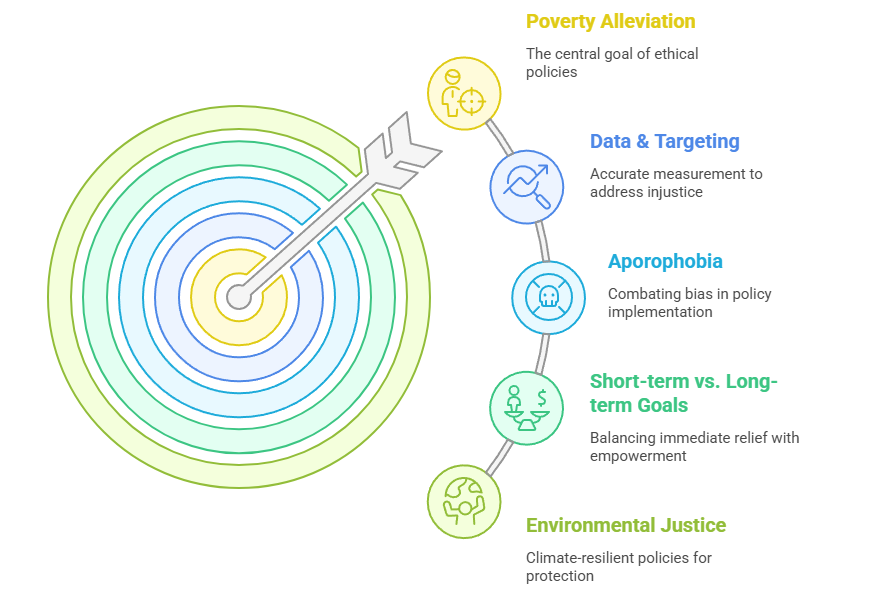
- Data & Targeting: Revising poverty lines and accurate measurement is ethically important — undercounting is an injustice.
- Aporophobia (Hatred of the Poor): Bias against the poor can skew policy and implementation.
- Short-term vs. Long-term Goals: Balancing immediate relief (ration, cash transfers) with long-term empowerment (quality education, healthcare).
- Environmental Justice: Climate-resilient policies to protect vulnerable populations.
Way Forward
- Strengthen human-centric policies rooted in empathy and constitutional values (Article 21, Right to Life & Dignity).
- Adopt a multi-dimensional poverty index that looks beyond income to measure progress in health, education, and living standards.
- Expand grassroots participation (Gram Sabhas, Panchayati Raj Institutions) so that policies reflect real ethical priorities.
- Implement anti-bias training and encourage civil society & media to fight aporophobia.
Conclusion
Poverty is fundamentally an ethical issue that tests the moral fabric of society. Tackling it requires not just economic growth but also ethical leadership, compassion-driven policies, transparent governance, and active participation of all stakeholders.
As Mahatma Gandhi said, “Recall the face of the poorest and weakest person you may have seen, and ask yourself if the step you contemplate is going to be of any use to him.” This timeless test is as relevant to policy-making today as it was decades ago. |


3 comments