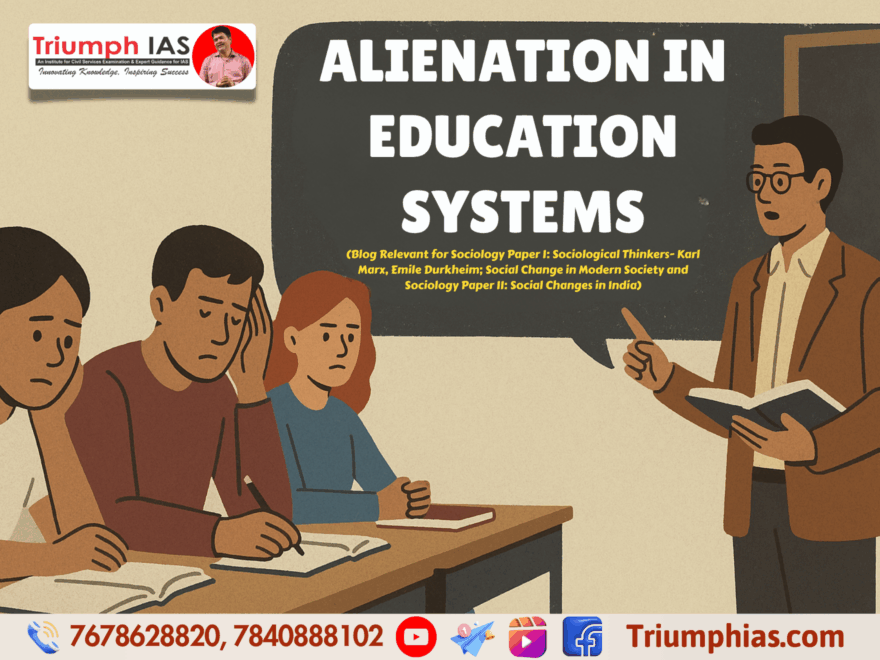
Introduction: Alienation in Education Systems
Despite being hailed as the cornerstone of empowerment, the education system often fails to resonate with the very individuals it seeks to uplift. Across India and the globe, many students feel alienated — emotionally detached, socially marginalized, and intellectually uninspired. This blog delves into the sociological underpinnings of alienation within educational institutions, exploring why education, instead of being a bridge to liberation, often becomes a wall of exclusion.
Understanding Alienation in the Context of Education
In sociology, alienation is the feeling of estrangement individuals experience when they are disconnected from society, others, or even themselves. While Marx introduced this concept in relation to labor and capitalism, modern sociologists have extended it to education — a key institution of socialization.
In the educational context, alienation refers to:
- Lack of sense of belonging in school environments,
- Perceived irrelevance of curriculum,
- Breakdown of meaningful teacher-student interaction,
- Structural inequalities that discourage participation.
Why Does Alienation Occur in Indian Education?
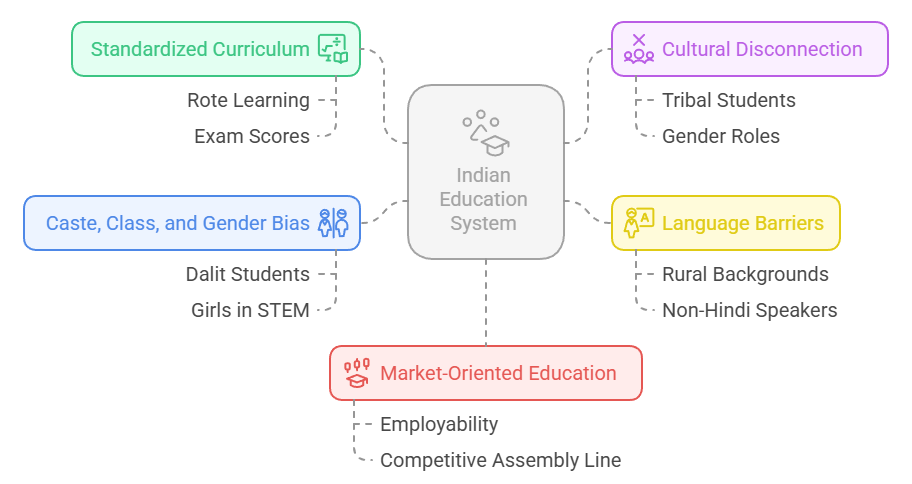
- Standardized, Rote-Based Curriculum
Indian education still emphasizes rote learning and exam scores over critical engagement and creativity. This mechanistic model fails to relate to students’ personal or community lives, making education feel imposed rather than meaningful.
- Cultural Disconnection
A tribal student learning about Mughal kings in a language they barely speak, or a girl reading about gender roles in a patriarchal textbook, is likely to feel excluded. Textbooks rarely represent the cultural diversity of India, leading to an alienation of identity.
- Language Barriers
Mother tongue instruction is limited despite NEP 2020’s recommendations. English-dominated pedagogy alienates students from rural and non-Hindi-speaking backgrounds, leading to poor comprehension and self-esteem issues.
- Caste, Class, and Gender Bias
Sociologists like G.S. Ghurye and M.N. Srinivas have highlighted how caste hierarchies permeate classrooms:
- Dalit students are often seated separately or assigned menial tasks.
- Girls face exclusion in science and math fields.
- Upper-caste dominance in school boards affects curriculum design.
- Overemphasis on Market-Oriented Education
The shift toward job-oriented education and employability has turned learning into a commodity. Students feel like products in a competitive assembly line rather than individuals on a journey of growth.
Sociological Analysis
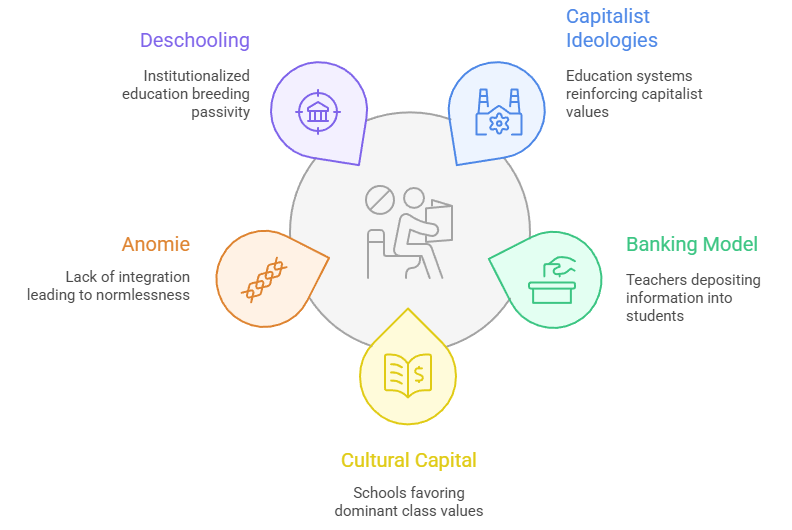
- Alienation and Exploitation: Karl Marx would argue that Education systems, like factories, reproduce capitalist ideologies and alienate individuals from critical thought. Students become passive recipients of knowledge.
- The Banking Model of Education: Paulo Freire criticized traditional education where teachers “deposit” information into students. He advocated for dialogical learning to overcome alienation.
- Cultural Capital and Reproduction: Pierre Bourdieu emphasized that schools privilege the values, norms, and language of the dominant class. This alienates students from marginalized communities who lack the requisite ‘cultural capital.’
- Anomie and Lack of Integration: Durkheim believed education could create solidarity. However, failure to integrate diverse student identities leads to anomie — a condition of normlessness and disconnection.
- Deschooling Society: Ivan Illich argued that institutionalized education often breeds passivity and hierarchy, leading to a loss of authentic, community-based learning.
Recent Cases
- Rohith Vemula Case (2016): A Dalit PhD student at Hyderabad Central University, Rohith’s suicide exposed the deeply entrenched caste-based alienation in higher education.
- IIT Suicides: Premier institutions, despite academic excellence, have witnessed rising student suicides due to mental health issues linked to pressure and alienation.
- Tribal Dropouts: According to a UNICEF report (2023), tribal children have the highest dropout rates due to linguistic and cultural misalignment with formal schooling.
Symptoms of Alienation in Students
- Low participation in class discussions
- Absenteeism and eventual dropouts
- Emotional detachment and apathy
- Academic underachievement despite effort
- Depression, anxiety, and suicidal ideation
Government Policies Addressing Educational Alienation
| Policy |
Objective |
| NEP 2020 |
Emphasizes inclusive, experiential learning and mother-tongue instruction |
| Samagra Shiksha Abhiyan |
Promotes equity and access in school education |
| Mid-Day Meal Scheme |
Encourages school attendance, particularly among marginalized children |
| Manodarpan |
Mental health initiative for school and college students |
Solutions to Combat Alienation
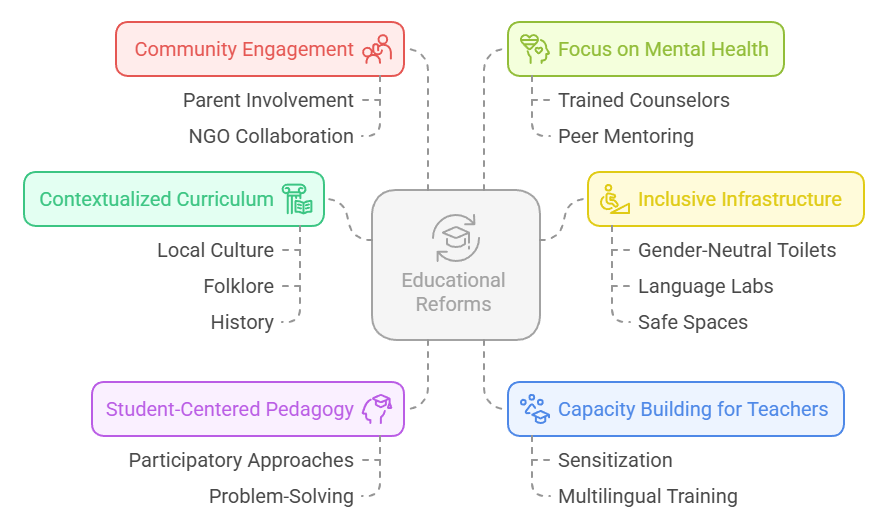
- Contextualized Curriculum
- Incorporate local culture, folklore, history, and language into syllabi.
- Decentralized textbook development with tribal, Dalit, and women representation.
- Student-Centered Pedagogy
- Shift from authoritarian teaching to participatory, problem-solving approaches.
- Encourage critical thinking and creativity over rote learning.
- Inclusive Infrastructure
- Gender-neutral toilets, language labs, safe spaces for marginalized communities.
- Capacity Building for Teachers
- Sensitization to caste, gender, and cultural diversity.
- Training in multilingual and interactive teaching methods.
- Community Engagement
- Involve parents, elders, and NGOs in the schooling process.
- Bridge the gap between school and society.
- Focus on Mental Health
- Appoint trained counselors.
- Promote peer mentoring and emotional literacy in schools.
Conclusion:
Alienation in education is not a fringe issue — it lies at the heart of India’s learning crisis. As the gap between learners and learning widens, there is an urgent need to humanize education. An inclusive, dialogical, and student-centric system — one that listens more than it instructs — can convert classrooms from spaces of alienation to arenas of empowerment.
Previous Year Questions
Paper 1
- “Discuss the role of education in reproduction of inequality. Illustrate with Indian examples.” (2021)
Paper 2
- “Analyze the challenges faced by Indian educational institutions in providing inclusive education.” (2023 )
- “Explain how education contributes to social mobility in India. Why is it often unsuccessful among the marginalized?” (2019)
|

One comment