Introduction
AI Washing is an emerging phenomenon where companies and organizations exaggerate or falsely claim the use of artificial intelligence (AI) in their products or services to attract investment, market share, or public attention. As AI rapidly transforms the global landscape, this misleading practice raises critical concerns for consumers, policymakers, and sociologists alike. This blog explores the meaning of AI washing, why it matters, and its broader sociological implications.
What is AI Washing?
AI Washing refers to the deceptive marketing tactic where organizations label their conventional software or services as “AI-powered” without integrating genuine artificial intelligence or machine learning capabilities. The practice is akin to “greenwashing” in environmental discourse, where companies make misleading claims about eco-friendliness.
Why is AI Washing a Problem?
- Consumer Misinformation: Customers may invest in or use products under the false impression that they are powered by cutting-edge AI.
- Market Distortion: True innovation gets diluted as every company claims to be “AI-first,” making it difficult to separate genuine progress from hype.
- Policy and Regulation Challenges: Policymakers struggle to frame effective regulations when the definition of “AI” is manipulated for profit.
- Societal Trust: Overhyping AI can lead to disillusionment and mistrust in technology.
Sociological Analysis
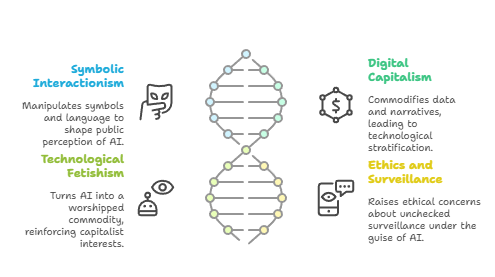
- Symbolic Interactionism & Meaning-Making: AI washing manipulates symbols and language in society. Labeling something as “AI” shapes public perception, influences consumer behavior, and reconstructs the “meanings” attached to technology in everyday life. According to Herbert Blumer, meaning is derived through social interaction—AI washing distorts this by creating a false narrative around technology.
- Digital Capitalism and Social Stratification: Sociologists describe the new digital capitalism where data and digital narratives become commodities. AI washing is a tool in this platform economy, leading to further technological stratification. Only privileged groups may access real AI benefits, while the masses are fed pseudo-AI products.
- Technological Fetishism: Drawing from Karl Marx’s concept of commodity fetishism, AI washing turns technology into a fetishized commodity. The “AI” label is worshipped, often without understanding its actual utility, reinforcing capitalist interests and deepening class divisions in access to real technological advancements.
- Ethics, Surveillance, and Power: Michel Foucault’s ideas of surveillance and biopower are relevant. False claims about AI capabilities can lead to unchecked surveillance and data collection in the name of “smart” services, raising ethical concerns and the need for greater accountability.
Impact on Indian Society
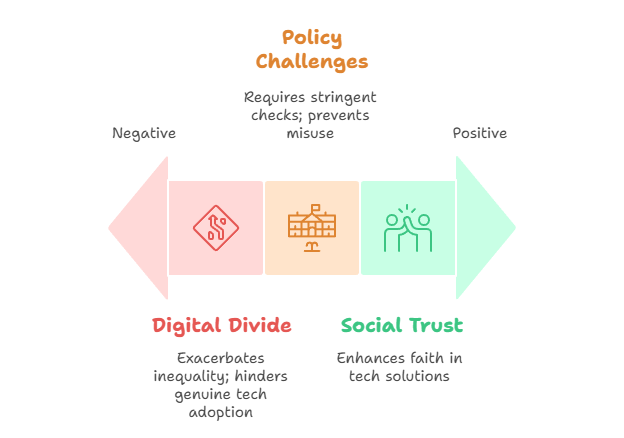
- Digital Divide: In India, AI washing could widen the digital divide as rural and marginalized populations may not discern between real and fake AI-driven solutions.
- Policy Challenges: Government initiatives like Digital India and AI for All require stringent checks to ensure genuine adoption of AI, not just marketing buzzwords.
- Social Trust in Technology: If overhyped claims collapse, trust in technological solutions for public welfare, governance, and education may erode.
Conclusion
AI washing is not just a technical or marketing issue—it is a sociological problem with deep implications for trust, social stratification, policy, and the very nature of technological change in society. As AI becomes central to India’s development discourse, a sociological lens is vital to separate genuine innovation from mere hype and protect public interest.
PYQs
Paper 1:
- Examine the ethical concerns arising from the use of Artificial Intelligence in decision-making processes.(2023)
- Discuss the impact of digital technology on social change in contemporary India.(2022)
- How does the increasing use of social media and digital platforms transform social relationships and community life in India?(2021)
- Examine the role of information and communication technology (ICT) in shaping social stratification and mobility in Indian society.(2020)
- Discuss the implications of surveillance technologies on individual freedom and privacy in modern society.(2018)
- Science and technology are instruments of social change. Comment.(2017)
Paper 2:
- Examine the sociological consequences of automation and artificial intelligence for the Indian workforce.(2023)
- Assess the role of Digital India initiatives in promoting social inclusion and empowerment.(2022)
- Discuss the challenges posed by digital surveillance for democratic governance in India.(2021)
- How has the platform economy affected the nature of work, employment, and worker security in India?(2020)
- Information and communication technology (ICT) as an instrument of social change—Discuss with reference to India.(2016)
|


One comment