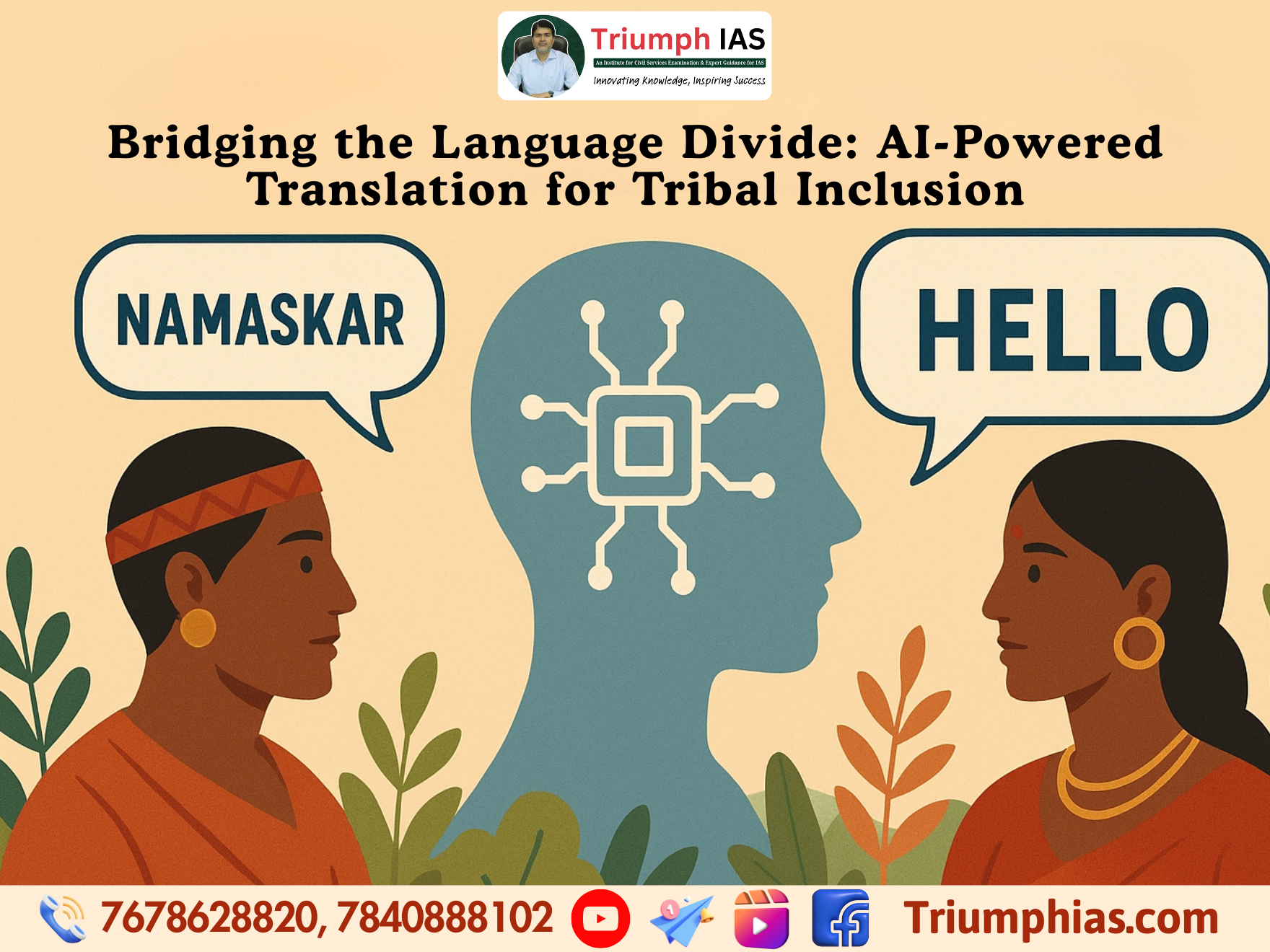
Introduction: Bridging the Language Divide: AI-Powered Translation for Tribal Inclusion
Language is not merely a medium of communication; it is a vehicle of culture, identity, and social participation. In multilingual societies like India, the absence of access to digital and governmental content in tribal languages has historically reinforced marginalization. The launch of Aadi Vaani, India’s first AI-powered translator for tribal languages, exemplifies how technology can mediate social inclusion, echoing sociological concerns about equity, cultural preservation, and empowerment.
Technological Intervention and Social Inclusion
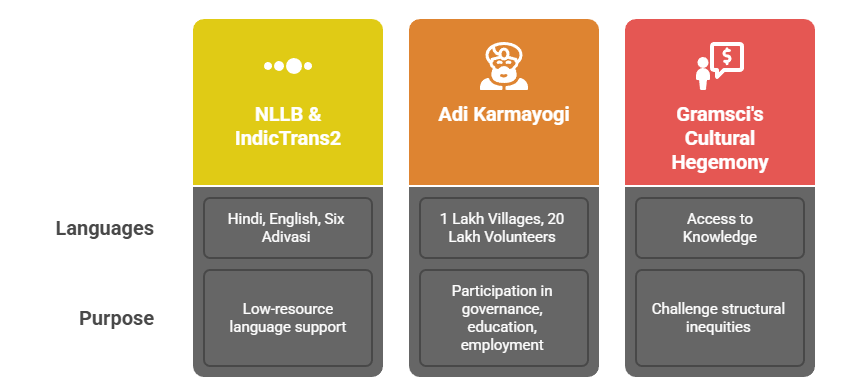
- Aadi Vaani translates between Hindi, English, and six Adivasi languages: Bhili, Mundari, Gondi, Santali, Kui, and Garo.
- Using AI models NLLB (No Language Left Behind) and IndicTrans2, it addresses “low-resource” languages, enabling tribal communities to participate in governance, education, and employment opportunities.
- Linked with Adi Karmayogi, covering 1 lakh villages and 20 lakh volunteers, it illustrates Gramsci’s notion of cultural hegemony, where access to knowledge empowers subordinate groups to challenge structural inequities.
BHASHINI and Linguistic Equity
- The National Language Translation Mission (BHASHINI) promotes translation across 22+ Indian languages, enhancing digital accessibility and inclusivity.
- Integration with platforms like e-Shram, e-Gram Swaraj, CPGRAMS, AICTE, and UGC enables marginalized communities to exercise agency, resonating with Amartya Sen’s capability approach, which emphasizes expanding substantive freedoms and opportunities.
Sociological Dimensions and Thinkers
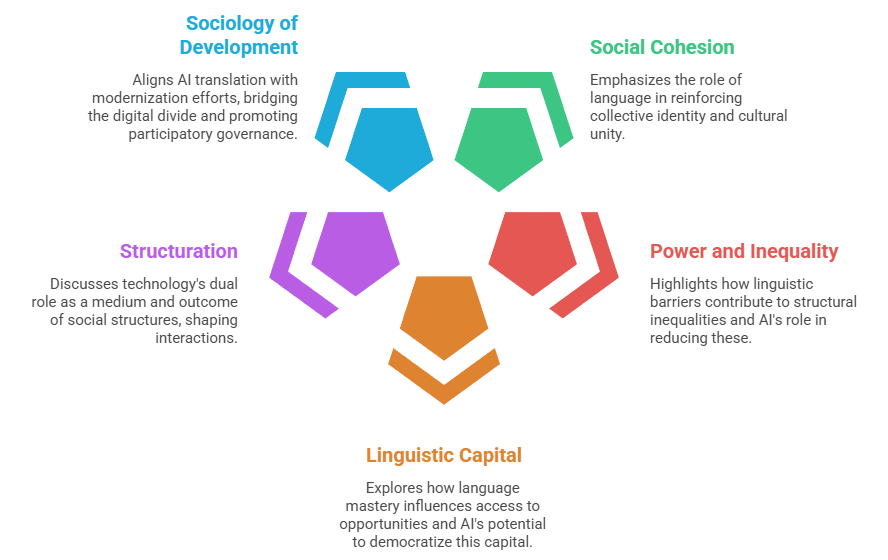
- Émile Durkheim – Social Cohesion: Preserving tribal languages strengthens social solidarity by reinforcing collective identity and shared cultural symbols.
- Karl Marx – Power and Inequality: Linguistic barriers are part of structural inequality, where dominant groups control access to knowledge and resources. AI translation reduces this asymmetry, facilitating empowerment.
- Pierre Bourdieu – Linguistic Capital: Mastery of dominant languages often acts as cultural capital, influencing access to opportunities. By enabling tribal languages digitally, AI democratizes linguistic capital.
- Anthony Giddens – Structuration: Technology acts as both a medium and outcome of social structures. Tools like Aadi Vaani reshape interactions while being shaped by policies and grassroots initiatives.
- Sociology of Development: AI translation aligns with modernization and development frameworks, bridging the digital divide and fostering participatory governance.
Stratification and Mobility
- Linguistic marginalization of tribal communities is a form of social inequality, analogous to caste, class, and gender stratification.
- Lack of access to dominant languages limits educational, economic, and social mobility, reinforcing structural hierarchies.
- AI translation tools like Aadi Vaani act as interventions to reduce barriers, potentially improving upward mobility and access to social and human capital.
- Bourdieu’s concept of linguistic/cultural capital applies here: tribal languages gain visibility and functional value, enabling participation in mainstream socio-economic life.
Social Change in Modern Society
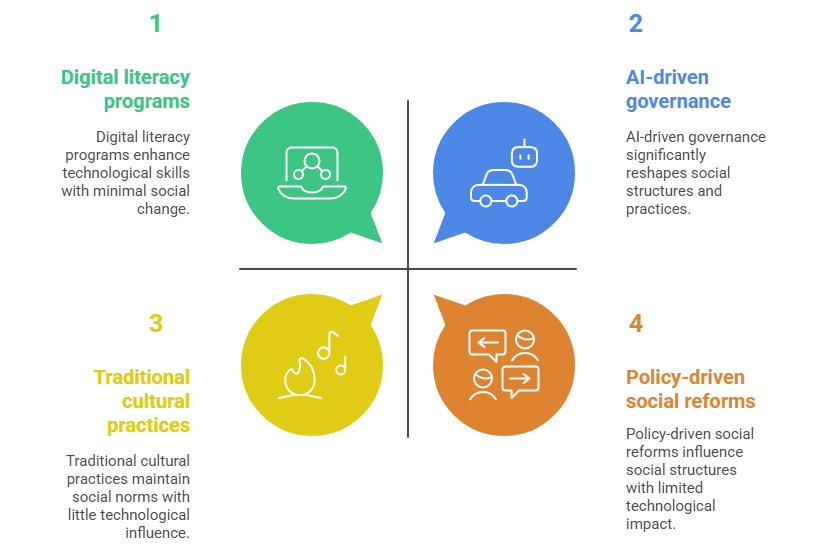
- Technology-driven initiatives represent modernization and social transformation, changing the way marginalized communities interact with state, education, and markets.
- Giddens’ structuration theory: AI tools are both shaped by social structures (government policies, tribal governance) and reshape social practices, like digital participation and civic engagement.
- Digital inclusion promotes cultural preservation while fostering change, illustrating adaptive social change rather than loss of tradition.
- It highlights innovation-driven social change, showing how policy and technology transform social relations and opportunities.
Challenges and Considerations
- Cultural Sensitivity: AI translation must preserve context, idioms, and cultural nuances to avoid misrepresentation.
- Digital Literacy: Communities require training to fully utilize technological tools.
- Sustainability: Continuous updates are needed to maintain accuracy and relevance as languages evolve.
Conclusion:
Aadi Vaani and BHASHINI exemplify the intersection of technology, policy, and society. Sociologically, these initiatives are mechanisms for empowering marginalized communities, promoting cultural preservation, and ensuring equitable access to knowledge. By integrating AI with grassroots capacity-building, India moves toward a society where linguistic diversity, social inclusion, and digital empowerment converge, reflecting the visions of thinkers from Durkheim to Sen in contemporary contexts.
|

2 comments