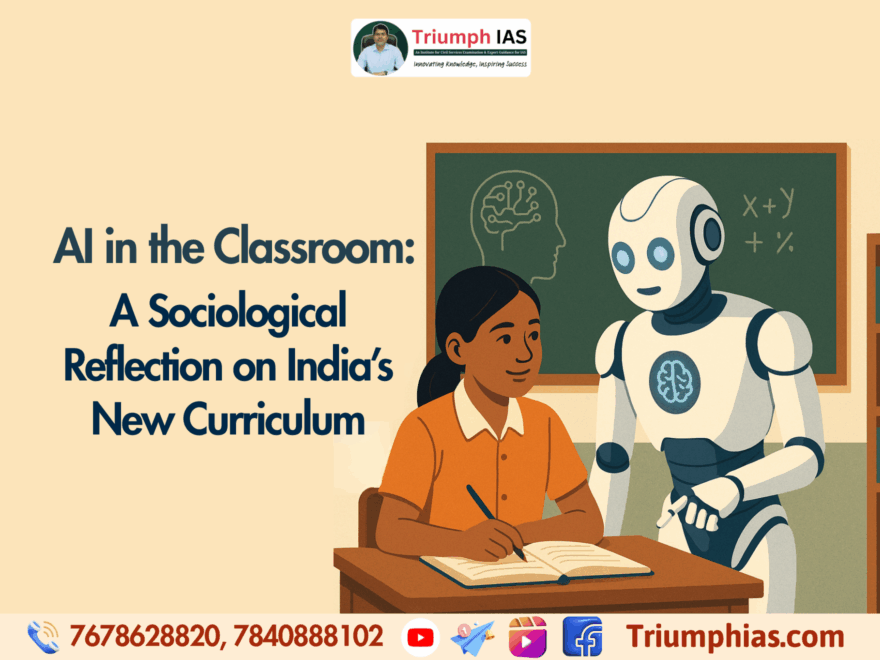
AI in the Classroom: A Sociological Reflection on India’s New Curriculum
In 2026–27, Indian classrooms will enter a new era. The Ministry of Education plans to introduce Artificial Intelligence (AI) and Computational Thinking (CT) from Class 3 onwards under the National Curriculum Framework for School Education (NCF-SE) 2023. It’s a move aligned with the National Education Policy (NEP) 2020, meant to prepare students for a future shaped by technology.
At first glance, it feels like a historic leap — a chance to make children future-ready in an AI-driven world. Yet from a sociological perspective, this reform isn’t just about technology; it’s about society, inequality, and power. The classroom, after all, is one of the most powerful mirrors of social change.
Education, Technology, and the Social Order
The sociologist Émile Durkheim saw education as a vital social institution that transmits collective values and maintains social cohesion. If we apply his lens, AI in classrooms is more than a curriculum change — it’s a new form of socialization.
By teaching students to understand algorithms, logic, and data, the state is cultivating a generation attuned to technological rationality. AI education becomes a way of preparing children not just for jobs, but for a society where technology mediates almost all human relationships — from communication to governance.
However, Durkheim also warned that rapid social changes can disrupt moral order. If AI education expands without moral and ethical grounding, it risks producing technically skilled but socially detached individuals. Hence, embedding AI ethics and social responsibility within education becomes essential to preserve solidarity in an increasingly digital society.
Marx’s Critique: Technology and Inequality
Karl Marx would read this initiative through the lens of class and power. For him, technology is never neutral — it serves the interests of those who control it.
While AI promises empowerment, its integration into schools could also reproduce class divisions. Urban elite schools with modern labs and trained teachers will likely thrive, while rural or underfunded schools may struggle even to access basic digital tools. In Marxist terms, AI education might deepen the digital divide, allowing privileged students to accumulate technological capital — a new form of power in the knowledge economy.
Moreover, since much of the AI infrastructure is controlled by corporate giants like Google or Microsoft, the curriculum might indirectly align with market needs rather than students’ holistic development. Marx might call this the “commodification of education,” where schooling becomes a tool for producing future workers, not critical citizens.
If this happens, AI education risks serving as an ideological apparatus — reinforcing capitalist interests while appearing progressive.
Weber and the Rationalization of Learning
Max Weber’s idea of rationalization — the move toward efficiency, calculation, and control — perfectly fits the rise of AI in education.
AI tools promise “personalized learning,” algorithmic grading, and data-driven teaching. Yet, this could lead to the bureaucratization of education, where learning becomes measurable but less meaningful. Teachers might turn into data managers, focusing on test results and digital dashboards rather than human connection and creativity.
Weber warned that modern societies risk getting trapped in an “iron cage” of rationality — where efficiency replaces empathy. The same could happen in AI classrooms: a perfectly organized but emotionally sterile space where algorithms know students better than teachers do.
The sociological question is: Can we embrace technology without losing the soul of education?
Bourdieu: Cultural Capital and Digital Hierarchies
Pierre Bourdieu’s theory of cultural capital explains how education reproduces social inequality by rewarding the cultural habits of dominant classes.
With AI education, a new kind of cultural capital — digital capital — is emerging. Students who grow up surrounded by gadgets, coding camps, and English-language digital culture will find AI learning natural. Those from less privileged backgrounds may struggle to keep pace.
Even when given equal access, differences in habitus — the deeply ingrained dispositions shaped by family and environment — mean that not all students will interpret or use AI knowledge in the same way. Thus, AI education could unintentionally legitimize inequality by turning digital fluency into a marker of intelligence or worth.
Without careful policy design, India’s AI initiative may widen—not narrow—the gap between elite and marginalized learners.
Paulo Freire: AI as a Tool for Liberation or Domination
Paulo Freire, in Pedagogy of the Oppressed, argued that true education should awaken critical consciousness — helping learners question and transform their world.
If AI education is taught as mere skill acquisition, it risks becoming a “banking model” of education — where students passively absorb information. But if used critically, AI can become a tool for liberation. Imagine classrooms where students analyze how AI shapes news, influences elections, or perpetuates biases — that’s education for empowerment.
Freire would insist that AI literacy must include dialogue and reflection, not just coding. Students should ask: Whose interests does this algorithm serve? Whose data is being used? Who gets excluded from the benefits of AI? Only then can AI education contribute to social justice rather than technological domination.
Durkheim to Freire: A Sociological Balancing Act
Taken together, these thinkers highlight a tension between technological progress and social equity.
- Durkheim reminds us of education’s role in maintaining cohesion — AI must foster shared ethics, not alienation.
- Marx warns that without addressing class inequality, AI could become another instrument of capitalist reproduction.
- Weber alerts us to the dangers of bureaucratizing learning and losing human agency.
- Bourdieu helps us see how digital privilege translates into new hierarchies.
- Freire challenges us to make AI a means of liberation, not conformity.
Together, they remind us that education is never just about knowledge — it’s about who gains power through it.
The Indian Context: Promise and Paradox
In India, these sociological insights take on particular urgency. Nearly half of Indian schools lack basic digital infrastructure, and many teachers are untrained in AI pedagogy. This isn’t just a technological problem — it’s a social one.
For AI to succeed, the rollout must be phased and inclusive. Teacher training, local-language resources, and low-tech alternatives (like “unplugged AI” activities) are essential. Otherwise, AI education could become a new form of digital elitism, benefiting the few while excluding the many.
Sociologists would also emphasize the intersectional dimension — how caste, gender, and region intersect with digital access. If boys in urban centers learn coding while girls in rural areas struggle with connectivity, AI could reinforce patriarchal and regional inequalities.
Thus, technology alone cannot democratize education; social justice must guide technological reform.
Conclusion: Towards a Humanized AI Education
The integration of AI and CT into India’s school system is both visionary and risky. It holds the potential to create a generation of innovative, critical, and technologically fluent citizens. But it could also deepen inequalities, depersonalize learning, and commodify education if implemented uncritically.
A sociological perspective teaches us that technology and society shape each other. To ensure AI education serves the public good, it must balance efficiency with empathy, innovation with inclusion, and skill with social consciousness.
In the words of Paulo Freire, “Education does not change the world. Education changes people. People change the world.”
If India’s AI curriculum empowers students to question, create, and care — not just compute — it will truly be a revolution worth celebrating.
|

One comment