Introduction
Agriculture has always been the backbone of Indian society and economy. Even today, a large proportion of India’s workforce depends on agriculture for livelihood. However, the agrarian class structure in India has undergone massive changes over time due to colonial policies, land reforms, Green Revolution, globalization, and contemporary agrarian distress. Understanding these shifts is crucial, as agrarian change directly connects with debates on inequality, poverty, rural development, and social transformation.
Colonial Agrarian Class Structure in India
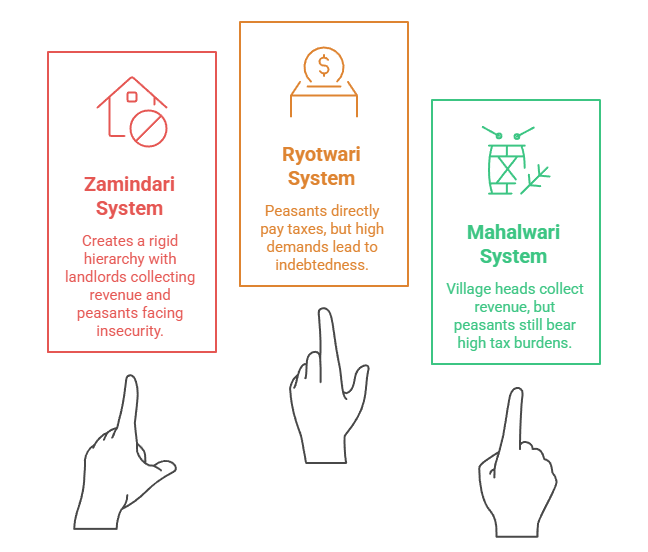
During British colonial rule, agrarian relations were shaped by exploitative land revenue systems:
- Zamindari system (Bengal, Bihar, UP): Landlords (zamindars) collected revenue from peasants. Cultivators had little security and were often subjected to forced labor. This created a rigid hierarchy of zamindars, tenants, and agricultural laborers.
- Ryotwari system (Madras, Bombay): Peasants (ryots) directly paid taxes to the state, but the burden of high revenue demands led to indebtedness.
- Mahalwari system (Punjab, NW Provinces): Revenue collection was entrusted to village heads, but peasants still bore high tax burdens.
The agrarian class system under colonial rule was marked by semi-feudal relations, absentee landlordism, and widespread peasant exploitation. The result was rural poverty, famines, and frequent peasant movements like the Indigo Revolt (1859), Tebhaga movement (1946), and Telangana struggle (1946–51).
Agrarian Class Structure after Independence
Post-independence, the Indian state attempted to restructure agrarian relations through land reforms. Major steps included:
- Abolition of Zamindari: Large estates were legally abolished, and tenants gained ownership rights.
- Ceilings on landholdings: Redistribution of surplus land aimed at reducing inequality, though implementation was weak.
- Tenancy reforms: Some states, like Kerala and West Bengal, achieved significant land redistribution.
Despite these reforms, agrarian inequality persisted. A new class of rich peasants and capitalist farmers emerged, especially in states like Punjab, Haryana, and Western Uttar Pradesh. Meanwhile, a large population of landless laborers and marginal farmers remained vulnerable.
The Green Revolution and Agrarian Class Change
The Green Revolution (1960s–70s) transformed India’s agriculture by introducing high-yield seeds, chemical fertilizers, and mechanization. This created new divisions in the agrarian structure:
- Rich farmers: Benefited from irrigation, subsidies, and technology. They accumulated wealth, entered politics, and formed powerful agrarian lobbies.
- Small and marginal farmers: Could not afford costly inputs, remained indebted, and dependent on larger farmers or moneylenders.
- Landless laborers: Mechanization reduced employment opportunities, increasing migration to urban areas.
Thus, the Green Revolution intensified regional disparities (prosperity in Punjab, Haryana vs. stagnation in Bihar, Odisha) and class differentiation within rural society.
Agrarian Class and Globalization
With liberalization and globalization (1990s onwards), agriculture entered into global markets. This created new challenges:
- Farmers became dependent on export-oriented cash crops (cotton, sugarcane), increasing vulnerability to price fluctuations.
- Corporate farming and contract farming led to new forms of exploitation.
- The 2020 Farm Laws debate reflected tensions between agrarian classes (rich farmers fearing corporate dominance vs. small farmers struggling for MSP security).
The agrarian crisis has manifested in farmers’ protests and rising cases of farmers’ suicides, particularly among debt-ridden small farmers.
Sociological Analysis
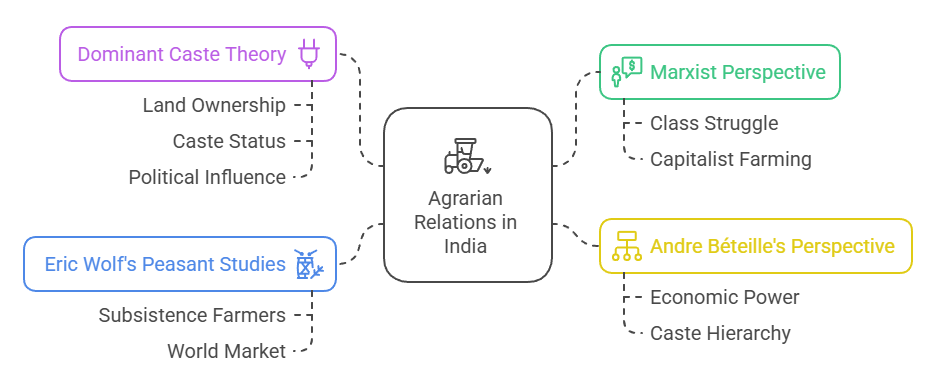
- Marxist Perspective (A.R. Desai, Daniel Thorner)
Marxist scholars view agrarian relations in India as semi-feudal and semi-capitalist. They emphasize the conflict between landlords, rich peasants, poor peasants, and agricultural laborers. The persistence of exploitation, indebtedness, and farmers’ protests is seen as a form of class struggle, with capitalist farming growing alongside feudal remnants.
- M.N. Srinivas and Dominant Caste Theory
M.N. Srinivas highlighted how dominant castes like Jats, Marathas, Yadavs, Reddys, and Patidars hold power in rural India by combining land ownership, caste status, and political influence. Agrarian class structure is thus not only about economic position but also deeply tied to the caste hierarchy.
- Andre Béteille’s Perspective
Andre Béteille studied South Indian villages and argued that class, caste, and power are closely interconnected. He showed how agrarian inequality cannot be understood in isolation. Land ownership gives economic power, but caste status and political influence shape how this power is exercised in rural society.
- Eric Wolf’s Peasant Studies
Eric Wolf placed Indian peasants within the larger context of global capitalism. He pointed out that Indian peasants are not only subsistence farmers but also linked to the world market through cash crops, exports, and price fluctuations. This makes their vulnerability both local and global.
Current Issues in Agrarian Class Structure

- Farmers’ Protests (2020–21): Highlighted the fear of corporatization and the demand for legal MSP. Rich and middle peasants led the movement, while small farmers remained fragmented.
- Farmers’ Suicides: Debt, crop failure, and lack of institutional credit have pushed marginal farmers into distress, especially in Vidarbha, Telangana, and Andhra Pradesh.
- Rural-urban migration: Agrarian distress forces laborers to migrate to cities, creating a link between rural poverty and the informal urban economy.
- Climate change: Increasing droughts, floods, and heatwaves are worsening agrarian inequality. Small and marginal farmers are the worst affected.
Agrarian Class and Social Change in India
The transformation of agrarian relations has broader social consequences:
- Decline of caste dominance in some regions due to land reforms and political assertion of OBCs and Dalits.
- Rise of peasant politics: Rich farmers’ movements (e.g., Bharatiya Kisan Union) shaped Indian democracy.
- Gender and agrarian structure: Women are increasingly part of agricultural labor but often remain unpaid and excluded from land ownership.
- Education and mobility: Children of rich farmers move to cities, enter new occupations, while landless laborers face barriers to mobility.
Thus, agrarian change is central to debates on development, inequality, and democracy in India.
Conclusion
The agrarian class structure in India has shifted from feudal zamindars to capitalist farmers, but inequality persists in new forms. While rich farmers dominate rural politics and benefit from state policies, small and marginal farmers continue to struggle. Understanding these dynamics is vital for sociology students, especially for UPSC Mains Sociology Paper 2, as it connects theoretical perspectives with ground realities.
Agrarian transformation is not just about land and crops; it is about class, caste, gender, and power relations that shape Indian society.
Previous Year Questions
Paper 1
- Distinguish between peasant and farmer. Examine whether peasantry continues to exist in contemporary societies. (2014)
- Examine the Marxist perspective on agrarian class structure. (2015)
- Discuss the relevance of Eric Wolf’s analysis of peasants in the context of globalization. (2016)
- Do you agree with Daniel Thorner’s characterization of Indian agrarian structure as “semi-feudal and semi-capitalist”? (2017)
- Explain the interrelationship between caste, class and power in agrarian society with reference to Andre Béteille’s studies. (2018)
- Evaluate the role of dominant castes in shaping agrarian social structure in India. (2019)
- Discuss the sociological perspectives on the Green Revolution and its impact on agrarian class differentiation. (2020)
- How do globalization and neo-liberal policies affect the peasantry? Discuss in light of peasant studies. (2021)
- Critically examine the view that Indian agrarian change represents a transition from “feudalism to capitalism”. (2022)
- Explain how Marxist and Weberian perspectives differ in understanding agrarian stratification. (2023)
Paper 2
- Describe the agrarian class structure during the colonial period and its impact on rural society. (2014)
- Discuss the role of land reforms in restructuring agrarian class relations in India. (2015)
- Examine the impact of the Green Revolution on rural class structure and regional inequality. (2016)
- Explain the relationship between caste and agrarian structure with examples from Indian villages. (2017)
- Discuss the role of rich farmers in Indian politics since the Green Revolution. (2018)
- Critically evaluate the impact of globalization and liberalization on agrarian classes in India. (2019)
- Examine how agrarian distress and farmer suicides reflect changes in the agrarian class structure. (2020)
- Do you agree that the Farmers’ Protests of 2020–21 were shaped by contradictions within the agrarian class structure? (2021)
- How do gender relations intersect with agrarian structure in India? Illustrate with examples. (2022)
- Critically analyze the persistence of semi-feudal relations in Indian agriculture despite modernization. (2023)
- Discuss how climate change and environmental degradation are reshaping agrarian classes in contemporary India. (2024)
|

One comment