
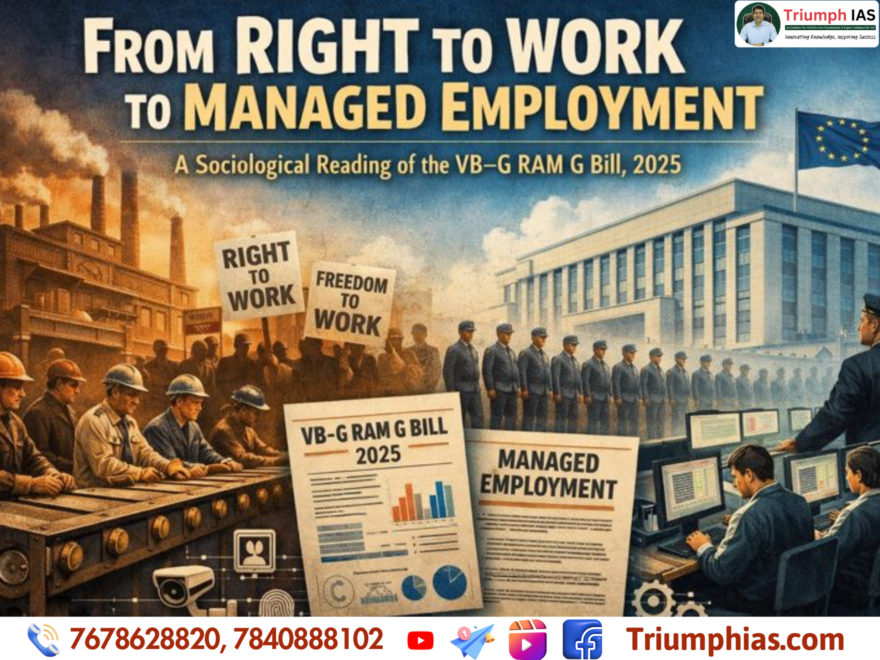
From Right to Work to Managed Employment: A Sociological Reading of the VB-G RAM G Bill, 2025
(Relevant for Sociology Paper 1: Works and Economic life and Politics and Society and Sociology Paper 2: Vision of Social change in India and Politics and Society)
VB-G RAM G BillThe introduction of the Viksit Bharat-Guarantee for Rozgar and Ajeevika Mission (Gramin) Bill, 2025 marks a decisive transformation in India’s rural welfare architecture. By replacing the rights-based, demand-driven framework of MGNREGA with a budget-capped, supply-driven employment model, the state signals a redefinition of rural poverty, work, and citizenship. While the reform is justified by declining poverty and the aspiration of Viksit Bharat @2047, sociology urges us to examine what is gained—and what may be lost—when welfare shifts from entitlement to discretion. MGNREGA as Social CitizenshipT.H. Marshall’s concept of social citizenship is foundational to understanding MGNREGA. The 2005 Act did not merely provide employment; it institutionalised a justiciable right to work, recognising employment as a social right necessary for dignity and survival. For rural households, especially landless labourers, women, and marginal farmers, MGNREGA functioned as a buffer against market volatility and agrarian distress. The VB–G RAM G Bill represents a departure from this framework. By limiting coverage to notified rural areas and introducing capped allocations, employment becomes conditional rather than universal. Sociologically, this reflects a shift from rights-based welfare to administrative welfare, where access depends on state planning priorities rather than citizen demand. Welfare State to Developmental StateThis transition mirrors a broader transformation in the Indian state. Scholars of political sociology argue that India is moving from a welfare state logic to a developmental and regulatory state. The Bill’s emphasis on asset creation, productivity, and convergence with PM Gati Shakti reflects a belief that poverty alleviation should occur through infrastructure-led growth rather than income guarantees. Max Weber’s notion of rational-legal authority helps explain this shift. Employment is now to be planned through Viksit Gram Panchayat Plans (VGPPs), aggregated and aligned with national infrastructure goals. While this enhances coordination and efficiency, it also bureaucratises access to work, reducing the immediacy and responsiveness that characterised MGNREGA. Rural Poverty: Decline or Reconfiguration?
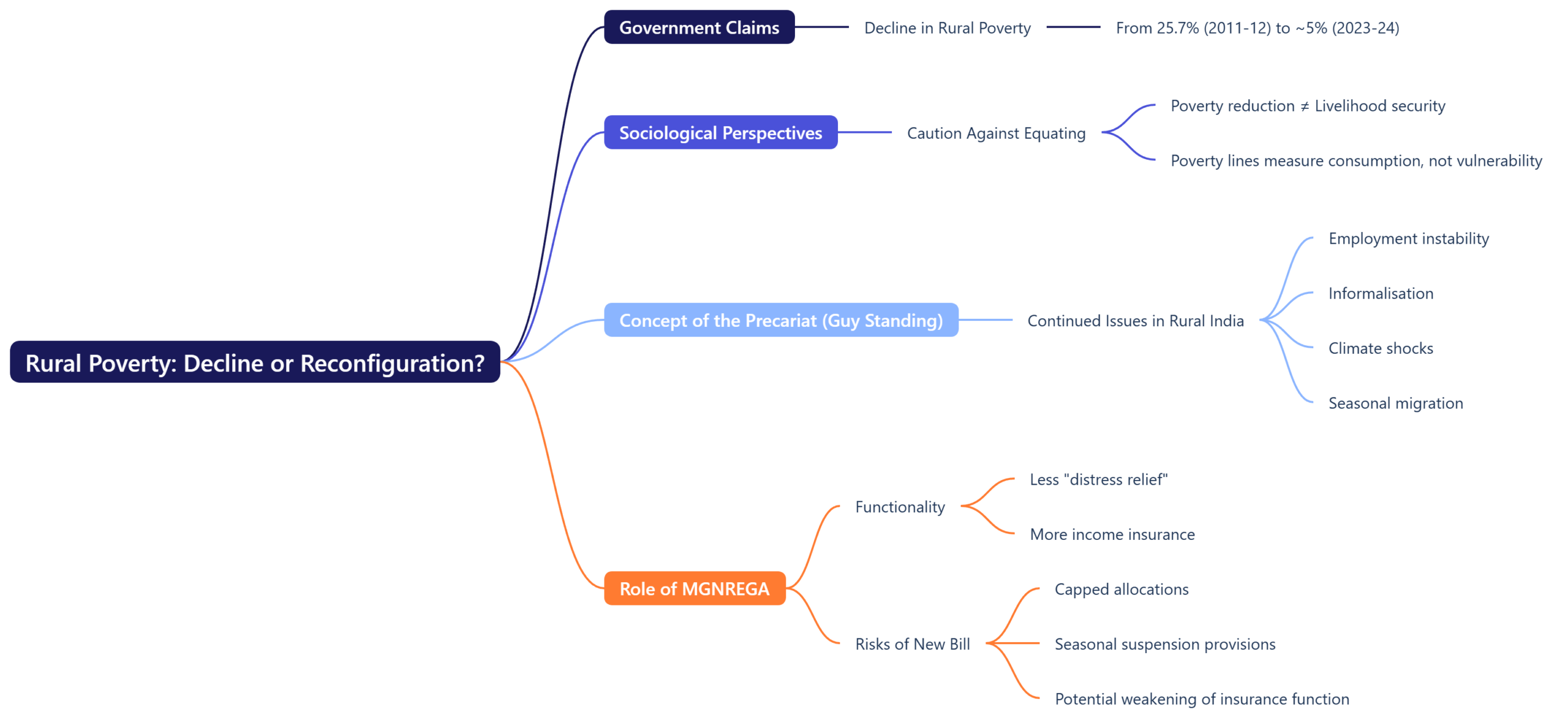
The government justifies the reform by citing a sharp decline in rural poverty—from 25.7% in 2011–12 to nearly 5% in 2023–24. However, sociologists caution against equating poverty reduction with livelihood security. Poverty lines measure consumption, not vulnerability. Guy Standing’s concept of the precariat is relevant here. Even as income poverty declines, rural India continues to face employment instability due to informalisation, climate shocks, and seasonal migration. For such households, MGNREGA functioned less as “distress relief” and more as income insurance. The new Bill’s capped allocations and seasonal suspension provisions risk weakening this insurance function. Labour, Agriculture, and Power RelationsThe provision allowing States to pause employment for up to 60 days during peak agricultural seasons reveals underlying class dynamics. From a Marxian perspective, this reflects the state’s role in managing labour supply to support agrarian capital and landowning classes. By ensuring labour availability during sowing and harvesting, the policy implicitly prioritises farm productivity over labourers’ income stability. This aligns with Marx’s idea of the reserve army of labour, where surplus workers are regulated to serve production needs. While economically rational, such regulation risks reproducing rural power hierarchies, where landless labourers bear the adjustment costs of development. Fiscal Federalism and State CapacityThe revised cost-sharing pattern (60:40 for most States) significantly increases States’ fiscal responsibility. From a sociological lens, this raises concerns about uneven state capacity. Poorer States with high dependence on public employment may struggle to finance the programme adequately, leading to regional disparities in employment security. This resonates with Myrdal’s theory of cumulative causation, where initial disadvantages—low revenue base, high vulnerability—compound over time. A supply-driven, budget-capped model may inadvertently reinforce spatial inequality unless accompanied by compensatory fiscal transfers. Gender and Social InclusionFeminist sociologists have consistently highlighted MGNREGA’s transformative impact on rural women. Guaranteed local employment increased women’s workforce participation, bargaining power, and financial autonomy. The VB-G RAM G Bill’s conditional coverage and reduced flexibility may disproportionately affect women, who rely on proximity and predictability of work due to unpaid care responsibilities. Additionally, Scheduled Castes, Scheduled Tribes, and migrant households—groups with limited political voice—face higher risks of exclusion when welfare becomes discretionary. Pierre Bourdieu’s idea of social capital explains why better-connected communities may navigate planning processes more effectively, while marginal groups remain invisible in VGPPs. From Demand-Driven to Technocratic Planning
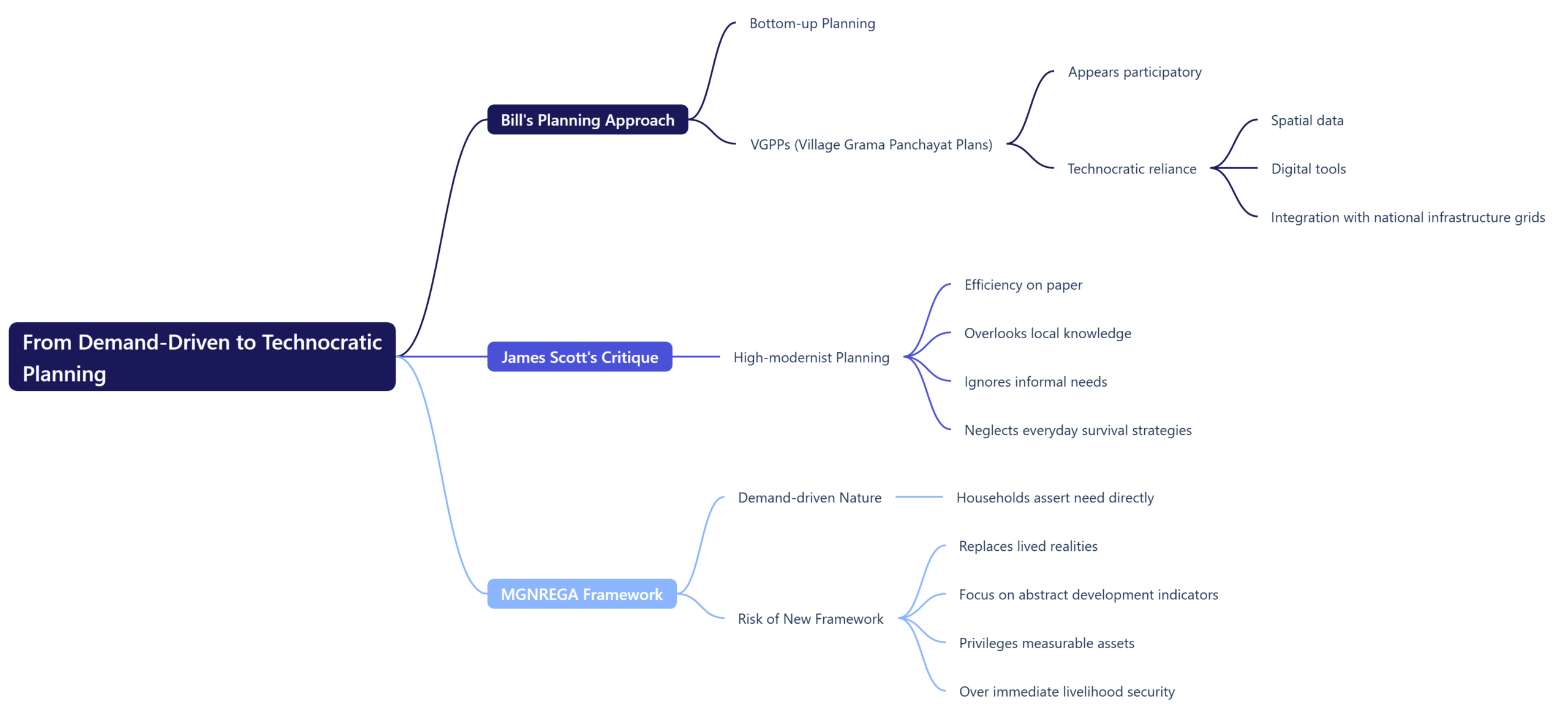
The Bill’s bottom-up planning through VGPPs appears participatory but is deeply technocratic, relying on spatial data, digital tools, and integration with national infrastructure grids. James Scott’s critique in Seeing Like a State is instructive here. He warns that high-modernist planning, while efficient on paper, often overlooks local knowledge, informal needs, and everyday survival strategies. MGNREGA’s demand-driven nature allowed households to assert need directly. The new framework risks replacing lived realities with abstract development indicators, privileging measurable assets over immediate livelihood security. Climate Risk and Rural LivelihoodsSociology of environment underscores that rural employment cannot be delinked from climate vulnerability. IPCC assessments show that climate shocks are increasing employment volatility in agriculture-dependent regions. MGNREGA played a crucial role in climate adaptation through water conservation, afforestation, and drought-proofing works. While the new Bill emphasises planned asset creation, capped allocations may limit the ability to scale employment during climate-induced distress. Ulrich Beck’s risk society thesis reminds us that modern risks require flexible, responsive institutions—not rigid budgeting. Rights vs Productivity: A False Dichotomy?The Bill frames the reform as a necessary transition from “distress relief” to “productive employment.” Sociologically, this presents a false dichotomy. Amartya Sen’s capability approach argues that income security and productivity are mutually reinforcing. Without basic security, households cannot invest in skills, mobility, or entrepreneurship. MGNREGA’s rights-based framework provided this foundational security. Diluting it risks undermining the very productivity gains the Bill seeks to achieve. Conclusion: Rethinking Developmental JusticeThe VB-G RAM G Bill, 2025 reflects a changing vision of rural India—less poor, more aspirational, and integrated into national development goals. Yet sociology reminds us that development is not merely about growth or asset creation; it is about security, dignity, and voice. A balanced rural employment framework must retain the moral core of the right to work while innovating towards sustainable livelihoods. Without strong safeguards, universal access, and fiscal support to States, the shift from rights-based welfare to managed employment risks excluding the most vulnerable. Viksit Bharat will be meaningful not when rural distress disappears from policy narratives, but when rural citizens retain enforceable claims over work, security, and dignity in a rapidly changing economy. |
To Read more topics, visit: www.triumphias.com/blogs
Read more Blogs:
How Experienced Faculty in Live Online Sociology Optional Classes Help You Crack UPSC
2 comments