
The Right to Disconnect: A Sociological Lens on Work-Life Balance in India
(Relevant for Sociology Paper 1: Stratification and Mobility and Works and Economic Life)
|
In an era dominated by smartphones, emails, and instant messaging, the boundaries between work and personal life are increasingly blurred. The proposed Right to Disconnect Bill 2025, introduced as a Private Member’s Bill (PMB) in the Lok Sabha, aims to legally protect employees from after-hour work demands and reinforce healthy work-life boundaries. While the Bill is yet to become law, it raises critical questions about modern labor practices, societal expectations, and mental health—all of which can be analyzed through a sociological lens. Understanding the BillThe Right to Disconnect Bill proposes several key provisions:
Globally, countries like France, Portugal, and Australia have already enacted similar rights, reflecting a growing international recognition that employee well-being is integral to sustainable productivity. Sociological Perspectives on Work-Life Balance
The Right to Disconnect can be examined using classical and contemporary sociological theories that explore the relationship between work, society, and individual well-being.
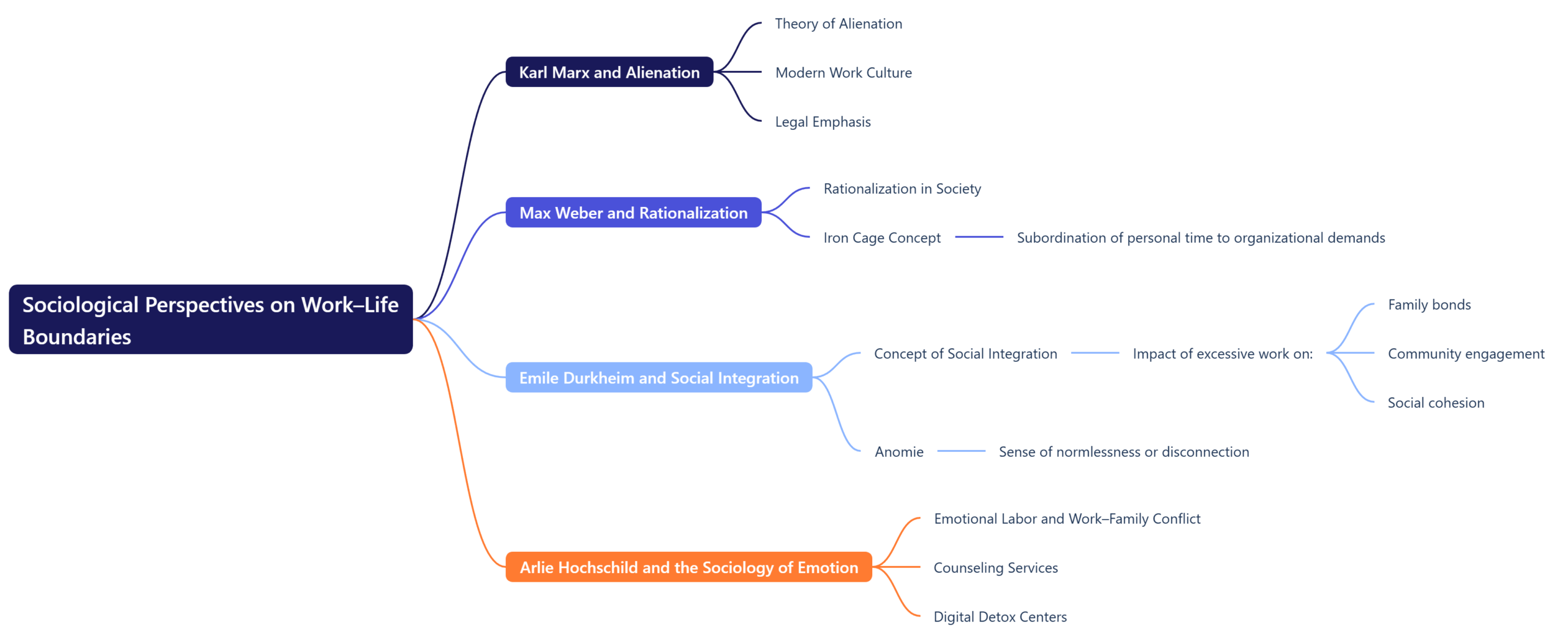
Karl Marx’s theory of alienation is particularly relevant in the context of modern work culture. Marx argued that under capitalist production, workers become estranged from the products of their labor, the production process, fellow workers, and even themselves. In today’s digitally connected workplaces, this alienation extends to temporal intrusion, where employees are expected to be “always on,” eroding autonomy and self-determination. The Bill’s emphasis on protecting after-hour boundaries can be seen as a step toward reclaiming autonomy and reducing alienation.
Max Weber highlighted how rationalization in modern society leads to efficiency-driven bureaucracies. While efficiency enhances productivity, it also creates the “iron cage” of rationalized work structures, where employees’ personal time is subordinated to organizational demands. The Right to Disconnect addresses this imbalance by asserting a legal framework that resists the encroachment of work into private life, thereby humanizing bureaucratic rationalization.
Emile Durkheim’s concept of social integration can illuminate why disconnecting from work matters. Excessive work demands can weaken family bonds, community engagement, and social cohesion, producing anomie—a sense of normlessness or disconnection from societal expectations. By legally ensuring time for personal life, the Bill strengthens social bonds and fosters collective well-being.
Contemporary sociologist Arlie Hochschild studied emotional labor and work–family conflict. She showed that modern employees often experience emotional overload, balancing organizational demands with personal and familial responsibilities. The Bill’s provision for counselling services and digital detox centres aligns with Hochschild’s insights, addressing the psychosocial costs of constant connectivity. Private Members’ Bills in IndiaA Private Member’s Bill (PMB) is introduced by an MP who does not hold a ministerial portfolio. In the Indian parliamentary system, PMBs are typically discussed on Fridays and rarely become law. Since Independence, only 14 PMBs have been passed by both Houses, with none succeeding since 1970. While the legislative journey for the Right to Disconnect Bill is uncertain, PMBs often play a crucial role in agenda-setting, drawing public and political attention to emerging social issues. In this case, the Bill spotlights the societal consequences of digital overwork and mental health challenges in professional life. Work, Technology, and TelepressureSociologists increasingly study the implications of digital technologies on work-life balance. Concepts such as telepressure—the psychological stress of responding promptly to work communications—highlight the mental strain of constant connectivity. Likewise, “info-obesity”, or the overload of digital information, contributes to anxiety, stress, and burnout. The Bill’s provisions for digital detox centres reflect an understanding that work-life boundaries are not only legal or contractual issues but also psychosocial ones, influencing health, productivity, and social well-being. Comparative Perspective: Global TrendsFrance’s Right to Disconnect law (2017) and Portugal’s similar legislation exemplify a global shift toward protecting employee autonomy in the digital age. Australian policies encouraging flexible working hours and after-hour boundaries further show how societies are responding to the social and health costs of overwork. India’s proposed Bill positions the country within this emerging global discourse on labor rights, mental health, and societal well-being. Sociological Implications
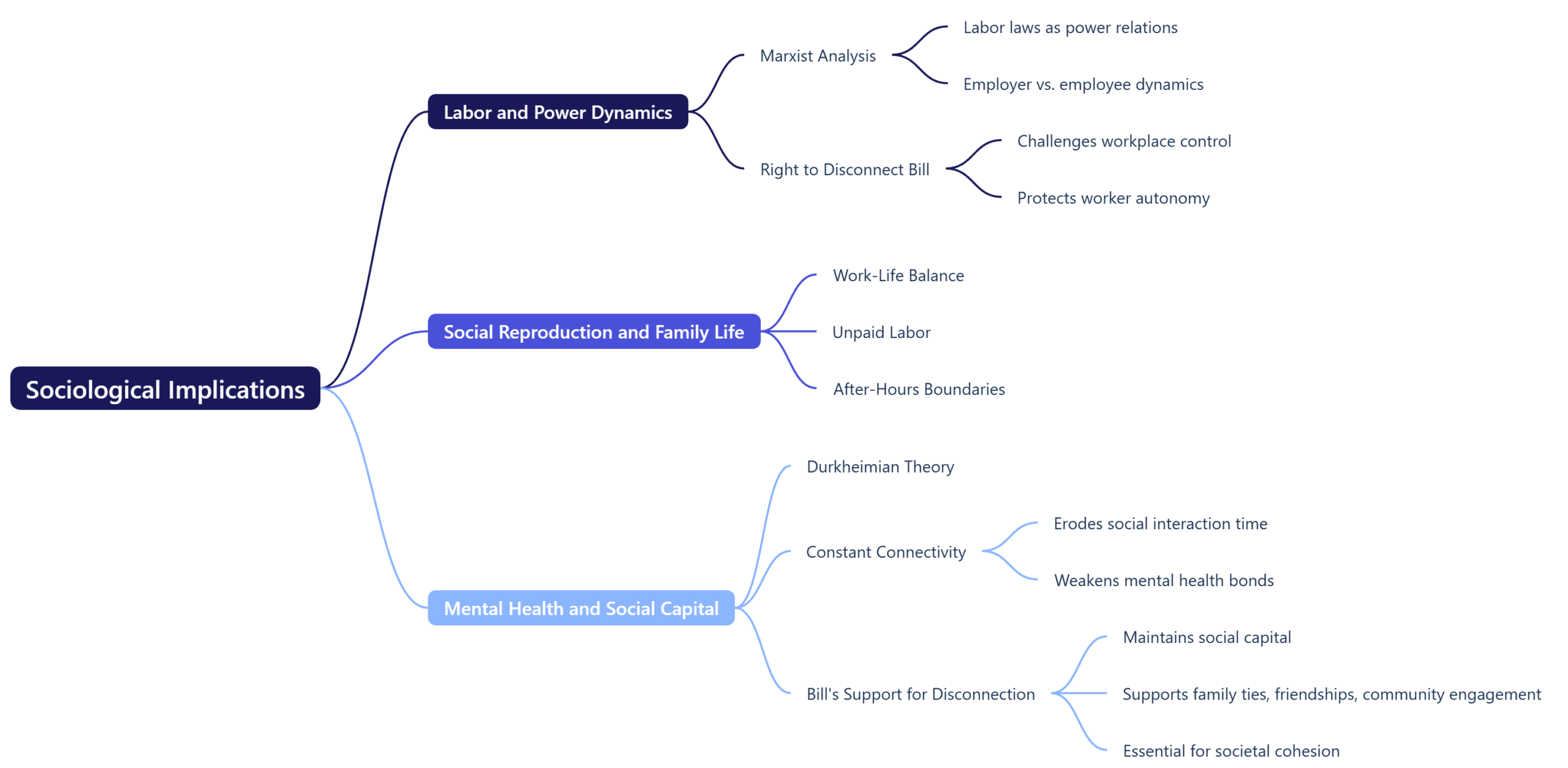
Marxist analysis reminds us that labor laws are not just about individual well-being—they reflect power relations between employers and employees. The Right to Disconnect Bill challenges subtle forms of workplace control, where organizational expectations extend into private life, asserting legal safeguards for worker autonomy.
Work-life balance has direct consequences for social reproduction, a concept highlighted by feminist sociologists like Nancy Fraser and Silvia Federici. When work intrudes into personal life, the unpaid labor of caregiving, emotional support, and family maintenance is compromised. Protecting after-hours boundaries helps preserve these vital social functions, contributing to broader societal stability.
Durkheimian theory connects well-being with social integration and support networks. Constant connectivity erodes time for social interactions, weakening bonds that sustain mental health. By ensuring employees can disconnect, the Bill supports the maintenance of social capital—family ties, friendships, and community engagement—that is essential for societal cohesion. Challenges and CritiquesWhile the Bill is socially progressive, it faces several challenges:
These challenges highlight a key sociological insight: laws alone cannot change social norms. Successful implementation depends on a broader cultural shift toward valuing employee well-being as part of societal health. ConclusionThe Right to Disconnect Bill 2025 represents more than a workplace regulation; it embodies a sociological intervention aimed at restoring temporal autonomy, emotional well-being, and social cohesion. By protecting after-hours boundaries, the Bill addresses the alienation described by Marx, the emotional labor highlighted by Hochschild, and the erosion of social bonds noted by Durkheim. Whether or not the Bill becomes law, its introduction signals a growing recognition that employee well-being is a societal concern, not merely an individual or corporate one. In a digitally connected world, safeguarding the right to disconnect is central to maintaining not just personal health but also family stability, community ties, and social solidarity. As sociologists have long emphasized, work is not an isolated sphere—it is interwoven with social life, mental health, and societal functioning. The Right to Disconnect Bill offers India an opportunity to align labor law with these sociological realities, promoting a healthier, more balanced, and socially cohesive workforce. |
To Read more topics, visit: www.triumphias.com/blogs
Read more Blogs:
Protection of Plant Varieties and Farmers’ Rights (PPV&FRA) Act, 2001
2 comments