Introduction: Feminist Critique of Marriage
Marriage, often romanticized as a union of love and companionship, has historically functioned as a tool of patriarchy—especially in conservative societies like India. A feminist critique of marriage reveals how this social institution, masked as a personal choice, is in fact embedded with deep gendered power relations, economic inequality, and legal subordination.
With growing awareness of women’s rights, gender equality, and LGBTQ+ movements, it is imperative to critically question: Is marriage still relevant? Or is it in urgent need of reinvention?
This blog explores the sociological and feminist analysis of marriage, links with family, kinship, patriarchy, gender stratification.
Understanding Marriage Through Feminist Lens
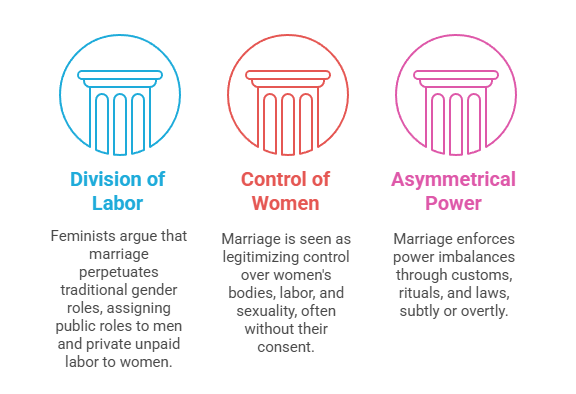
From a feminist sociological standpoint, marriage is not just a personal bond—it’s a social structure crafted to sustain male dominance.
- Feminists argue that marriage institutionalizes the division of labor between men and women—public roles for men, private unpaid labor for women.
- It legitimizes the control of women’s bodies, labor, and sexuality, often without their informed consent.
- Even in modern legal frameworks, marriage enforces asymmetrical power dynamics, subtly or overtly, through customs, rituals, and laws.
Historical Roots of Patriarchal Marriage
Historically, marriage emerged not as a celebration of love, but as a means of controlling women’s fertility, property, and labor.
- In ancient Hindu society, the woman (strī) was always under male control—first her father, then husband, then son.
- Dowry systems commodified women.
- Bride-price and child marriage were practiced to cement family alliances, not female agency.
Even today, many Indian marriages continue to follow arranged systems where family honor, caste endogamy, and dowry overshadow individual choice.
Sociological Analysis

- Marxist Feminism:
Marxist feminists view marriage as an economic institution that reinforces capitalist exploitation by assigning women the role of unpaid laborers within the home. Thinkers like Friedrich Engels and Silvia Federici argue that through marriage, women’s reproductive and domestic labor is appropriated without compensation, serving both the family and the capitalist system. This unpaid labor supports the wage labor economy while keeping women economically dependent on men.
- Radical Feminism:
Radical feminists argue that marriage is a central institution of patriarchy that perpetuates the sexual domination of women. Andrea Dworkin and Catharine MacKinnon contend that marriage legitimizes male control over female bodies and sexuality, often blurring the line between consent and coercion. They emphasize that marriage has historically legalized sexual access and control over women, making it a system of institutionalized oppression.
- Liberal Feminism:
Liberal feminists focus on achieving gender equality within the existing legal and institutional frameworks, including marriage. Betty Friedan, in her seminal work The Feminine Mystique, called for legal reforms to address the social and psychological limitations placed on women through the institution of marriage. This perspective advocates for equal legal rights, divorce access, shared responsibilities, and protection against domestic abuse.
- Functionalism (Critiqued):
While not a feminist theory, functionalism views marriage as a vital social institution that contributes to social stability by fulfilling functions such as reproduction, socialization, and emotional support. Talcott Parsons emphasized the complementary roles of men as breadwinners and women as caregivers. Feminists critique this model for reinforcing gender stereotypes and naturalizing the subordination of women under the guise of social harmony.
- Intersectionality:
The intersectional perspective, introduced by Kimberlé Crenshaw, highlights how marriage interacts with other axes of oppression such as caste, class, race, and sexuality. It argues that not all women experience marriage the same way—Dalit women, Muslim women, queer individuals, or poor women may face unique layers of inequality. Intersectionality urges sociologists and feminists to analyze marriage through a multi-dimensional lens, revealing how overlapping systems of power shape individual experiences.
Cultural Symbols of Female Subordination
Marriage is surrounded by symbols, rituals, and customs that glorify femininity only when it is subordinated to masculinity.
- The kanyadaan ritual reduces the bride to a gift being ‘given away’.
- Mangalsutra, sindoor, and name-changing practices brand a woman as ‘belonging’ to her husband.
- The wedding day is glorified as the woman’s day, yet it is the man who controls the proceedings, speeches, and expectations post-marriage.
These cultural representations create a false sense of empowerment, while reinforcing the gender hierarchy within marriage.
Legal and Institutional Inequities
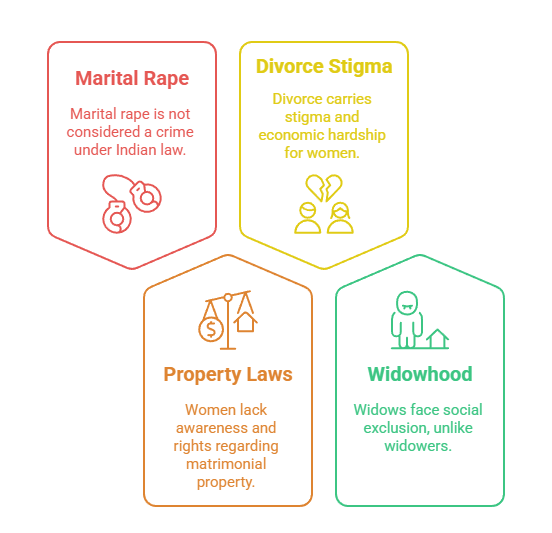
Despite constitutional guarantees, women in marriage face significant legal inequalities:
- Marital rape is not a crime under Indian Penal Code (Section 375 Exception 2).
- Property laws remain skewed; many women are not even aware of their rights in matrimonial property.
- Divorce, even when legally available, is stigmatized and economically punishing for women.
- Widows face social exclusion, while widowers are encouraged to remarry.
These inequities are not incidental but structural—marriage serves as a control mechanism, particularly in patriarchal settings.
Unpaid Labor and the Marriage Economy
Feminist economists like Silvia Federici and Mariarosa Dalla Costa emphasize that marriage institutionalizes unpaid labor:
- Married women disproportionately perform childcare, housework, and eldercare.
- Their contributions remain invisible in national income accounts (GDP).
- This unpaid domestic work subsidizes the economy, yet receives no formal recognition.
According to the NSSO Time Use Survey (2019), Indian women spend 5+ hours daily on unpaid care work, compared to less than 1 hour for men.
Thus, marriage becomes an economic contract cloaked as love, where women’s labor is extracted without compensation.
Marital Stereotypes in Popular Culture
Cultural products—films, songs, advertisements—reinforce the idea that marriage is a woman’s goal and a man’s choice.
- Songs like “You Can’t Hurry Love” or “Fine China” highlight how women are cast as fragile and dependent.
- Bollywood’s obsession with big fat weddings glamorizes ritual over equality.
- Single women are portrayed as incomplete, desperate, or rebellious.
Such portrayals further marginalize non-marital lifestyles—singlehood, live-in relationships, queer unions—and perpetuate gender stereotypes.
Contemporary Issues: Is Marriage Still Relevant?
Today, many youth question the necessity of marriage:
- Growing acceptance of live-in relationships, especially in urban India.
- Rise of single mothers by choice and cohabitation models.
- Legal and policy reforms (e.g., decriminalization of Section 377, recognition of domestic partnerships).
However, state and society still privilege marital unions through:
- Tax benefits, inheritance rights, visa statuses, and medical next-of-kin privileges.
Thus, opting out of marriage often results in legal and social penalties, making marriage compulsory by design.
Indian Context
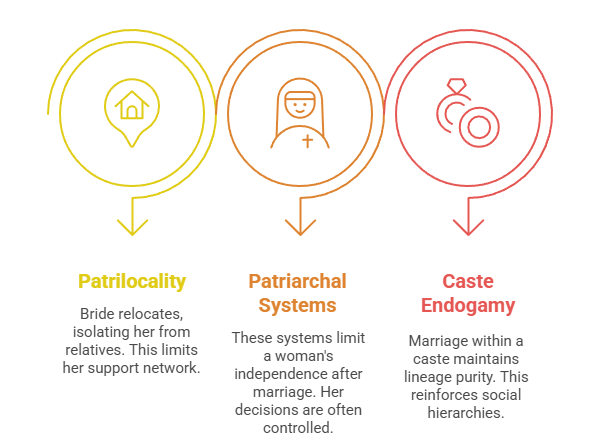
- Patrilocality (bride moves to groom’s home) enforces isolation from natal kin.
- Patriarchal kinship systems discourage women’s autonomy post-marriage.
- Caste endogamy ensures control over marriage to preserve lineage purity (M.N. Srinivas).
Feminist sociologists like Nandini Sundar, Urvashi Butalia, and Sharmila Rege have emphasized how marriage is central to gender oppression in Indian society, especially within patriarchal and caste hierarchies.
Companionship and Care
Feminist alternatives do not reject companionship—they reject its commodification and state-sanctioned policing.
- Relationship models based on consent, equality, fluidity, and mutual respect—without legal compulsion or economic dependency—are possible.
- Queer theory critiques monogamous, state-defined marriage and instead promotes chosen families and fluid partnerships.
Equality is not enough—liberation means the freedom to love, care, and commit outside patriarchal boundaries.
Conclusion
A feminist critique of marriage exposes the hidden architecture of patriarchy within what appears to be a personal decision. Marriage, historically and structurally, has functioned as a mechanism of control, particularly over women’s labor, sexuality, and identity.
In the Indian context, while legal reforms and changing social norms offer hope, true gender justice requires a radical reimagining of how we define intimacy, partnership, and family. Marriage must evolve—or be replaced—with systems that are consensual, egalitarian, inclusive, and liberatory.
PYQs
Paper I:
- “Discuss how feminist theory has changed the understanding of family and marriage.” (2021)
- “How does patriarchy manifest in social institutions?” (2019)
Paper II:
- “Evaluate the impact of social legislation on marriage and family in contemporary India.” (2022)
- “Discuss the challenges faced by women in Indian society within the family system.” (2020)
- “Explain how marriage reinforces caste and gender hierarchies.” (2018)
|



2 comments