Introduction: A Dalit Finally Got a Haircut in Gujarat
On August 7, 2024, a symbolic yet powerful moment unfolded in Alvada village, Banaskantha district, Gujarat. For the first time since Independence, a Dalit man, 24-year-old Kirti Chauhan, received a haircut from a village barber. While it may appear ordinary at first glance, this act represented the end of an age-old practice of caste-based discrimination that had denied Dalits such basic services for nearly eight decades. With around 6,500 residents, including 250 Dalits, Alvada became a reminder of how deeply entrenched caste inequalities still are in rural India.
This event is not just about one haircut. It is about the persistence of untouchability, everyday discrimination, and the slow transformation of caste relations in Indian society.
Caste and Everyday Exclusion in Indian Villages
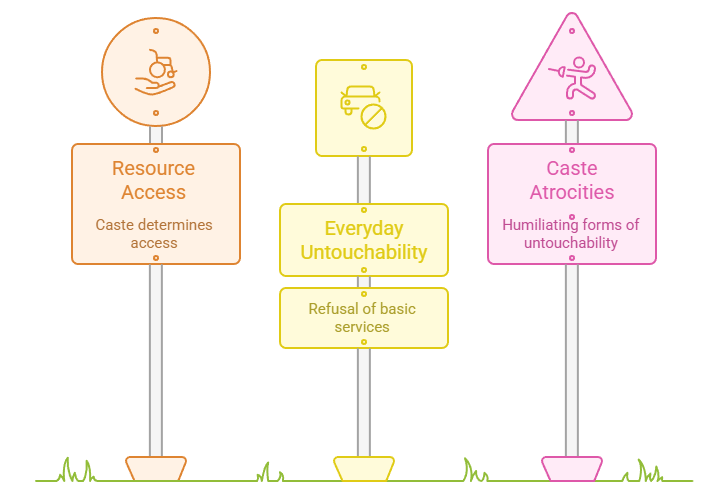
- Social Stratification: Caste continues to be a powerful determinant of access to resources, services, and dignity. While constitutional safeguards exist, practices like Dalits being denied haircuts, temple entry, or access to village wells still persist in many areas.
- Everyday Untouchability: Sociologist Ghanshyam Shah has shown that caste discrimination often operates through “everyday practices”—like refusal of service at shops, segregation in schools, or exclusion in religious spaces.
- Dalits in Gujarat: Gujarat has witnessed several caste-based atrocities, including the Una flogging case (2016). The Alvada incident adds another dimension by exposing subtle yet humiliating forms of untouchability that remained unquestioned for decades.
Historical Continuity:
Chhogaji Chauhan, a 58-year-old Dalit from Alvada, summed up the generational pain: “Our ancestors faced this discrimination even before Independence, and my children endured it for eight decades.”
- Colonial Legacy: British ethnographers documented caste restrictions, but often reinforced them by codifying caste hierarchies in administration.
- Post-Independence: The Indian Constitution (Article 17) abolished untouchability. Yet, in practice, caste prejudices remained deeply rooted in rural society.
- Persistence of Stigma: As N. Srinivas noted, “Sanskritisation” allowed lower castes to imitate higher castes’ rituals, but access to equal dignity remained limited.
Why a Haircut Matters:
Something as simple as a haircut carries symbolic value because:
- It reflects social interaction and recognition of equality.
- It represents breaking of ritual purity-pollution barriers that barbers often enforced under caste norms.
- It liberates Dalits from the need to travel to other villages, hiding their identity for basic services.
This small act becomes a marker of social justice and a step towards cultural citizenship, where every citizen’s dignity is respected.
Sociological Analysis
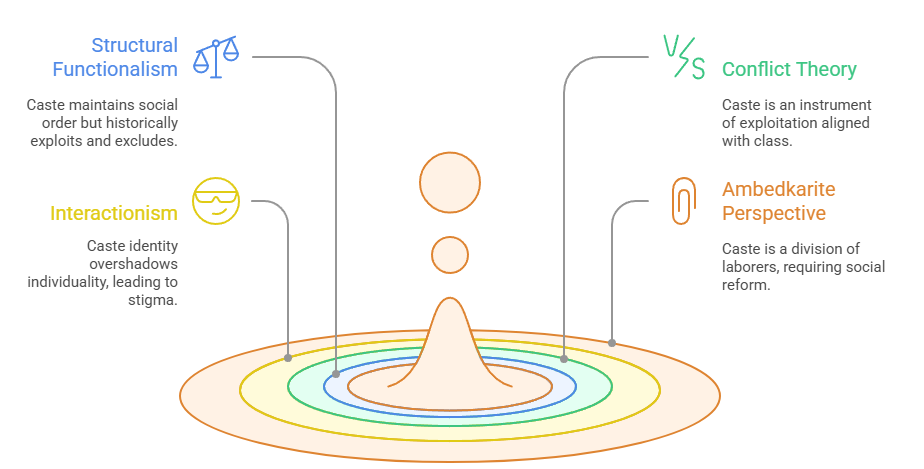
- Structural Functionalism: According to structural functionalists like Parsons and Davis-Moore, stratification exists to maintain social order. In caste, however, this order has historically been exploitative and exclusionary. The denial of a haircut maintained social distance between Dalits and others, preserving caste hierarchy.
- Conflict Theory (Marx & A.R. Desai): Marxist sociologists like A.R. Desai argue that caste operates as an instrument of exploitation aligned with class. In Gujarat, Dalits often work as farm laborers under upper-caste landlords. Denying them services like haircuts reinforced their subordinate economic and social position.
- Interactionism (Erving Goffman): Goffman’s idea of “stigma” applies here. Dalits faced stigma every time they sought a haircut, as their caste identity overshadowed their individuality. The recent haircut becomes an act of resisting stigma and reclaiming dignity.
- Ambedkarite Perspective: B.R. Ambedkar emphasized that caste is not just a division of labor but a division of laborers. He argued that self-respect movements must challenge everyday humiliations. The Alvada incident reflects Ambedkar’s call for annihilation of caste through social reform and assertion.
Broader Implications for Indian Society
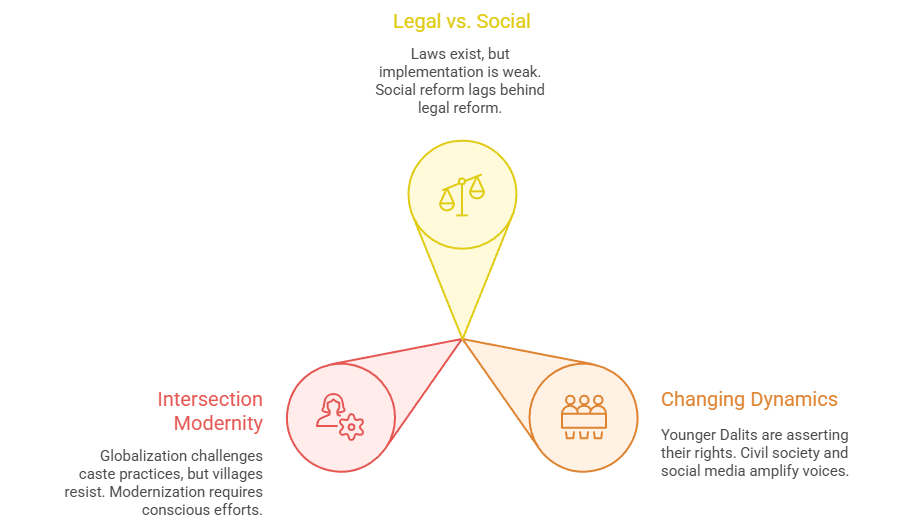
- Legal vs. Social Reality
- Laws like the Scheduled Castes and Scheduled Tribes (Prevention of Atrocities) Act, 1989 exist, but their implementation in villages remains weak.
- The Alvada case shows that social reform lags behind legal reform.
- Changing Social Dynamics
- Younger Dalits like Kirti Chauhan are asserting their rights more strongly.
- Civil society groups, Dalit movements, and social media have amplified voices against caste discrimination.
- Intersection with Modernity
- Globalization and urban migration are challenging caste practices, but villages remain resistant.
- The haircut event highlights that modernization does not automatically erase caste; it requires conscious efforts.
Way Forward
- Legal Enforcement: Stronger implementation of SC/ST Atrocities Act.
- Social Awareness: Community-level campaigns to normalize inter-caste interactions.
- Educational Interventions: Schools as spaces to challenge caste prejudices.
- Dalit Assertion Movements: Strengthening grassroots activism for dignity and equality.
- State and Civil Society Collaboration: NGOs and government must jointly address such discriminatory practices.
Conclusion
The haircut in Alvada village is not just about grooming—it is about dignity, rights, and equality. It reminds us that even 78 years after Independence; caste continues to govern daily life in subtle and overt ways. At the same time, it also signals hope and resistance. When Dalits reclaim everyday rights, they break centuries of exclusion. The incident is a contemporary example of how social change occurs slowly but meaningfully, linking theory to lived realities. It shows that the road to annihilating caste may be long, but every small victory—like a haircut—becomes a milestone in India’s march toward equality.
PYQs
Paper I
- Critically examine M.N. Srinivas’s concept of ‘Dominant Caste’ in the context of contemporary caste relations. (2014)
- Discuss the relevance of Louis Dumont’s concept of purity and pollution in understanding caste practices in India. (2015)
- How does Goffman’s concept of ‘stigma’ help in understanding caste-based discrimination in Indian society? (2016)
- “Caste is not a division of labour; it is a division of labourers.” (Ambedkar). Explain. (2017)
- Is caste system changing its form but not its substance? Discuss with examples. (2018)
- Examine how Marxist and Weberian perspectives help us in understanding caste in India. (2019)
- Untouchability continues to be practiced in everyday life despite legal prohibitions. Explain. (2020)
- How relevant is the concept of Sanskritisation for explaining caste mobility today? (2021)
- Critically discuss the persistence of caste as a form of social stratification in contemporary India. (2022)
- Examine the role of caste in shaping patterns of social exclusion and discrimination in India. (2023)
- “Social mobility in India is constrained more by caste than by class.” Discuss. (2024)
Paper II
- Discuss the role of Dalit movements in social transformation in India. (2014)
- Analyse the persistence of untouchability in Indian villages despite constitutional safeguards. (2015)
- Write a note on atrocities against Dalits in contemporary India. (2016)
- Explain the link between caste and access to public spaces and services in rural India. (2017)
- Critically examine the impact of Dalit assertion movements on Indian democracy. (2018)
- Discuss caste discrimination in the context of modern institutions such as schools, markets, and workplaces. (2019)
- How do caste-based practices in rural India reproduce social inequality? Illustrate with examples. (2020)
- “Caste conflicts in India are both a challenge to democracy and a product of it.” Discuss. (2021)
- Analyse the persistence of caste-based segregation in rural India with reference to access to everyday services. (2022)
- Explain the role of constitutional provisions and social movements in reducing caste discrimination in India. (2023)
- “Despite globalization and urbanization, caste continues to govern everyday life in India.” Critically analyse. (2024)
|


One comment