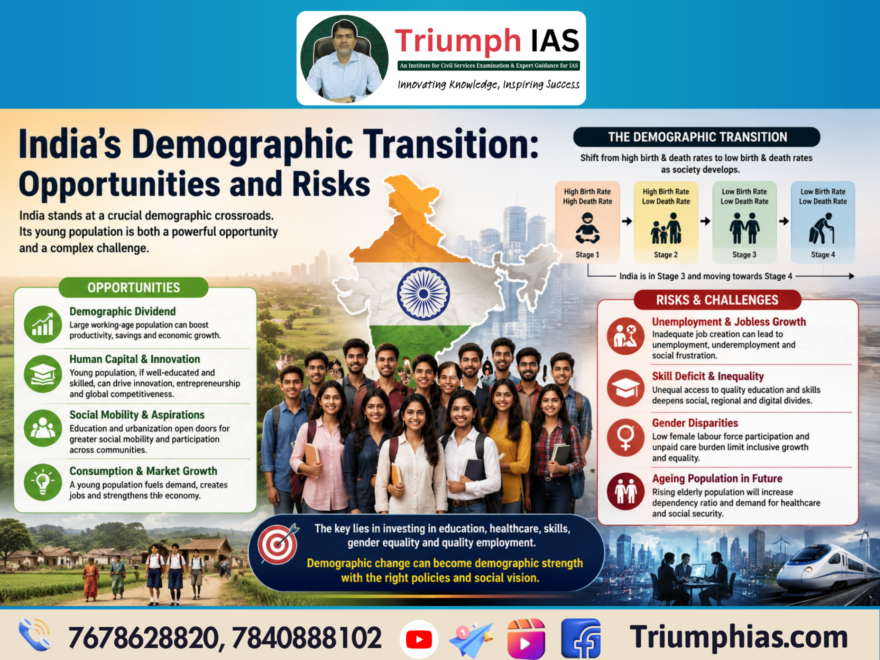
India is currently witnessing one of the most significant demographic transformations in human history. A demographic transition refers to the shift from high birth and death rates to lower birth and death rates as a society progresses through economic development, urbanization, improved healthcare, and modernization. This transition changes the age composition of society, creating new social, economic, and political realities.
With more than half of its population in the working-age group, India possesses a historic demographic advantage commonly known as the “demographic dividend.” However, a large youthful population can become a demographic burden if adequate opportunities for education, employment, and social mobility are not created. Therefore, India’s demographic transition represents both an extraordinary opportunity and a serious sociological challenge.
Main Blog:
Demographic Transition and Social Change
From a sociological perspective, demographic changes are not merely numerical shifts; they fundamentally transform social institutions such as family, education, economy, and political systems. Classical sociologists like Émile Durkheim associated increasing population density and division of labour with the emergence of complex societies characterized by greater interdependence.
In India, declining fertility rates, increasing life expectancy, and rapid urbanization have altered traditional family structures. The transition from joint families towards nuclear families, changing gender roles, delayed marriages, and lower fertility preferences reflect broader processes of modernization and individualization.
Opportunities of India’s Demographic Transition
1. Demographic Dividend and Economic Growth
A larger working-age population can increase productivity, savings, and innovation. If supported by quality education, skill development, and employment opportunities, India’s youth population can become the driving force behind economic growth and global competitiveness.
2. Social Mobility and Expansion of Aspirations
Education and urbanization have increased individual aspirations and opened avenues for social mobility. Historically marginalized groups, including women, Scheduled Castes, and other disadvantaged communities, can utilize demographic change as an opportunity for greater participation in economic and public life.
3. Innovation and Knowledge Economy
A young population provides a foundation for technological advancement, entrepreneurship, and the growth of the digital economy. India’s expanding startup ecosystem demonstrates the potential of its human capital.
Risks and Challenges of Demographic Transition
1. Unemployment and Jobless Growth
A demographic dividend is not automatic. The absence of sufficient employment opportunities can result in unemployment, underemployment, social frustration, and economic insecurity among youth.
2. Skill Deficit and Educational Inequality
Large sections of India’s youth continue to face unequal access to quality education and skill training. The digital divide and disparities between urban and rural regions may deepen existing social inequalities.
3. Gender and Labour Force Challenges
Despite improvements in education, women’s participation in the labour market remains constrained by patriarchal norms, unpaid care responsibilities, and lack of supportive workplace structures. A true demographic dividend requires greater gender equality.
4. Population Ageing and Future Dependency
While India is currently young, declining fertility and increased life expectancy will eventually lead to an ageing population. This will require stronger healthcare systems, social security mechanisms, and policies for elderly care.
Sociological Perspective on Demographic Transition
Modernization theory argues that industrialization, education, and urbanization lead to changes in demographic behaviour and social institutions. However, sociologists also highlight that demographic benefits are shaped by existing structures of inequality based on class, caste, gender, and region.
The concept of “demographic dividend” must therefore be understood not only as an economic phenomenon but also as a question of social justice. Human capital development, equal opportunities, and inclusive institutions determine whether demographic transition produces prosperity or social tension.
Conclusion:
India stands at a crucial demographic crossroads. The country’s youthful population presents an unprecedented opportunity to accelerate economic development, technological innovation, and social transformation. However, demographic advantages are time-bound and require investment in education, healthcare, employment generation, and gender equality.
The destiny of India’s demographic transition will ultimately depend on whether the nation can transform its population into empowered human capital. A society that successfully invests in its people converts demographic change into demographic strength.



3 comments