Ethnicity, Identity Politics, and Social Mobilisation

Ethnicity, Identity Politics, and Social Mobilisation

Relevant for Sociology Optional Paper 1, Paper 2, and GS Paper I (Indian Society)

Introduction

In contemporary societies, ethnicity and identity have emerged as powerful forces shaping political behaviour, social movements, and collective action. While modernization was expected to weaken traditional identities, the resurgence of ethnic consciousness across the world demonstrates that identity remains a central organizing principle in social life. Ethnicity, identity politics, and social mobilisation have therefore become crucial themes in sociology, particularly in understanding social conflict, representation, and democratic participation.

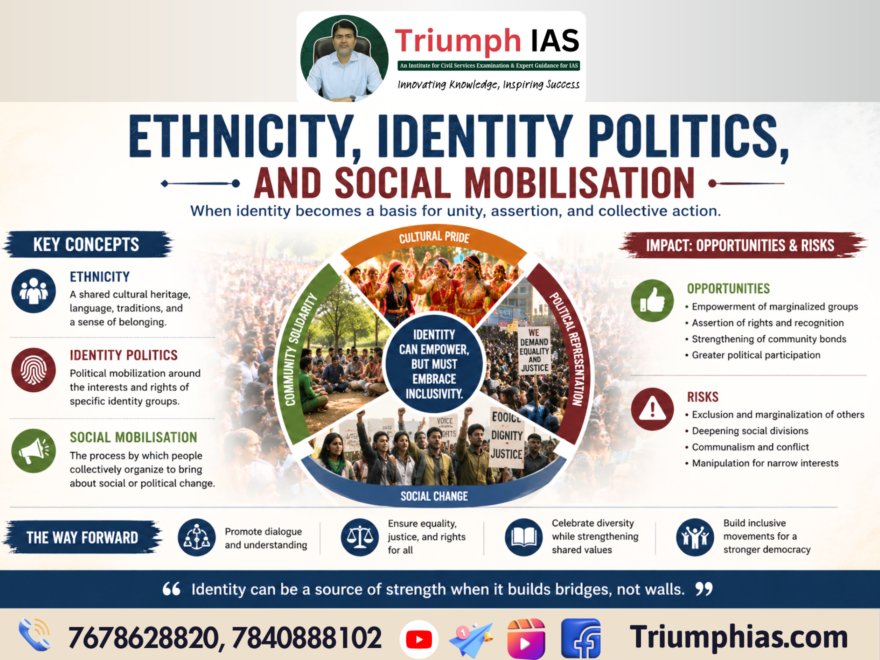
Ethnicity refers to a shared sense of belonging based on common ancestry, culture, language, religion, history, or traditions. According to Max Weber, ethnic groups are formed through a subjective belief in common descent rather than actual biological ties. Ethnicity is thus a social construction that creates collective consciousness among members of a group.

The significance of ethnicity has increased in the context of globalization. Contrary to expectations that globalization would create a homogeneous world culture, it has often strengthened ethnic identities. As cultural boundaries become blurred, communities seek to preserve their distinctiveness by emphasizing their ethnic roots. This phenomenon is visible in demands for linguistic recognition, cultural autonomy, and regional self-governance across many societies.

Identity politics refers to political mobilization based on shared social identities such as ethnicity, caste, race, religion, gender, or language. It involves collective efforts by marginalized or underrepresented groups to secure recognition, representation, and resources. Identity politics challenges the assumption that individuals participate in politics merely as citizens; instead, it highlights how social identities influence political participation and access to power.

Sociologists have offered diverse perspectives on identity politics. The conflict perspective views identity-based mobilization as a struggle over resources and power. Antonio Gramsci’s concept of cultural hegemony explains how subordinate groups challenge dominant narratives through identity assertion. Postmodern theorists such as Michel Foucault emphasize how identities are shaped through discourse and power relations, making identity politics a form of resistance against exclusion and domination.

Social mobilisation refers to the process through which groups organize collective action to achieve social, political, or economic objectives. Ethnic identity often serves as a powerful basis for mobilisation because it generates solidarity, emotional attachment, and shared grievances. Social mobilisation may take various forms, including protest movements, political campaigns, cultural revival movements, and demands for autonomy.

The relationship between ethnicity and social mobilisation is particularly evident in multicultural societies. In India, ethnic and identity-based mobilisations have influenced democratic politics through regional movements, linguistic agitations, tribal assertions, and caste-based movements. The mobilization of historically marginalized communities has expanded political participation and strengthened democratic representation. However, identity politics can also generate social fragmentation, communal tensions, and competitive victimhood when group interests are pursued at the expense of broader social cohesion.

Sociologist Manuel Castells argues that in the network society, identities become critical sources of meaning and resistance. Communities increasingly organize around cultural and symbolic identities rather than purely economic interests. This shift explains the growing prominence of identity-based social movements in contemporary societies.

Conclusion

In conclusion, ethnicity, identity politics, and social mobilisation remain central to understanding modern social and political processes. While identity-based mobilization can empower marginalized groups and deepen democracy, it also poses challenges to social integration. Sociology provides valuable tools for examining how identities are constructed, negotiated, and mobilized in the pursuit of recognition, justice, and social change.

UPSC Civil Services (Mains) Question

Q. “Ethnicity has become an important basis of social mobilisation in contemporary societies.” Discuss with suitable sociological perspectives and examples. (20 Marks)

To Read more topicsvisit: www.triumphias.com/blogs

Read more Blogs:

Dalit and Backward Class Movements in Contemporary India

A good life is one inspired by love and guided by knowledge – Triumph IAS & Vikash Ranjan Sir

🔥 YOUR FINAL UPSC RANK CAN BE DECIDED BY JUST TWO PAPERS — ESSAY & OPTIONAL!

Most aspirants study hard.
But very few know how to convert knowledge into MARKS.

That’s where Triumph IAS creates the difference. 🚀

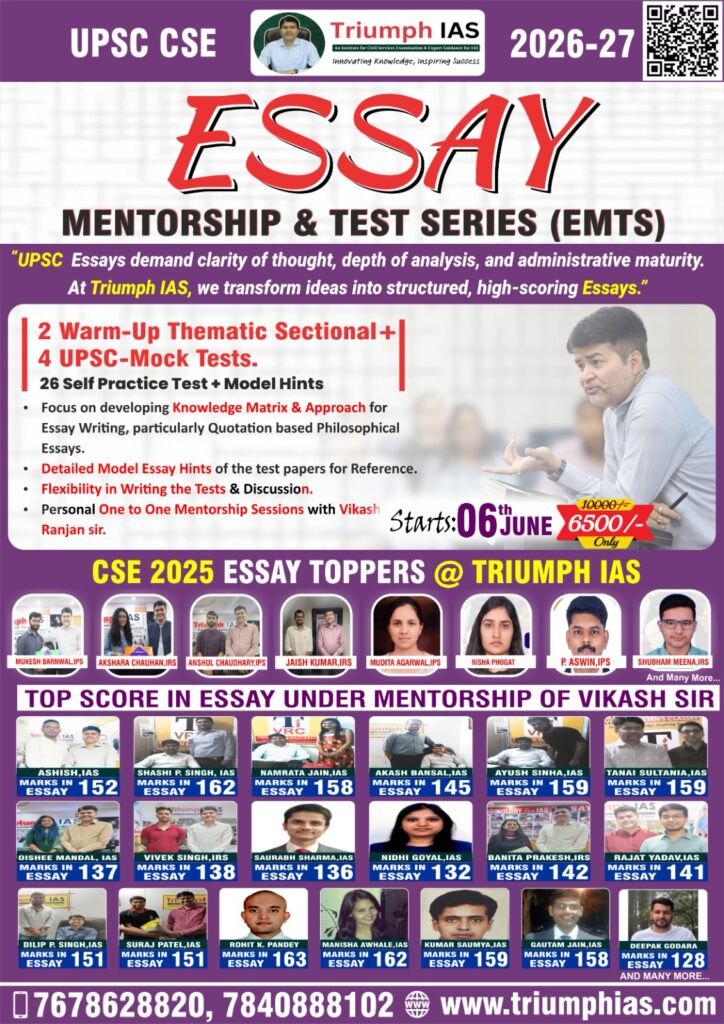
✍️ EMTS – Essay Mentorship & Test Series (CSE Mains 2026–27)

Under the mentorship of Vikash Ranjan Sir, master the art of writing structured, philosophical, multidimensional, and topper-level essays.

Scientific Essay Writing Approach
Knowledge Matrix Framework
5 Exclusive Essay Approach Classes
2 Thematic Tests + 4 UPSC Mock Tests
Detailed Model Essay Hints
Flexible Writing & Discussion Sessions
Personal 1-to-1 Mentorship

🏆 Trusted by UPSC Essay Toppers
━━━━━━━━━━━━━━━━━━

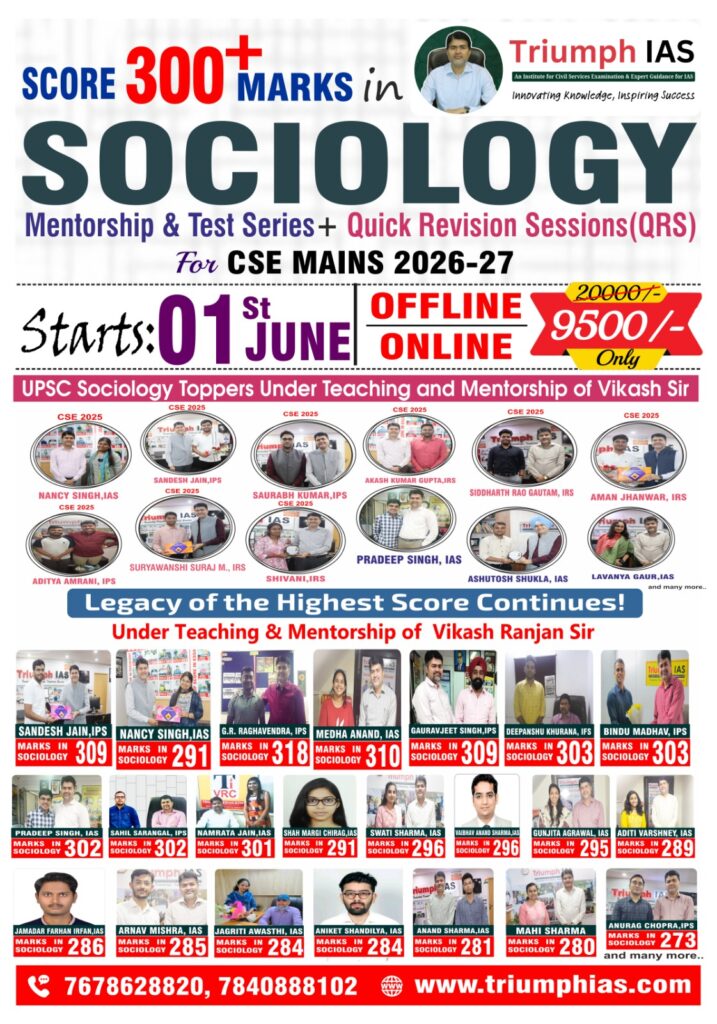
📚 SMTS – Sociology Mentorship & Test Series + Quick Revision Session (QRS)

🎯 SCORE 300+ MARKS IN SOCIOLOGY OPTIONAL

A structured, analytical, and result-oriented mentorship program designed to maximize your Sociology score under the guidance of Vikash Ranjan Sir.

Program Highlights:

26 Full-Length Tests with Detailed Evaluation
PYQ–NYQ Trend Analysis
Quick Revision Sessions on Unconventional Questions
Brainstorming & Concept Enrichment Sessions
1-to-1 Personal Mentorship Discussions
Topic-wise Answer Writing Practice
Current Social Issues Compilation
Home-based Practice Tests with Model Hints
Thinkers Integration & Value Addition Notes
Essay & GS Enrichment through Sociology

  • 🏆 Legacy of High Scores Continues:
  • 🌟 G.R. Raghavendra, IPS – 318
  • 🌟 Medha Anand, IAS – 310
  • 🌟 Sandesh Jain, IPS – 309
  • 🌟 Gauravjeet Singh, IPS – 309
  • 🌟 Deepanshu Khurana, IFS – 303
  • 🌟 Pradeep Singh, IAS – 302
  • 🌟 Swati Sharma, IAS – 296
  • 🌟 Gunjita Agarwal, IAS – 295

…and many more successful aspirants.

━━━━━━━━━━━━━━━━━

Batch Starts: 01 June

  • 📍 Available in OFFLINE & ONLINE Mode
  • 📞 Call/WhatsApp: 7678628820 | 7840888102
  • 🌐 triumphias.com
  • 📍 Triumph IAS
  • 23-B, 3rd Floor, Pusa Road
  • Near Karol Bagh Metro Pillar No. 114, New Delhi
EMTS – Essay Mentorship & Test Series (CSE Mains 2026–27)

One comment

Leave a Reply

Your email address will not be published. Required fields are marked *