
Declining Social Mobility and the Crisis of Aspirations
(Relevant for Sociology Optional Paper 1, Paper 2, and GS Paper I (Indian Society)
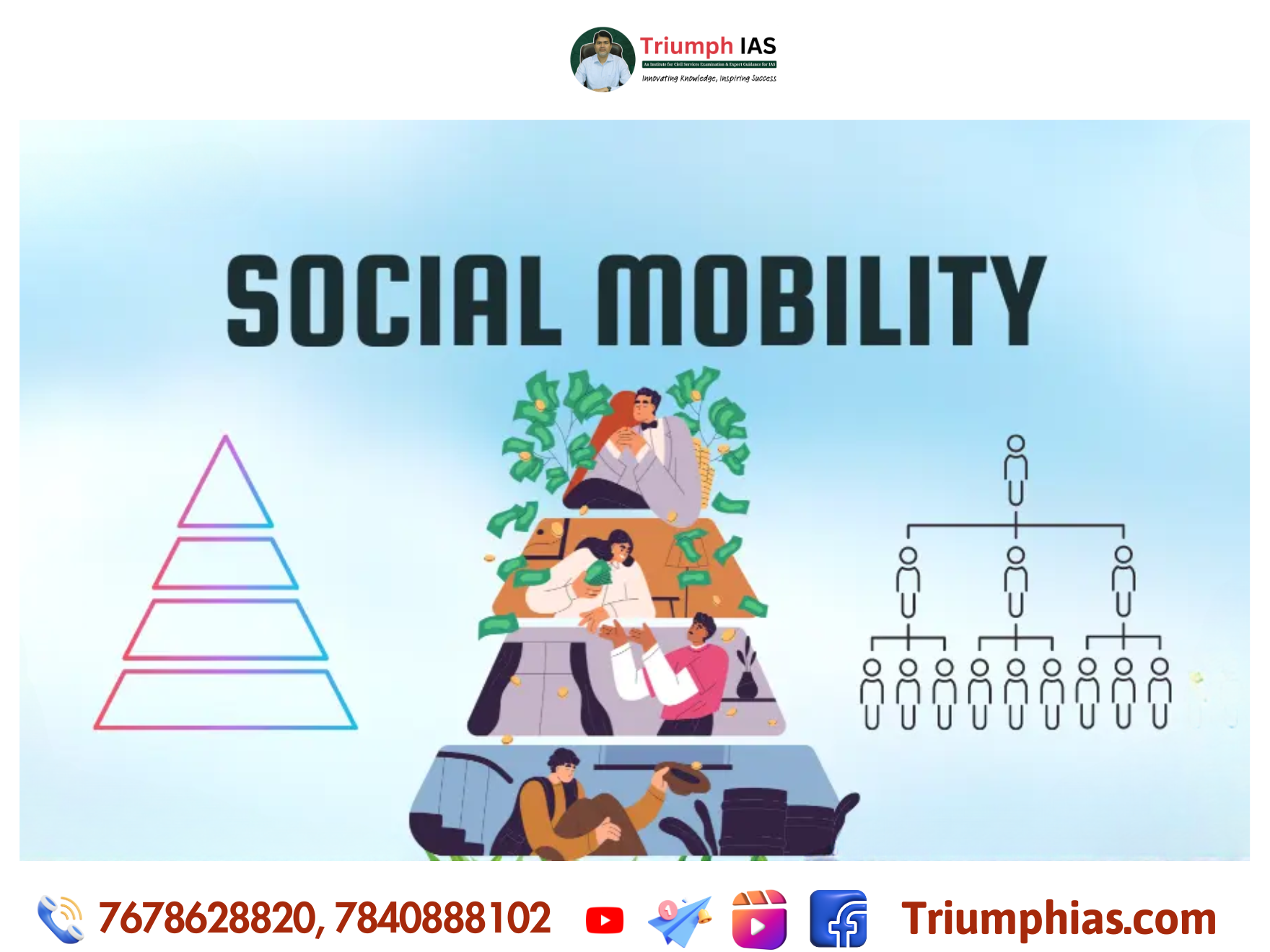
IntroductionSocial mobility—the ability of individuals or groups to move upward or downward in the social hierarchy—has long been regarded as a crucial indicator of a dynamic and equitable society. In sociological terms, mobility reflects how far social structures allow individuals to improve their socio-economic status through education, employment, and opportunity. However, recent trends across many societies, including India, suggest that declining social mobility is producing what scholars increasingly describe as a “crisis of aspirations.”
Dimension:Social Mobility in Sociological PerspectiveClassical sociologists recognised mobility as central to understanding modern societies. Industrialisation and urbanisation were expected to weaken rigid hierarchies and create opportunities for upward movement. In theory, meritocracy would replace inherited privilege. Education, skill acquisition, and occupational mobility were seen as the main vehicles through which individuals could improve their life chances. However, contemporary research suggests that mobility is becoming increasingly constrained. While economic growth has expanded opportunities for some, structural inequalities continue to limit mobility for many. As a result, individuals who aspire to move upward often encounter barriers that prevent their aspirations from being realised. Structural Constraints on MobilitySeveral structural factors contribute to declining mobility. First, economic inequality has widened in many societies. When wealth and opportunities become concentrated among a small section of society, access to quality education, employment networks, and social capital becomes restricted. Children born into privileged families often inherit advantages that help them maintain their socio-economic position. Second, educational stratification plays a significant role. While education is widely seen as the ladder of mobility, disparities in schooling quality, access to coaching, digital resources, and higher education opportunities create unequal outcomes. Students from disadvantaged backgrounds frequently struggle to compete in systems that reward already privileged groups. Third, labour market transformations have altered the structure of opportunities. The growth of contractual work, the gig economy, and automation has reduced stable employment pathways that traditionally facilitated upward mobility. Even highly educated youth often face precarious employment, underemployment, or delayed entry into stable careers.
Aspirations and Social FrustrationThe crisis emerges when aspirations rise faster than opportunities. Modern societies constantly promote narratives of success, meritocracy, and self-achievement through media, education, and political discourse. Individuals are encouraged to believe that hard work alone guarantees upward mobility. However, when structural barriers prevent the fulfilment of these aspirations, frustration and disillusionment may develop. Sociologists often describe this condition as “aspirational frustration”—a mismatch between expectations and actual opportunities. Young people who invest heavily in education but face unemployment or limited career prospects may experience a sense of injustice and alienation. In societies experiencing rapid social change, this gap between expectations and outcomes becomes particularly pronounced. The result may include declining trust in institutions, social unrest, or the attraction of populist narratives that promise quick transformation. The Indian ContextIn India, social mobility has historically been shaped by the intersection of caste, class, and education. Post-independence policies such as reservations, expansion of education, and economic liberalisation opened new opportunities for many communities. Yet inequalities remain deeply entrenched. Rural-urban divides, unequal access to quality education, and persistent caste-based discrimination continue to influence mobility patterns. While a growing middle class has emerged, a large segment of youth still struggles to convert educational attainment into stable employment. The growing visibility of success stories through digital media has also raised aspirations among young people from diverse backgrounds. However, when institutional opportunities fail to match these aspirations, frustration becomes more widespread. Reimagining Mobility and OpportunityAddressing the crisis of aspirations requires policies that expand genuine opportunities rather than merely raising expectations. Strengthening public education, ensuring equitable access to higher education, promoting inclusive economic growth, and creating stable employment opportunities are essential steps. From a sociological perspective, mobility must also be understood not only in economic terms but in relation to dignity, recognition, and social justice. When societies enable individuals from diverse backgrounds to achieve their aspirations through fair and inclusive systems, social mobility becomes a powerful instrument of democratic stability. Ultimately, the challenge for contemporary societies lies in bridging the widening gap between aspiration and opportunity. Without addressing structural inequalities, the promise of mobility risks becoming an illusion rather than a lived reality. |
UPSC Civil Services (Mains) Question
“Rising aspirations without corresponding opportunities often produce social frustration.”
Discuss this statement in the context of declining social mobility in contemporary societies.
To Read more topics, visit: www.triumphias.com/blogs
Read more Blogs:
Poverty, Deprivation, and the Debate on the Multidimensional Poverty Index (MPI)
A thought-provoking discussion on declining social mobility, exploring how limited opportunities and systemic barriers impact aspirations and the ability to achieve upward growth.