
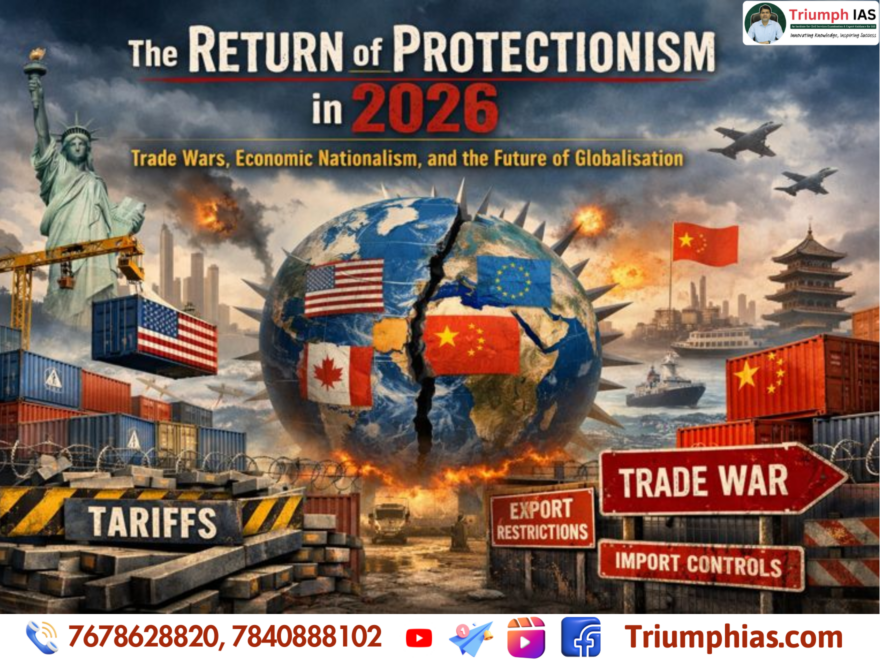
The Return of Protectionism in 2026: Trade Wars, Economic Nationalism, and the Future of Globalisation
(Relevant for Sociology Paper 2)
Introduction: A World Retreating from Free TradeOne of the most visible themes dominating today’s global news in January 2026 is the renewed rise of protectionism. Across continents, governments are announcing tariffs, trade restrictions, domestic subsidies, and strategic controls in the name of national interest, economic security, and political stability. The optimism of free trade that defined the early 21st century appears to be giving way to a more guarded, inward-looking global order. From tariff threats and supply-chain realignments to “buy national” policies and strategic decoupling, the world economy is witnessing a structural shift away from hyper-globalisation. This moment is not merely an economic episode; it represents a deeper transformation in state–market relations, global power hierarchies, and political ideologies. This blog analyses the return of protectionism as a major current-affairs theme of 2026, its causes, consequences, and what it means for countries like India in a fractured global economy. Understanding Protectionism in the Contemporary ContextWhat Is Protectionism Today?Unlike the crude tariff walls of the past, modern protectionism is subtle, strategic, and technologically driven. It includes:
Protectionism in 2026 is less about isolation and more about control over strategic sectors such as energy, semiconductors, defence, food systems, and digital infrastructure. Why Protectionism Is Making a Comeback1. Economic Insecurity After Multiple Global ShocksThe global economy has faced continuous disruptions over the past decade:
These shocks exposed the vulnerabilities of over-reliance on global supply chains. As a result, governments now prioritise resilience over efficiency. 2. The Politics of Economic NationalismProtectionism is not only an economic choice but a political strategy. Leaders across democracies and authoritarian regimes increasingly frame trade policies around:
Economic nationalism resonates strongly with voters who feel excluded from the gains of globalisation, making protectionism electorally attractive. 3. Geopolitics and Strategic RivalriesTrade is no longer separate from geopolitics. In 2026:
The global economy is increasingly divided into strategic blocs, weakening multilateral trade norms. The Crisis of the Global Trading SystemDecline of MultilateralismInstitutions designed to regulate global trade struggle to keep pace with unilateral actions by powerful states. Dispute resolution mechanisms are weakened, and rules are selectively applied. This erosion of multilateralism marks a shift from rule-based globalisation to power-based economic order. Fragmentation of Global MarketsInstead of one integrated global market, we are witnessing:
This fragmentation increases costs, reduces efficiency, and creates uncertainty—particularly for developing economies. India and the New Trade RealityIndia’s Strategic DilemmaIndia finds itself at a complex crossroads:
In 2026, India’s trade policy reflects this duality—engaging selectively with global partners while protecting sensitive sectors. Self-Reliance vs Global CompetitivenessDomestic manufacturing incentives aim to strengthen industrial capacity, but excessive protection risks:
The challenge for India is to pursue strategic protectionism without falling into economic isolation. Social Consequences of Protectionist PoliciesImpact on Workers and ConsumersProtectionist policies often promise job creation, but their real outcomes are mixed:
In many cases, the costs of protectionism are socialised, while benefits are concentrated among specific sectors. Inequality Between NationsDeveloping countries dependent on exports face shrinking market access, widening the gap between advanced economies and the Global South. Protectionism thus reinforces global inequality, undermining development goals. Technology, Trade, and Economic SovereigntyThe Rise of Tech ProtectionismOne of the most striking features of 2026 is the regulation of:
Technology is now treated as a strategic asset rather than a neutral commodity, reshaping global innovation ecosystems. Digital Borders in a Global EconomyCountries increasingly enforce digital sovereignty through data localisation and platform regulation. While these measures protect national interests, they also restrict the free flow of information and innovation. Environmental Dimensions of ProtectionismGreen Trade BarriersClimate policies are now intersecting with trade:
While environmentally justified, these measures can act as hidden trade barriers, disadvantaging poorer nations. The Risk of “Green Protectionism”Without financial and technological support, developing countries may struggle to meet new standards, turning climate action into a tool of exclusion rather than cooperation. Sociological Perspective: Who Benefits from Protectionism?From a sociological lens, protectionism reflects:
Economic decisions are embedded in social structures, political ideologies, and cultural anxieties. Is De-Globalisation Inevitable?Despite rising protectionism, complete de-globalisation is unlikely. What we are witnessing is re-globalisation on new terms—more fragmented, strategic, and politicised. Globalisation is not disappearing; it is being reconfigured. The Way Forward: Balancing Openness and SecurityTo navigate this new era, countries must:
The goal should be resilient globalisation, not rigid protectionism. Conclusion: A Turning Point in the Global Economic OrderThe resurgence of protectionism in 2026 marks a significant turning point in global economic history. Trade is no longer governed purely by efficiency and comparative advantage, but by politics, security, and identity. For countries like India, this moment presents both risks and opportunities. Strategic engagement, institutional strength, and inclusive growth policies will determine whether protectionism becomes a shield for development or a barrier to progress. The choices made today will shape not just economic outcomes, but the future architecture of global cooperation. |
To Read more topics, visit: www.triumphias.com/blogs
Read more Blogs:
Digital India at a Turning Point: Technology, Governance, and Social Transformation in 2026
Education in Transition: Reform, Inequality, and the Future of Learning in Contemporary India
6 comments