
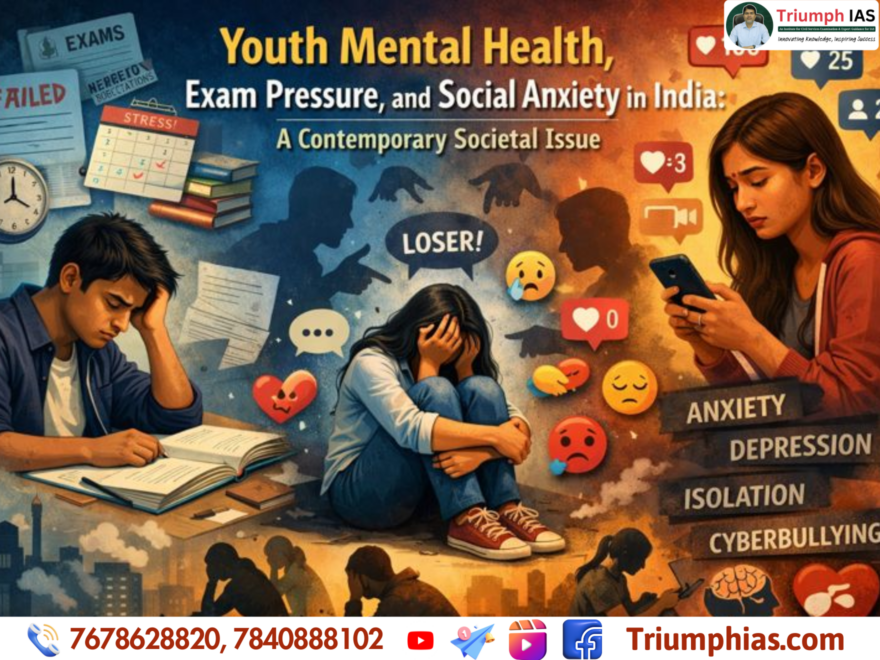
Youth Mental Health, Exam Pressure, and Social Anxiety in India: A Contemporary Societal Issue
(Relevant for Sociology Paper I and II)
IntroductionIn recent years, youth mental health has emerged as a pressing and widely discussed issue in Indian society. News reports of student suicides, rising cases of anxiety and depression, intense competition in entrance examinations, and the growing influence of social media have pushed mental health from the margins of public discourse to the centre of societal concern. Cities like Kota, Hyderabad, Delhi, and Chennai—known for their coaching hubs—have become symbolic of a broader crisis facing India’s youth. The issue is no longer confined to academic spaces; it reflects deeper structural problems related to education, employment, family expectations, digital culture, and social inequality. India is often described as a young nation, with a large proportion of its population below the age of 30. While this demographic reality is celebrated as a “demographic dividend,” it also carries significant risks if the aspirations, well-being, and mental health of young people are neglected. This blog examines youth mental health as a current and deeply societal issue, focusing on exam pressure, social anxiety, and the changing social environment in which Indian youth are growing up. The Growing Visibility of Youth Mental Health IssuesMental health problems among young people were long underreported and stigmatised in Indian society. Emotional distress was often dismissed as weakness, lack of discipline, or moral failure. However, recent years have witnessed a shift in public awareness. Media coverage of student suicides, campaigns by mental health professionals, and discussions on social media have made psychological distress more visible. According to various surveys and reports, a significant proportion of Indian students experience high levels of stress, anxiety, and burnout. The COVID-19 pandemic further intensified these issues by disrupting education, increasing isolation, and creating uncertainty about the future. Even after the pandemic, its psychological after-effects continue to shape youth experiences, making mental health a sustained societal concern rather than a temporary crisis. Exam-Centric Education and the Culture of CompetitionOne of the most important structural causes of youth mental health stress in India is the exam-centric nature of the education system. High-stakes examinations such as JEE, NEET, UPSC, state public service exams, and various university entrance tests determine access to limited seats in prestigious institutions and secure jobs. Success in these exams is often portrayed as the primary pathway to social mobility and family honour. This culture of competition creates immense psychological pressure. Students begin exam preparation at an increasingly young age, often sacrificing leisure, social interaction, and emotional development. Coaching centres promote narratives of relentless hard work and self-sacrifice, normalising exhaustion and anxiety. Failure, which is statistically inevitable for most candidates, is often internalised as personal inadequacy rather than recognised as a consequence of structural scarcity. From a sociological perspective, this system reflects a mismatch between aspirations and opportunities. When millions compete for a few thousand seats, stress and despair become predictable outcomes rather than individual anomalies. Family Expectations and Social PressureFamily plays a central role in shaping youth aspirations in India. Parents, often driven by their own experiences of economic insecurity, place high expectations on children to succeed academically and professionally. While such expectations are rooted in care and concern, they can also become sources of emotional pressure. In many households, academic success is closely tied to social status and family reputation. Children may feel responsible not only for their own futures but also for fulfilling parental dreams and financial expectations. Open conversations about mental health are still limited in many families, making it difficult for young people to express distress or seek support. This dynamic is particularly intense in middle- and lower-middle-class families, where education is viewed as the primary means of escaping poverty or precarity. As a result, mental health struggles are often hidden until they reach crisis levels. Social Media, Comparison, and AnxietyThe rise of social media has profoundly altered the social environment of Indian youth. Platforms like Instagram, YouTube, and LinkedIn constantly expose young people to curated images of success, productivity, and happiness. While social media can provide connection and information, it also fosters unhealthy comparison and performance anxiety. Young users are regularly confronted with peers announcing exam ranks, job placements, foreign university admissions, and entrepreneurial success. These displays create an illusion that everyone else is moving ahead, intensifying feelings of inadequacy and failure. The pressure to build a personal brand, even while studying, adds another layer of stress. Digital spaces also blur the boundary between work, study, and leisure, making it difficult for young people to disengage and recover emotionally. The constant connectivity contributes to sleep deprivation, reduced attention spans, and heightened anxiety. Gender, Class, and Unequal Mental Health BurdensYouth mental health issues do not affect all groups equally. Gender, class, caste, and region significantly shape experiences of stress and access to support. Young women often face the dual pressure of academic performance and conformity to gender norms related to marriage, appearance, and behaviour. Concerns about safety, mobility, and social judgement further contribute to anxiety. Students from marginalised caste and class backgrounds encounter additional stressors, including discrimination, financial insecurity, and lack of academic support. For first-generation learners, the burden of success is often accompanied by fear of failure and social alienation in elite educational spaces. Rural youth face limited access to quality educational institutions and mental health services, while also dealing with uncertainties related to agrarian distress and migration. These intersecting inequalities reveal that youth mental health is deeply embedded in broader structures of social stratification. Stigma and the Lack of Mental Health InfrastructureDespite increased awareness, mental health remains heavily stigmatised in Indian society. Seeking therapy or counselling is still associated with weakness or instability in many social contexts. As a result, young people often delay seeking help until problems become severe. India also faces a severe shortage of mental health professionals, particularly in public institutions. Counselling services in schools and colleges are often inadequate or absent. Where services do exist, they may be expensive, inaccessible, or culturally insensitive. Recent policy initiatives, such as the inclusion of mental health in public health discussions and the expansion of tele-counselling services, are steps in the right direction. However, implementation gaps and social attitudes continue to limit their effectiveness. Youth, Employment Anxiety, and the FutureMental health stress among youth is closely linked to employment uncertainty. Rising unemployment, underemployment, and the prevalence of short-term or precarious jobs have made the transition from education to work increasingly uncertain. Degrees no longer guarantee stable employment, undermining long-held assumptions about education and success. This uncertainty fuels anxiety about the future and erodes confidence in institutions. Competitive exams for government jobs, once seen as secure pathways, have become more crowded and unpredictable. For many young people, repeated exam attempts and delayed entry into the workforce lead to frustration and loss of self-worth. The gap between societal promises and lived realities has become a significant source of psychological distress. Rethinking Success and Building Supportive SystemsAddressing youth mental health requires more than individual coping strategies; it demands systemic change. Educational institutions must move beyond exam-centric evaluation and prioritise holistic learning and emotional well-being. Families need to foster environments where failure is treated as a learning experience rather than a moral collapse. Public investment in mental health infrastructure, especially in schools and colleges, is essential. Normalising conversations about mental health through education, media, and community initiatives can help reduce stigma. Digital platforms, while part of the problem, can also be leveraged to spread awareness and provide accessible support. Most importantly, society must rethink narrow definitions of success. Recognising diverse talents, career paths, and life trajectories can reduce the intense pressure placed on young people. ConclusionYouth mental health in India is not merely a psychological issue but a deeply sociological one rooted in structural pressures, institutional failures, and changing cultural values. By applying classical and contemporary sociological perspectives, the issue can be understood as a reflection of broader transformations in Indian society. |
To Read more topics, visit: www.triumphias.com/blogs
Read more Blogs:
Digital Surveillance, Welfare Delivery, and the Sociology of the Indian State
One comment