
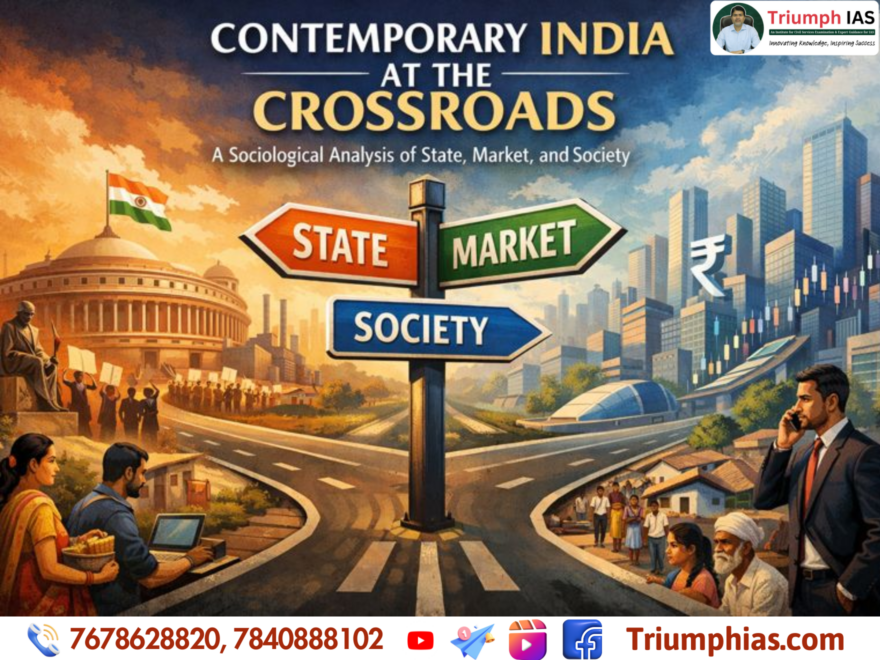
Contemporary India at the Crossroads: A Sociological Analysis of State, Market, and Society
(Relevant for Sociology Paper I and II)
IntroductionThe relationship between the state, market, and society has always been central to sociological inquiry. In contemporary India, this triadic relationship is undergoing rapid transformation due to economic restructuring, technological penetration, global interdependence, and shifting political priorities. Recent current affairs—from labour law reforms and platform economies to regional autonomy demands, digital governance, and global economic uncertainties—offer fertile ground for sociological analysis. For students of Sociology Optional, current affairs are not merely background information; they serve as empirical illustrations of classical and contemporary sociological theories. This blog attempts a comprehensive sociological reading of recent developments in India and the global context, linking them with key sociological concepts, thinkers, and debates relevant for UPSC Mains. Changing Role of the State: From Welfare to Regulatory Governance
One of the most significant trends in recent years has been the reconfiguration of the Indian state’s role. While the post-independence Indian state was characterised by welfare orientation and planned development, recent policies indicate a shift towards regulatory and facilitative governance. The replacement of traditional welfare schemes with restructured employment and insurance programmes reflects what sociologists call state retreat and selective intervention. Rather than direct provisioning, the state increasingly creates frameworks within which markets and private actors operate. This aligns with neo-liberal governance, where efficiency, targeting, and fiscal discipline are prioritised over universal welfare. From a Marxian perspective, this transition raises questions about class interests. Welfare retrenchment disproportionately affects informal workers, rural labourers, and marginalised communities, reinforcing structural inequalities. The state, in this reading, acts not as a neutral arbiter but as a facilitator of capital accumulation. In contrast, Weberian sociology views this shift through the lens of rationalisation. The state increasingly relies on formal rules, digital databases, and bureaucratic efficiency, sometimes at the cost of substantive justice. Labour Reforms, Rural Employment, and InformalisationRecent debates around rural employment guarantees, labour codes, and social security coverage highlight the enduring problem of informality in Indian society. Despite economic growth, nearly 90% of India’s workforce remains informal, lacking stable contracts, social security, and collective bargaining power. Sociologically, this reflects dual labour markets—a protected formal sector alongside a vast precarious informal sector. The restructuring of employment schemes indicates a shift from a rights-based approach to a managed employment model, where work availability depends on fiscal priorities and administrative discretion. Karl Polanyi’s concept of “disembedded markets” is particularly relevant here. Labour, when treated purely as a commodity, becomes vulnerable to market fluctuations, leading to social dislocation. Polanyi argued that societies inevitably push back through protective mechanisms. Contemporary demands for employment security and minimum wages represent such countermovements. The Gig Economy and Algorithmic Control
The rapid expansion of the gig and platform economy has emerged as a defining feature of contemporary labour markets. Ride-hailing, food delivery, logistics, and domestic services platforms promise flexibility and entrepreneurship, yet sociological analysis reveals deeper contradictions. From a Marxian lens, gig workers are alienated not only from the means of production but also from decision-making processes controlled by algorithms. Surplus value is extracted through commissions and dynamic pricing, while risks are transferred to workers. Max Weber’s theory of rationalisation helps explain algorithmic management, where efficiency, predictability, and calculability dominate labour relations. Human discretion is replaced by automated ratings and incentives, creating what sociologists describe as digital bureaucracy. From a feminist sociological perspective, gig platforms simultaneously expand opportunities for women while reproducing gendered labour divisions, especially in care and domestic work. Safety concerns, wage disparities, and lack of maternity benefits remain unresolved. Digital Governance, Surveillance, and Social StratificationIndia’s rapid digitalisation—through digital payments, biometric identification, and online service delivery—has transformed governance structures. While digital governance enhances efficiency and transparency, it also raises concerns about exclusion, surveillance, and data inequality. The digital divide remains a major sociological concern. Access to technology is uneven across class, caste, gender, and region. For marginalised groups, digitalisation can become a barrier rather than a bridge. Michel Foucault’s concept of governmentality is useful here. Digital tools allow the state to govern populations through data collection, monitoring, and behavioural nudging. Citizens increasingly become data subjects, raising ethical concerns about privacy and consent. At the same time, digital platforms enable new forms of civic participation and social mobilisation, illustrating the dialectical nature of technology—both emancipatory and controlling. Federalism, Identity Politics, and Regional AspirationsRecent demands for statehood, autonomy, and constitutional safeguards in regions such as Ladakh underscore the continuing relevance of identity politics and political sociology in India. These movements are rooted not merely in administrative grievances but in concerns over cultural preservation, political representation, and resource control. The demand for special constitutional provisions reflects fears of demographic change and marginalisation. Anthony Smith’s theory of ethno-symbolism helps explain how collective memories, symbols, and identities mobilise political action. Similarly, Parsons’ functionalism would interpret such demands as attempts to restore equilibrium within the federal structure. From a critical perspective, identity-based mobilisations also reveal tensions between national integration and cultural pluralism, a recurring theme in Indian sociology. Global Economic Uncertainty and Its Social ImpactRecent global economic slowdowns, inflationary pressures, and geopolitical tensions have significant social implications for India. Rising prices, employment insecurity, and fiscal constraints disproportionately affect vulnerable populations. World-systems theory, proposed by Immanuel Wallerstein, situates India within the semi-periphery of the global economy—integrated into global markets yet vulnerable to external shocks. Global economic instability often translates into domestic austerity measures, reinforcing inequality. Sociologically, economic uncertainty intensifies status anxiety, particularly among the middle class. Aspirational frustration, youth unemployment, and credential inflation contribute to social stress, mental health challenges, and political discontent. Education, Youth, and Aspirational AnxietyIndia’s demographic dividend is often celebrated, yet recent trends reveal growing aspirational anxiety among youth. Expansion of higher education has not been matched by commensurate employment opportunities, leading to underemployment and frustration. Robert K. Merton’s strain theory explains this phenomenon as a gap between culturally defined goals (success, stability) and institutional means (jobs, opportunities). When legitimate avenues are blocked, individuals experience strain, which may manifest as withdrawal, innovation, or deviance. Coaching cultures, competitive examinations, and migration aspirations further illustrate how education has become both a ladder of mobility and a site of stress. Gender, Care Economy, and Social ReproductionRecent policy discussions around care work, women’s employment, and social security highlight the gendered nature of development. Despite increased workforce participation, women continue to bear the disproportionate burden of unpaid care work. Feminist sociologists argue that capitalism relies heavily on invisible reproductive labour performed by women. Policies that ignore childcare, elder care, and domestic labour fail to address the structural roots of gender inequality. The commodification of care through platforms and private services has created new opportunities but also intensified precarity for women workers. Environment, Development, and Climate JusticeEnvironmental concerns—climate change, pollution, and resource depletion—have gained prominence in public discourse. Sociologically, environmental issues are deeply intertwined with questions of inequality and justice. The concept of environmental racism highlights how marginalised communities disproportionately bear the costs of environmental degradation. Development projects often displace tribal and rural populations, raising ethical concerns. Ulrich Beck’s “risk society” thesis explains how modernisation produces new global risks that transcend boundaries, requiring collective responses beyond nation-states. ConclusionContemporary India stands at a critical juncture where rapid economic and technological change intersects with deep-rooted social structures. Recent current affairs reveal that development is not merely about growth indicators but about power, inequality, identity, and justice. A sociological lens allows us to move beyond surface narratives and understand the structural forces shaping social reality. For Sociology Optional aspirants, integrating current affairs with theory is not optional—it is essential. As C. Wright Mills argued, cultivating the sociological imagination enables individuals to connect personal troubles with public issues, a skill indispensable for both academic analysis and public service. |


To Read more topics, visit: www.triumphias.com/blogs
Read more Blogs:
Non-Positivist Methodologies with References from Contemporary Society