What is the Climate Risk Index (CRI)?
The CRI is an annual index published by Germanwatch (a Bonn-based NGO) that “ranks countries by the human and economic toll of extreme weather events.”
Key features:
-
It uses data from extreme weather events (hydrological, meteorological, climatological) such as storms, floods, heat-waves, droughts.
-
It considers indicators like fatalities, number of people affected, economic losses — both in absolute and relative terms (per 100,000 people or per unit GDP) to reflect vulnerability and impact.
-
It is retrospective: it looks over a past period (e.g., 30 years) and also recent year-data. It does not directly predict future events, but gives a warning signal.
-
The 2026 edition (covering 1995-2024) reports that globally, more than 832,000 lives were lost and direct economic losses exceeded USD 4.5 trillion from more than 9,700 extreme weather‐events.
-
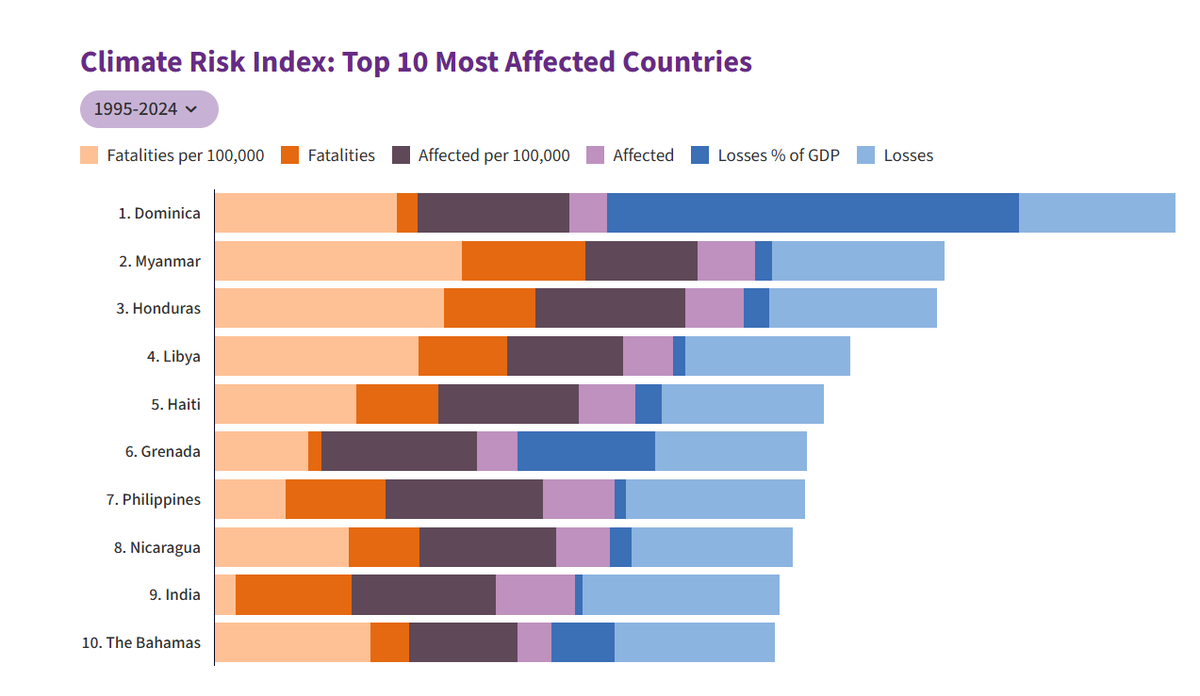
For India specifically: the CRI places India as 9th among countries most affected (1995-2024) and 15th for the year 2024 alone.
So, in short: the CRI gives us a quantitative, comparative look at how climate-extremes are affecting different nations — and by extension, how vulnerable those nations are.
Why this matters: Key take-aways
-
Extreme events are increasing
The CRI shows that hazards like heat-waves, storms, floods are not only more frequent but also more intense, owing in part to human-induced climate change.
-
Global South/Lower-income countries are disproportionately affected
In both the long-term and short-term indices, many of the most impacted countries are low or lower-middle income. This reflects how weaker resilience, infrastructure deficits, and greater exposure combine to raise vulnerability.
-
India’s vulnerability
For India: about 80,000 fatalities (≈9.6% of global fatalities) over 1995-2024, with roughly USD 170 billion losses (inflation-adjusted) reported in the CRI for India in that time frame.
Further, the pattern of disasters is diverse: heat-waves reaching ~50 °C, cyclones (e.g., 1998 Gujarat, 1999 Odisha, 2014 Hudhud, 2020 Amphan), floods (2013 Uttarakhand, 2019 Kerala/Assam) are all mentioned.
-
Policy signal & adaptation urgency
The CRI results serve not only as numbers but as a caution: high ranking means a country should urgently strengthen resilience, disaster preparedness, adaptation efforts and invest in infrastructure and communities vulnerable to climate extremes.
Sociological relevance: Why this matters beyond environment/economics
From a sociological perspective, the CRI links directly to issues of social structure, vulnerability, inequality, human agency, resilience, and change. Let’s unpack some key sociological dimensions.
1. Social vulnerability & structural inequality
Vulnerability to extreme weather is not evenly distributed in society. Socio-economic class, caste, gender, geographic location (coastal vs inland, rural vs urban slum vs formal housing), access to infrastructure, livelihood dependence on climate‐sensitive sectors (agriculture, fisheries) — all contribute.
For example, recurring floods or cyclones in coastal districts may disproportionately affect small-holder farmers, fish-dependent communities, landless labourers, informal settlers. The CRI’s high ranking for India hints that large sections of society face recurring climate shocks, reducing their capacity to recover.
2. Repeated shocks & cumulative disadvantage
The notion of “cumulative disadvantage” from sociology is relevant: when disasters keep hitting without enough time for recovery, communities fall into cycles of vulnerability. The CRI note for India: “continuous climate threats … recurring disasters leave little time for recovery before the next event strikes.”
Such repeated shocks amplify social inequality, as those with fewer assets or social safety nets slide further behind.
3. Resilience, agency & social capital
Resilience is more than physical infrastructure; it includes social systems, networks, community cohesion, knowledge, adaptability. Sociology emphasises social capital (networks/trust), cultural practices of coping, community organisation — all of which influence how societies absorb, adapt and bounce back from disasters.
The CRI signals the need for such resilience-building; sociologists would emphasise strengthening local institutions, community agency, inclusive participation in adaptation planning, rather than only top-down infrastructure.
4. Risk, justice & ethics
The climate risk exposure is entangled with issues of justice: those who are least responsible for greenhouse-gas emissions often bear the greatest burden of climate impact (the classic Global North–Global South / rich–poor inequity). The CRI highlights how lower-income countries dominate the most-affected list.
From a sociological lens, this raises questions of distributive justice (who pays the cost of climate change?), procedural justice (who gets a say in adaptation planning?), recognition justice (whose voices are heard?) and inter-generational justice.
5. Effects on livelihoods, migration, health & social dynamics
Climate extremes undermine livelihoods: agriculture gets hit by floods/droughts, fisheries by storms, urban informal workers by heat-stress. These disruptions have sociological consequences: migration (temporary or permanent), gendered impacts (women may have less access to recovery resources), health impacts (including mental health).
For example, a recent study finds extreme heat increases risk of depression in India, especially when humidity is high.
Also, migration induced by repeated climate shocks can alter social structures, household composition, traditional occupations, and put strain on urban infrastructure and social services.
6. Culture, risk perception & framing
How societies perceive climate risk, prepare and respond is shaped by culture, narratives, memory of disasters, trust in institutions. Sociologically, the CRI becoming prominent (especially during COP30/frame) means climate risk is increasingly part of public discourse, policy agendas and identity formation (for example communities seeing themselves as “vulnerable zones”).
Understanding how people interpret risk, adapt behaviourally, or resist change is as important as measuring the events.

What are the practical implications for India & UPSC-type policy thinking
Since you are likely preparing for exams (or a coaching scenario) — here are some practical implications to link the CRI with policy and society:
-
India’s high CRI rank means that disaster risk‐reduction (DRR), adaptation strategies, climate-resilient infrastructure, early-warning systems and community‐based resilience should be key policy priorities.
-
The fact that India’s losses (USD 170 billion) and 80,000 deaths in ~30 years underline the cost of inaction: policymakers must factor climate risk into development planning (infrastructure, agriculture, urban planning).
-
The sociological dimension: policies must be inclusive — prioritise marginalised communities, build bottom-up resilience, strengthen social safety nets, integrate gender and social equity into climate adaptation.
-
For UPSC answer writing: if asked about climate vulnerability, disaster risk and society you can cite the CRI figures (80,000 fatalities; USD 170 billion losses; India’s rank 9th) and then discuss how social structures influence vulnerability and resilience.
-
On the international front: at COP30, the CRI’s findings strengthen India’s argument for adapted finance (“loss & damage” funds), technology transfer, and global cooperation, since the index highlights that those most affected are often low/middle-income nations.
-
For the sociological optional (or integrated in GS) you can link climate risk with themes of social inequality, urbanisation, informal economy, migration, public health and governance.
Challenges & Critiques (important for balanced analysis)
-
Data‐quality and coverage: The CRI itself acknowledges underreporting especially in Global South countries, so the rankings may understate true vulnerability.
-
It is retrospective and covers only certain hazards (extreme weather events), not slower-onset impacts like sea-level rise, ecosystem degradation, or compound risks.
-
Ranking alone may invite simplistic comparisons (“why is country A worse than B?”) rather than nuanced understanding of context, governance, socio-economic factors. Sociologically, one must look beyond numbers.
-
There is the risk of framing vulnerable communities purely as “victims” rather than agents of resilience. A sociological lens insists on understanding agency, adaptation and local knowledge.
Conclusion
The Climate Risk Index is more than a list of numbers. For societies, it is a mirror reflecting how climate change is not just an environmental or technical problem — it is deeply social.
When a country like India ranks high in the CRI, the message is loud: development cannot ignore climate risk, and social justice, resilience, community agency must be central to adaptation and planning.
For anyone studying society, policy, environment or preparing for civil services, the CRI invites you to link extreme weather events with social vulnerability, inequality, governance, and human agency. It is a call to view climate change through a sociological lens, not just a scientific or economic one.
|

One comment