
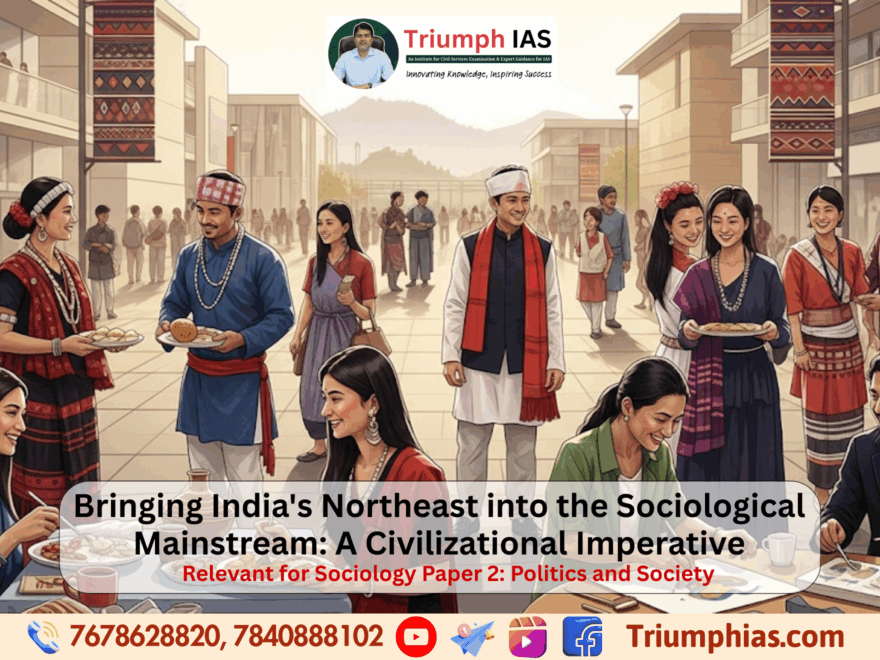
Bringing India Northeast into the Sociological Mainstream: A Civilizational Imperative
(Relevant for Sociology Paper 2: Politics and Society)
Introduction: India Northeast into the Sociological MainstreamThe North-East Region (NER) of India, home to over 45 million people, is not merely a geographical space—it is a sociological frontier that encapsulates the complexities of ethnicity, identity, marginalization, regionalism, and state-society relations. While political narratives often reduce it to a “strategic buffer zone” or a “gateway to ASEAN”, from a sociological lens, it is a marginalized civilization struggling for recognition, integration, and development in the Indian socio-cultural core. Despite being 8% of India’s landmass, its contribution to GDP is barely 2.3%, a reflection of not just economic underdevelopment but cultural and structural alienation—a theme echoed in D.P. Mukerji’s idea of tradition-modernity conflict and Andre Beteille’s discourse on inequality and integration. Theoretical Framework: Core-Periphery and Social DistanceSociologically, the NER fits well into Immanuel Wallerstein’s core-periphery model, where the region functions as a periphery within the Indian core. The region supplies raw resources (timber, oil, minerals) and receives finished goods, with little value addition or internal industrialization—leading to dependency and structural stagnation. The social distance between the Northeast and mainland India is not only geographical but deeply cultural, linguistic, and symbolic, reinforcing ‘othering’ and exclusion. G.S. Ghurye’s framework on “The Problem of the North-East Frontier” (from his book on India’s tribes) remains as relevant today as it was in the early 20th century. Ethnicity and the Crisis of IntegrationNER is a living laboratory of ethnic pluralism, comprising over 200 tribes and sub-tribes. While this makes it a vibrant ethnographic zone, it also leads to persistent ethnic contestations, as seen in:
These reflect Primordialist as well as Instrumentalist interpretations of ethnicity. The failure of the assimilationist model of nation-building here is evident. A more robust integrationist approach—informed by structural pluralism (Bhikhu Parekh) and consociationalism (Arend Lijphart)—is needed to replace majoritarian homogenization. Regionalism and the Dialectic of Development
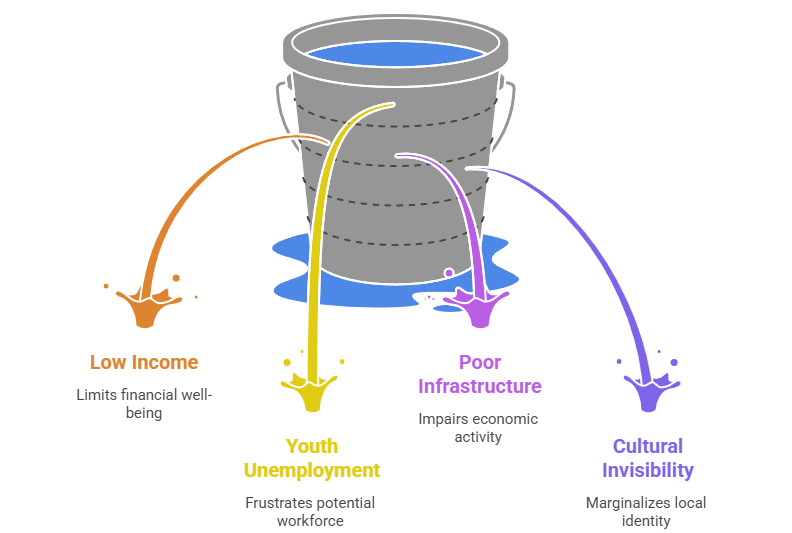
NER’s regional identity often morphs into regionalism, which sociologically arises from relative deprivation (Ted Gurr) and perceived neglect by the Union. This alienation is rooted in:
Here, M.N. Srinivas’s concept of ‘vote bank politics’ and D.P. Mukerji’s emphasis on cultural rootedness in planning become tools to understand how development initiatives—like PM-DevINE or NESIDS—must go beyond fiscal provisioning and address cultural alienation. Insurgency: A Manifestation of Social StrainDrawing from Robert K. Merton’s strain theory, the persistent insurgency in the region reflects a disjunction between cultural goals and institutional means. When legitimate avenues for political expression and economic mobility are blocked, rebellion and retreatism become dominant modes of adaptation. Over 70,000 people were displaced in the 2023 Manipur conflict—sociologically indicating a breakdown of social solidarity (Durkheim) and the failure of conflict resolution mechanisms. Cultural Diversity and the Sociology of RecognitionIn Charles Taylor’s “Politics of Recognition”, cultural communities demand visibility, respect, and voice. NER, with its festivals (Hornbill, Sangai), languages, and customary laws, deserves symbolic mainstreaming in India’s national imagination. However, most textbooks, media, and syllabi erase or exoticize the Northeast. The sociological consequence is a form of cultural marginality, which Pierre Bourdieu might term symbolic violence—where the dominant culture imposes invisibility upon the subordinate. Borderland Sociology: Mobility, Crime, and Cross-Border IdentityThe NER borders five countries, making it a transnational social field. Here, borders are not merely lines on a map but zones of cultural interpenetration and illicit flows. The rise in drug trafficking (from the Golden Triangle), illegal migration, and arms smuggling must be understood through the lens of:
Environment and Traditional Knowledge Systems
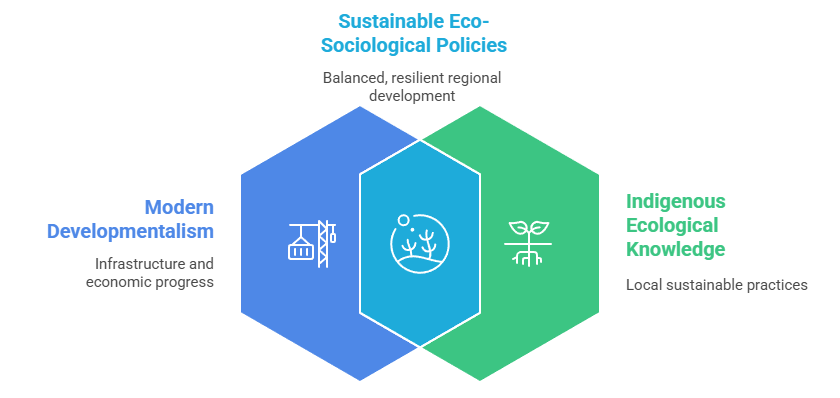
NER’s eco-cultural system reflects an ancient symbiosis between man and nature. However, modern developmentalism often imposes Cartesian binaries of man vs. nature—leading to degradation via:
Here, deep ecology (Arne Naess) and indigenous knowledge systems (as seen in Ziro Valley farming techniques or Meghalaya’s living root bridges) must inform our eco-sociological policies. The region can be India’s climate-resilient model if sustainability is mainstreamed. Role of the State: Between Coercion and CareThe Indian state’s approach oscillates between militarized securitization (AFSPA, counter-insurgency) and developmentalism. However, both often operate in top-down, bureaucratic paradigms, which alienate local communities. Habermas’s theory of communicative action offers a way out: foster dialogic state-society relationships where governance is participatory, not paternalistic. Empower Autonomous Councils, revive customary laws, and incorporate local epistemologies into policy frameworks. Recommendations with Sociological Anchors
Sociological Perspectives
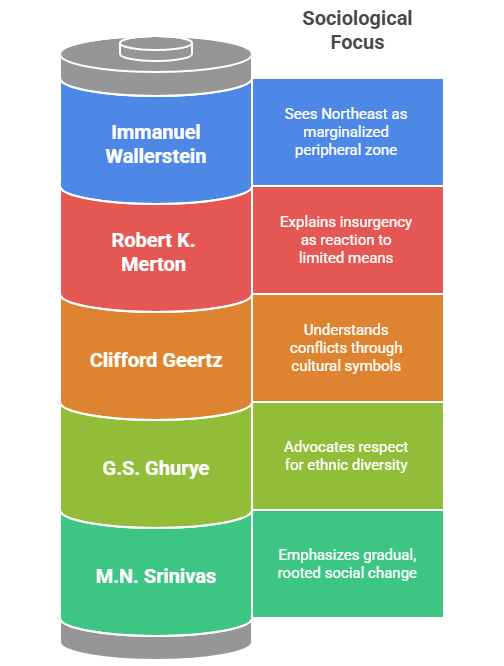
Indian sociologists have long emphasized the importance of cultural pluralism and localized autonomy in understanding diverse regions like Northeast India. Scholars such as M.N. Srinivas highlighted concepts like ‘Sanskritization’ and ‘cultural lag’, which explain how traditional societies negotiate modernization without losing their identity. Srinivas’s insight that social change must be gradual and rooted in local realities is crucial for the Northeast, where ethnic identities and indigenous practices are deeply entrenched. Similarly, G.S. Ghurye cautioned against the homogenizing tendencies of mainstream nationalism, advocating for policies that respect ethnic diversity while promoting integration. Indian sociological thought stresses participatory development and decentralized governance as necessary to bridge the gap between the region’s traditional social structures and the modern Indian state. On the other hand, Western sociologists provide a macro-structural and conflict-oriented lens. Using Immanuel Wallerstein’s world-systems theory, the Northeast can be seen as a peripheral zone within India’s national economy—rich in resources but marginalized in benefits and development. This structural marginalization fuels economic deprivation and social unrest. The strain theory of Robert K. Merton offers an explanation for insurgency, viewing it as a reaction to the disjunction between societal goals (mainstream prosperity) and the limited means available to the Northeast’s youth. Additionally, Clifford Geertz’s symbolic anthropology aids in understanding the region’s ethnic conflicts as rooted in complex cultural symbols and identities, where political claims are deeply intertwined with ethnic pride and historical narratives. Both Indian and Western perspectives converge on the importance of inclusive, culturally sensitive policies and the recognition of the Northeast as a distinctive socio-political entity within India’s broader fabric. Conclusion: Towards an Inclusive NationhoodThe Northeast is not India’s “forgotten periphery”—it is India’s living conscience, testing the promise of pluralism, equity, and dignity. From the standpoint of nation-building, integrating the NER is not merely a matter of infrastructure or policy—it is a sociological imperative to reconstruct India’s collective identity. As the region stands at the crossroads of historical marginalization and future promise, it must no longer be seen as a “problem to be solved”, but a civilizational asset to be celebrated. |
To Read more topics, visit: www.triumphias.com/blogs
Read more Blogs:
Gyan Bharatam: Digitising the Soul of India’s Civilisational Wisdom
Reimagining Equality: The Sociology of Reservation beyond the 50% Cap
3 comments