Delhi Court on Adultery and Maintenance
On 20th August 2025, the Delhi Family Court, presided by Judge Namrita Aggarwal, dismissed a woman’s plea for financial support from her former husband, citing Section 125(4) of the Criminal Procedure Code (CrPC). The court observed that since she was living in adultery and the fact was proven by a DNA test report, she was disentitled to claim maintenance. The judgment reiterated that while Section 125 aims to prevent destitution, it does not extend benefits to a spouse who violates the obligations of marriage.
This ruling adds to a line of precedents where Indian courts have wrestled with the tension between law, morality, gender justice, and family values, making it a significant case for sociological exploration.
Legal Framework: Section 125 CrPC
- Objective: Section 125 CrPC provides a quick remedy for neglected wives, children, and parents to prevent vagrancy and destitution. It is a welfare provision, not dependent on personal laws.
- Exception: Subsection (4) explicitly disqualifies a wife from claiming maintenance if:
- She is living in adultery, or
- She refuses to live with her husband without sufficient reason, or
- They are living separately by mutual consent.
- Implication: The law reflects a moral boundary—while protecting dependent women, it enforces sexual fidelity as a precondition for support.
Landmark Judgments
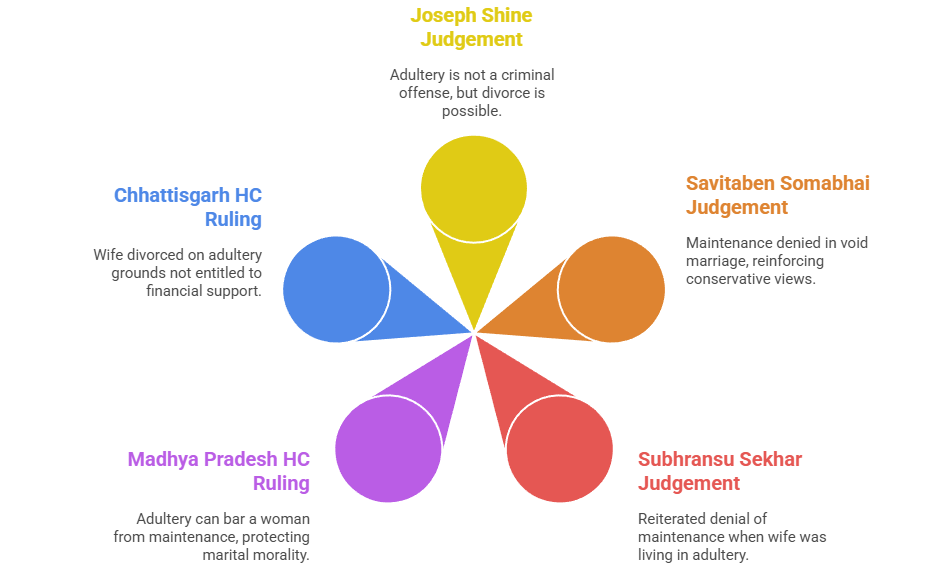
- Joseph Shine v. Union of India (2018, SC)
-
- Struck down adultery as a criminal offence (Sec. 497 IPC).
- However, SC clarified that adultery could still be a ground for divorce or civil consequences like denial of maintenance.
- Savitaben Somabhai Bhatiya v. State of Gujarat (2005, SC)
-
- Denied maintenance to a woman in a void marriage.
- Reinforces the conservative view of “legitimate marriage” as a precondition for rights.
- Subhransu Sekhar Samantray v. State of Orissa (2019, Orissa HC)
-
- Reiterated denial of maintenance under Sec. 125(4) when wife was living in adultery.
- Madhya Pradesh HC (March 2024)
-
- Held that adultery can bar a woman from maintenance, emphasizing protection of marital morality.
- Chhattisgarh HC (May 2025)
-
- Held that a wife divorced on adultery grounds is not entitled to financial support.
Together, these cases reveal that while criminalization of adultery is gone, civil law continues to embed moral expectations within the family structure.
Sociological Dimensions
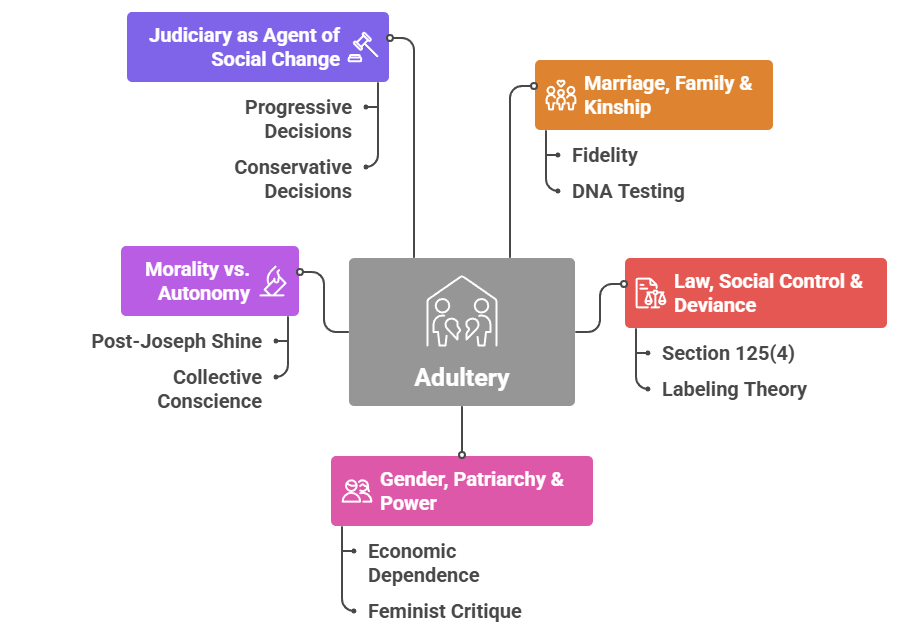
1. Marriage, Family & Kinship
- Adultery disrupts the institutional framework of family built on fidelity, legitimacy of children, and inheritance.
- DNA testing challenges traditional notions of fatherhood and lineage, shifting from social recognition to scientific proof.
- Parsons’ functionalist view: family stability depends on fidelity; adultery undermines this stability.
2. Law, Social Control & Deviance
- Section 125(4) acts as a mechanism of social control, penalizing sexual deviance.
- Becker’s labeling theory → women branded “adulterous” face legal and social marginalization.
- Foucault’s bio-power → use of medical tools (DNA) to regulate private life.
3. Gender, Patriarchy & Power
- Assumes economic dependence of women, reinforcing patriarchy.
- Feminist critique → morality clauses disproportionately punish women.
- Intersectionality → poor and marginalized women suffer more due to lack of alternatives.
4. Morality vs. Autonomy
- Post-Joseph Shine, adultery is not a crime, yet still treated as moral failing.
- Durkheim’s collective conscience: fidelity upheld as moral glue of society.
- Rights-based critique: welfare entitlements should not depend on private morality.
5. Judiciary as Agent of Social Change
- Judiciary oscillates: progressive (Joseph Shine) vs. conservative (maintenance denial).
- Reflects legal pluralism—balancing modern rights with traditional morality.
Constitution and Law
The case also opens up an important dimension: the intersection of Constitution, law, and social change.
- Article 14 (Right to Equality): Denial of maintenance raises debates about whether morality-based disqualification violates equality.
- Article 15 (Non-discrimination): Although gender-neutral on paper, adultery laws often disproportionately impact women.
- Article 21 (Right to Life with Dignity): Maintenance is part of social security; denial may compromise women’s dignity, especially where economic dependence is stark.
- Directive Principles (Art. 39 & 42): Envision protection of women and children; courts often cite these to justify maintenance as social welfare.
Other Relevant Laws:
- Hindu Marriage Act, 1955 → adultery as a ground for divorce.
- Code of Criminal Procedure, Sec. 125 → maintenance framework.
- Protection of Women from Domestic Violence Act, 2005 → expands women’s right to residence and support beyond marital fidelity.
- Muslim Women (Protection of Rights on Divorce) Act, 1986 → reflects religious dimensions in maintenance debates.
Impact:
- Reinforces moral policing of female sexuality.
- Highlights contradiction between constitutional ideals of equality/dignity and restrictive laws like Sec. 125(4).
- Courts remain a key arena for contestation—sometimes progressive, sometimes conservative—reflecting India’s transitional society.
Indian Context: Divorce, Maintenance & Women’s Rights
- Rising divorce rates → more litigation on maintenance.
- Maintenance laws stuck between welfare vs. morality.
- UCC debates highlight clash between secular rights and cultural norms.
- Feminist groups demand unconditional maintenance as a matter of economic rights.
Thinkers’ Perspectives
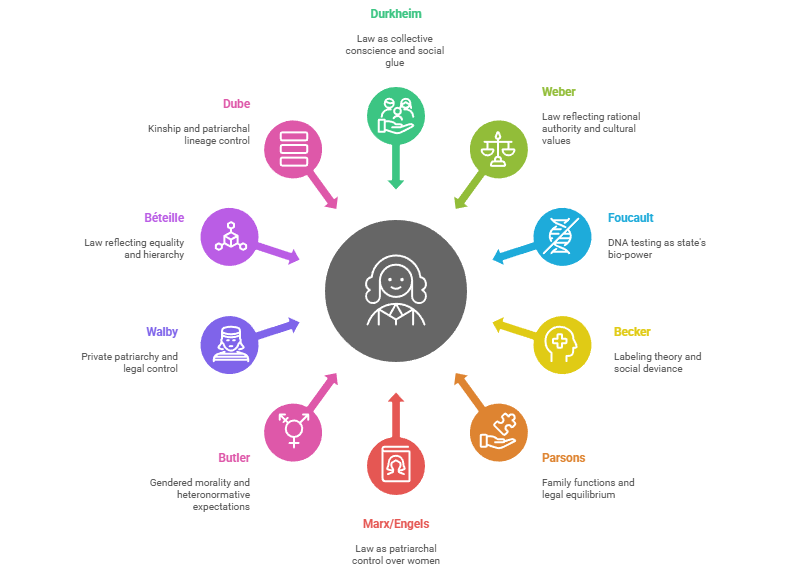
- Émile Durkheim – Law embodies collective conscience; fidelity upheld as social glue of family.
- Max Weber – Law reflects rational-legal authority but also cultural values; morality woven into formal law.
- Michel Foucault – DNA testing = state’s bio-power controlling sexuality, intimacy, reproduction.
- Howard Becker – Labeling theory; “adulterous” wife becomes socially deviant beyond courtroom.
- Talcott Parsons – Family functions (stability, socialization) disrupted by adultery; law restores equilibrium.
- Karl Marx / Engels – Adultery laws reflect patriarchal control over women’s bodies to safeguard male property and lineage.
- Judith Butler – Gendered sexual morality shows heteronormative expectations imposed on women.
- Sylvia Walby (Feminist Theorist) – Illustrates private patriarchy: women’s sexuality and dependency controlled via legal institutions.
- André Béteille (Indian Sociologist) – Law reflects interplay of equality ideals and hierarchical social norms in India.
- Leela Dube (Indian Feminist Anthropologist) – Kinship and women’s sexuality regulated through marriage; adultery disrupts patriarchal lineage control.
Critiques of the Judgment
- Pro: Protects marital sanctity, prevents misuse of maintenance, shields husbands from unfair burden.
- Con: Reinforces patriarchy, ignores women’s economic vulnerability, undermines welfare principle, disproportionately punishes women.
Conclusion
The Delhi Family Court ruling of August 2025 is more than just a legal decision—it is a mirror of Indian society’s struggle between tradition and modernity, morality and autonomy, patriarchy and gender justice. While the law aims to preserve marital fidelity, it also risks reinforcing women’s vulnerability in a society where they remain economically dependent.
|


One comment