Introduction
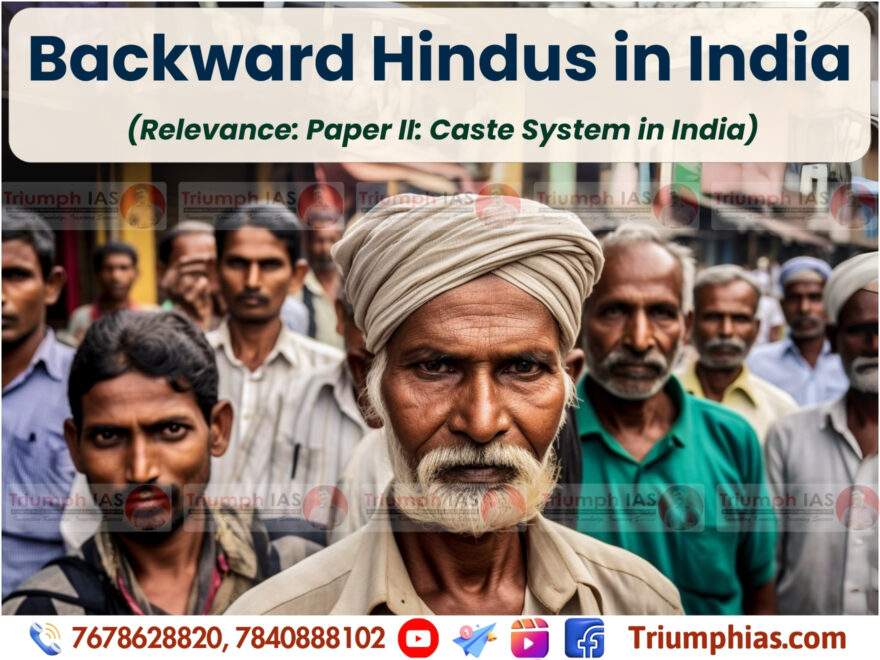
Caste has long been the backbone of Indian society, structuring both social mobility and social exclusion. Among Hindus, the term “Backward Hindus” usually refers to communities classified as Other Backward Classes (OBCs) and Most Backward Classes (MBCs). These groups have historically faced disadvantages in education, economy, and social status, lying between the upper castes and Scheduled Castes/Tribes in the social hierarchy.
Historical Context of Backward Hindus
- Colonial Census and Classification: The colonial census created rigid caste categories, branding many Hindu castes as “” Reports like the Hunter Commission (1882) and Sargent Commission (1944) recognized their limited educational and economic opportunities, formalizing their marginal status.
- Justice Party and Non-Brahmin Movement: In South India, backward Hindu castes challenged Brahmin dominance through the Justice Party and later the Dravidian movement. Groups like Nadars and Vellalars mobilized to demand equality, laying the foundation for backward caste politics.
- Post-Independence Constitutional Recognition: The Constitution recognized “socially and educationally backward classes” under Articles 15 and 16. The first Backward Classes Commission led by Kaka Kalelkar (1953) placed their concerns at the national level, though its impact was limited.
- The Mandal Commission Era: The Mandal Commission (1979–80) identified OBCs, mostly backward Hindus, as disadvantaged. Its recommendation of 27% reservations in jobs and higher education, implemented in 1990, redefined Indian democracy and made backward Hindus a central force in social justice discourse.
Sociological Characteristics of Backward Hindus
- Social Stratification: Backward Hindus occupy the middle rungs of the caste hierarchy. They often strive for upward mobility through Sanskritization but also assert backward status for reservations, revealing the paradox of caste and mobility.
- Economic Conditions: Traditionally tied to agriculture, artisanal work, and petty trade, backward Hindus remain overrepresented in informal and insecure work. While liberalization has benefited some with entrepreneurial opportunities, many still face agrarian distress and unemployment.
- Educational Backwardness: Backward Hindu groups historically had poor access to education. Reservations in higher education have opened new opportunities, but literacy rates and access to quality schooling remain uneven, especially in rural areas.
- Political Assertion: Backward Hindus have become a powerful political category. Leaders like Lalu Prasad Yadav, Mulayam Singh Yadav, and Nitish Kumar mobilized OBCs into dominant electoral blocs, reshaping politics in states like Uttar Pradesh and Bihar.
Sociological Analysis
- N. Srinivas – Backward Hindus often adopt upper-caste practices for social mobility, but this rarely transforms structural inequalities.
- Andre Béteille – Backward Hindus represent groups negotiating between traditional caste hierarchies and emerging class inequalities, showing the overlap of status and class power.
- R. Desai – Many OBCs are small and middle peasants, making their assertion both a caste and class struggle against landlords and capitalist structures.
- Gail Omvedt – OBC movements have often aligned with anti-Brahmin struggles. However, Omvedt cautions that they sometimes marginalize Dalit voices, creating divisions within anti-caste movements.
- Pierre Bourdieu – Backward Hindus lacked access to education, networks, and linguistic skills—forms of cultural capital. Reservation and social policies aim to bridge these long-standing deficits.
Contemporary Issues Related to Backward Hindus
- Caste Census Debate: The demand for caste census has intensified as it would provide updated data on the real size and conditions of backward Hindus, shaping policy on representation and resources.
- Reservation Politics: OBC reservations are contested, with sub-categorization into backward, more backward, and most backward groups. The “creamy layer” exclusion remains controversial, as dominant backward castes often capture benefits.
- Economic Liberalization: Globalization has created winners and losers among backward Hindus. While new OBC entrepreneurs have emerged, many remain in low-paying informal jobs, facing urban marginalization and rural poverty.
- Education and Social Mobility: Reservation in higher education has improved mobility, but rural backward Hindus still suffer from poor schooling and the digital divide. This creates gaps in competing for modern, skill-intensive jobs.
- Gender Dimension: Backward Hindu women face double discrimination—patriarchy within caste and systemic inequality outside it. Yet, participation in self-help groups like SEWA and Kudumbashree has begun to empower them socially and economically.
Current Relevance
- Bihar Caste Survey 2023 showed OBCs and EBCs form a majority, reviving debates on proportional representation.
- Supreme Court rulings on OBC reservations in medical admissions reaffirmed constitutional support for affirmative action.
- Women’s Reservation Bill 2023 raised demands for quotas within quotas for backward Hindu women.
- National politics increasingly revolves around OBC vote banks, showing the centrality of backward Hindus in India’s democratic process.
Challenges Ahead
- Intra-OBC Inequalities: Dominant castes like Yadavs and Kurmis often corner benefits, sidelining smaller groups.
- Intersectionality: Backward Hindu women continue to face layered inequalities.
- Urban Marginalization: Migrants often end up in insecure informal jobs with no social security.
- Cultural Prejudices: Despite political power, backward Hindus face stigma in education, jobs, and social interaction.
Way Forward
- Implement sub-categorization of OBCs to distribute benefits more equitably.
- Improve rural education and skill development to strengthen upward mobility.
- Expand entrepreneurship and self-employment programs targeting backward Hindu communities.
- Ensure gender-sensitive policies to uplift backward Hindu women.
- Conduct a nationwide caste census for data-driven policymaking.
Conclusion
The story of backward Hindus is one of paradoxes. They are politically empowered yet socially stigmatized, beneficiaries of reservations yet divided by internal inequalities. They embody the tension between orthogenetic change (internal caste reforms and mobilization) and heterogenetic change (external policies, globalization, and state intervention).
Analyzing backward Hindus requires connecting caste, class, gender, and politics. Their journey reflects India’s ongoing struggle to balance social justice, democracy, and development—a struggle central to understanding both sociology and contemporary Indian society.
Paper II
- Write a short note with a sociological perspective: Other Backward Classes. (2014)
- Explain different forms of untouchability in India. (2022)
|